

27 Coffee Station Decor Ideas That Make Every Morning Feel Like a Cafe
27 Coffee Station Decor Ideas That Make Every Morning Feel Like a Cafe
Intro: The Mugs That Lived in Three Different Cupboards
The first year in our house, I made coffee the same way every morning, and it still took forever. The mugs lived in one cupboard. The coffee lived in another. The sugar was on top of the fridge, because that was the only spot left. The milk lived in the fridge, obviously, but the little spoon I liked was in the dishwasher, always. Every morning I did a small lap of the kitchen before I had even woken up properly, opening doors, moving things, hunting for the one mug that did not chip my lip. Coffee was supposed to be my quiet five minutes. Instead it was a scavenger hunt.
Then I visited my friend Sara, who has a kitchen half the size of mine and a coffee corner that made me a little jealous, in the good way. Her coffee maker sat on a wooden tray. Her mugs hung on two little hooks under a shelf. A glass jar of coffee beans, a small sugar bowl, and a tiny plant sat beside it. Everything was in one spot, about two feet wide. She made coffee without taking a single step. She just reached, poured, and sat down. I went home and copied her, with a tray I already owned and mugs I already had, and my mornings changed that same week. That is the whole secret of these coffee station decor ideas: they are not about buying a cafe. They are about giving coffee one home, so your morning starts calm instead of scattered.
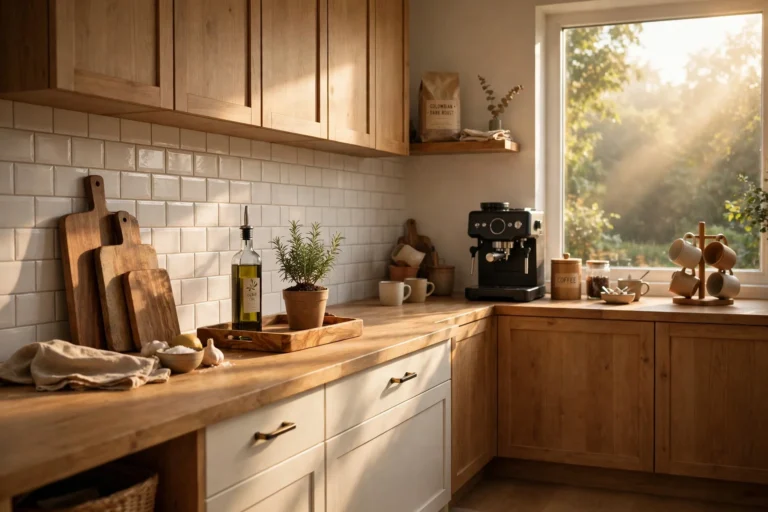
A coffee station is simply one corner where everything coffee lives. The maker, the mugs, the coffee, the sugar, the spoons, and one or two pretty things. It can be a corner of the counter, a rolling cart, a shelf over the counter, or a tray on a side table. It does not need to be big. It needs to pass the rule I use for every spot in this article, which I call the Counter, Cupboard, Corner Rule. Counter means everything you touch daily sits on the counter, in the open, ready. Cupboard means everything you touch weekly lives in one cupboard directly above or beside the station, never three cupboards away. Corner means the whole station fits in one corner or one stretch of counter, so the rest of the kitchen stays clear for actual cooking. If a coffee station decor idea breaks that rule, IMO it looks pretty in a photo and fails on a Tuesday morning. Every idea below keeps the rule, and keeps coffee within one arm’s reach.
Zone 1: The Station Itself, Where Coffee Gets One Home (Ideas 1 to 5)
1. Start With a Tray, Not a Shopping Trip
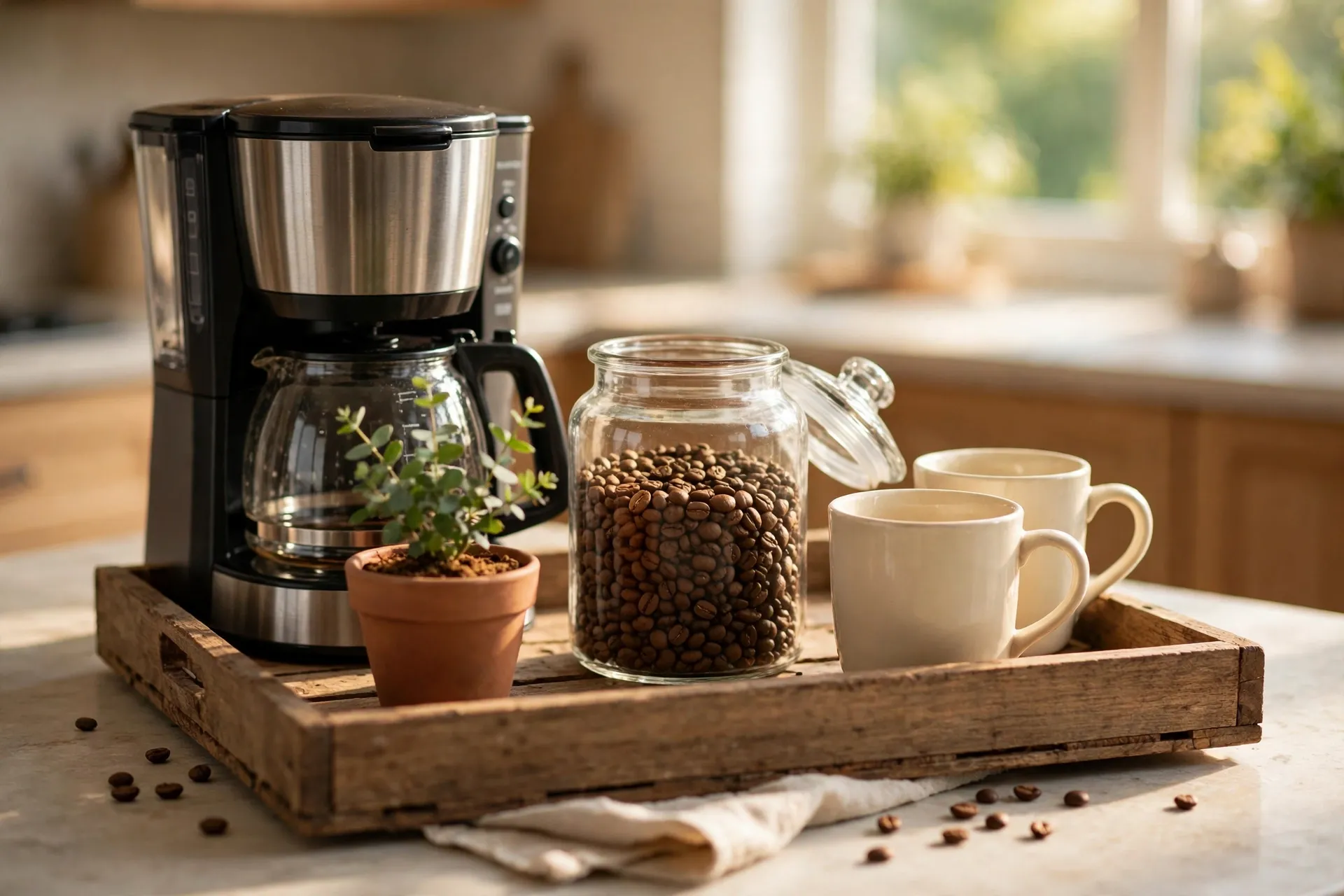
Put a tray under the coffee maker before you buy anything else. A wooden tray, a marble tray, a thrifted baking sheet, any tray with a small lip. The tray does three jobs at once. It catches drips and coffee grounds, so the counter stays clean. It marks the station’s borders, so the coffee things stop spreading across the whole counter. And it makes the whole corner look finished, even if the tray holds nothing but a coffee maker and two mugs. Measure your coffee maker first, then add about six inches on each side for a mug and a jar. If the tray is too small, the station spills off it by day two. If it is too big, it eats the counter. One tray, the right size, is the whole foundation.
2. Give the Coffee Maker a Backdrop, Not a Blank Wall
A coffee maker against a blank wall looks like an appliance waiting to be put away. Give it a backdrop and it looks like a station. Hang one small framed print, lean a little wooden sign that says COFFEE or BUT FIRST, COFFEE, or stick a strip of peel and stick tile behind the station. Keep the backdrop narrow, about as wide as the tray, so it reads as one vignette and not a gallery wall. FYI, keep paper prints and wooden signs at least a few inches from the coffee maker’s steam vent. Steam is the enemy of paper, and a warped print is worse than a blank wall. A tile strip or a framed print under glass handles steam much better.
3. Use a Rolling Cart When the Counter Is Full
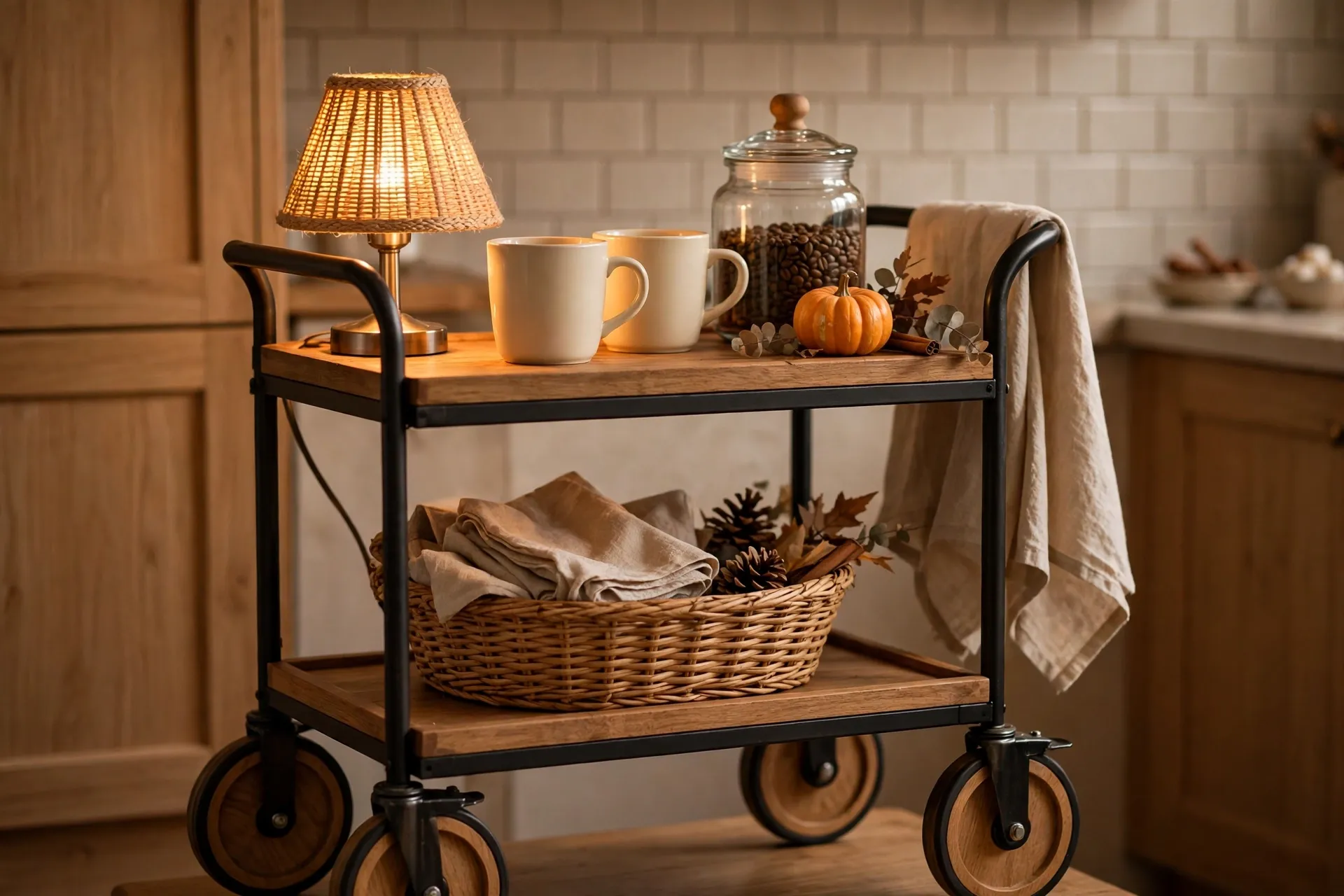
If your counters are already full of toasters and cutting boards, do not fight for counter space. Roll in a small bar cart or a two tier kitchen cart and make that the station. The top tier holds the coffee maker and mugs. The bottom tier holds the extra beans, the filters, and the box of tea for guests who do not drink coffee. The cart can roll against the wall during the day and roll out when you need it. Lock the wheels before you brew, or the cart will wander while the coffee maker gurgles, and nobody needs that excitement at 6 a.m. A cart also works beautifully in a dining room corner, which keeps the kitchen counter free for cooking.
4. Claim One Corner and Defend It
Pick the corner closest to the sink or the fridge, whichever you reach for first in the morning, and claim it for coffee only. Move the blender, the bread box, and the mail pile somewhere else. A coffee station that shares its corner with five other jobs is not a station, it is a junk drawer standing up. One corner, coffee only, every day. Put a small plant or a candle at the outer edge of the corner, as a friendly border. When the plant starts collecting mail and keys, you will know the corner is slipping. Move them back. The station stays a station because you defend its edges, not because you decorated it once.
5. Raise the Maker on a Riser or a Stand
A low coffee maker on a low counter means you bend down to see the water line and the brew button. Put the maker on a low wooden riser, a sturdy cake stand, or a small drawer unit made for coffee pods, and suddenly the station has levels. The maker sits higher, the mugs tuck underneath, and the whole corner looks styled instead of flat. Make sure the riser is steady and heat safe, and that the coffee maker’s cord still reaches the outlet without stretching. Test it with a full carafe of water before you trust it with hot coffee. A wobbly riser plus a full carafe is a mess you only make once.
Zone 2: Mugs, Cups, and the Morning Lineup (Ideas 6 to 10)
6. Hang the Daily Mugs, Store the Rest
Hang two to four mugs on hooks under a shelf or on a small mug tree, and store every other mug in a cupboard. The hung mugs are the daily lineup, the ones you actually reach for. The stored mugs are the guests, the seasonal ones, and the one with the chip you cannot throw away. This keeps the station from turning into a mug museum. Hang the mugs by their handles, facing the same direction, with a little space between them. If the mugs bump each other every time you grab one, you hung them too close. One inch of air between mugs is the difference between calm and clatter.
7. Mix Mug Styles on Purpose, Not by Accident
A station looks collected, not chaotic, when the mugs share one thing in common. All cream colored, all stoneware, all with a stripe, all in warm fall colors, any one thread will do. Mix shapes and sizes all you want, as long as that one thread holds them together. My daily four are all cream, but one is tall, one is wide, one has a speckled glaze, and one is my grandmother’s. They look like a set because the color ties them together. If every mug is a different color, a different size, and a different joke, the station looks noisy. Pick your thread, then let the rest vary. IMO cream and warm white mugs are the easiest thread, because they match every season and every tray.
8. Add a Mug for Guests, Labeled by Nothing
Keep one or two guest mugs on the station, slightly apart from your daily mugs, so a visitor never has to ask which mug they can use. Do not label them. A little space and a different color is label enough. Guests notice the gap and reach for the mug that sits a little apart, and they feel welcome instead of awkward. Keep the guest mugs the sturdy ones, not the thin vintage cups that crack if someone looks at them wrong. A guest holding a solid mug feels at home. A guest holding your most precious cup feels nervous, and nervous guests do not relax over coffee.
9. Put Spoons in a Jar, Not in a Drawer
A small jar or a little crock holding four to six teaspoons, right beside the coffee maker, ends the spoon hunt forever. Use a jar you can see through, so you can tell at a glance when the spoons are all in the dishwasher. Keep the jar short, so the spoons stick out enough to grab easily. A tall jar swallows short spoons, and fishing for a spoon with wet hands is a bad start to the day. Wash the jar weekly, because coffee drips find their way into everything on a coffee station. A clean spoon jar is a small thing, but it is the kind of small thing you notice every single morning.
10. Give the Morning a Landing Spot for the Hot Mug
Put one cork trivet, one small marble coaster, or one folded linen napkin beside the coffee maker as the landing spot for a hot mug. Not four coasters, not a stack of trivets, one landing spot. When you pour the first cup, it needs somewhere to land while you add milk or find your phone. Without a landing spot, the hot mug lands on the tray, on the counter, or on a pile of mail, and leaves a ring to prove it. A landing spot also protects a wooden tray from heat marks. Pick something you can wipe clean in one swipe, because it will get coffee on it, probably today.
Zone 3: Shelves, Walls, and Signs in Coffee Station Decor Ideas (Ideas 11 to 14)
11. Hang One Short Shelf, Not Three
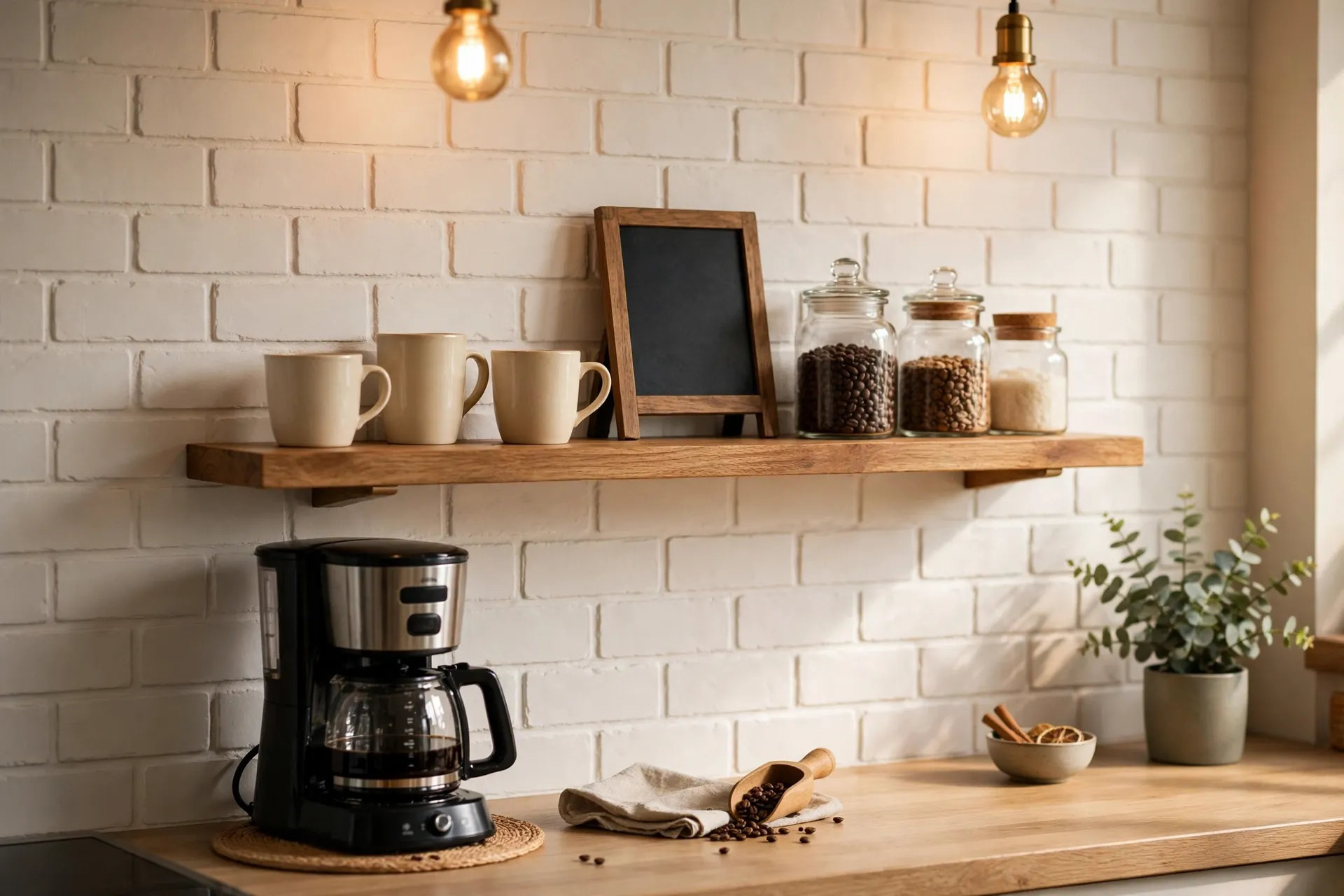
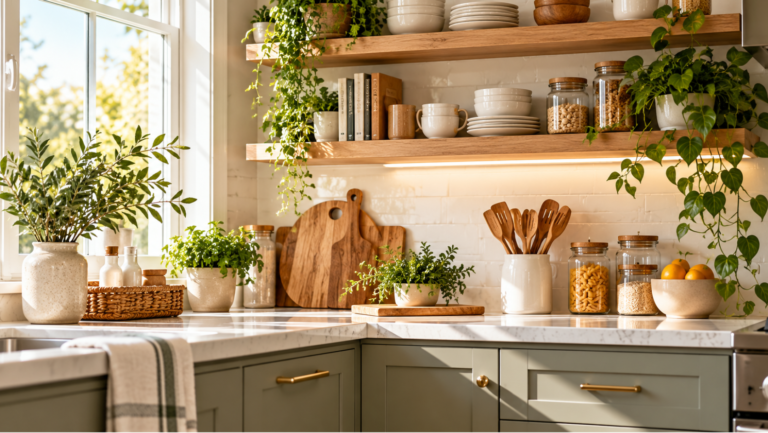
One short floating shelf above the station holds the mugs, a small plant, and a jar of beans, and it is done. Three shelves above a coffee station turn into a storage wall, and you will fill them with things that have nothing to do with coffee. Hang the shelf at a height where you can reach a mug without standing on tiptoe, usually about 15 to 18 inches above the counter. Anchor it into a stud or use proper wall anchors, because a shelf full of stoneware mugs is heavy. Style it with three groups: mugs on one side, a jar in the middle, a small plant on the other side. Leave a little empty space. A shelf packed edge to edge looks like a shop, not a station.
12. Lean a Sign, Do Not Nail a Mural
One small sign is plenty. Lean a wooden COFFEE sign against the wall, hang one framed print with a coffee quote, or prop a tiny chalkboard with today’s menu on it. One sign, chosen once, and left alone. A wall covered in coffee signs, coffee quotes, coffee clocks, and coffee art stops reading as decor and starts reading as a theme restaurant. Pick the sign that makes you smile, then stop. If you love chalkboards, write one line on it and change it on Sundays, not daily. A chalkboard that changes every day becomes a chore. A chalkboard that changes weekly becomes a ritual, and rituals are the point of a coffee station.
13. Add a Hook Rail for Everything That Dangles
A short hook rail under the shelf or on the wall beside the station holds the mugs, a small towel, and a little pair of scissors for opening coffee bags. Hooks keep the dangly things off the counter, where they tangle with everything else. Use sturdy hooks, screwed in, not adhesive hooks that give up on a humid morning. Space the hooks about four inches apart, so mugs do not clink. Hang the towel on the end hook, farthest from the coffee maker, so it stays dry. A hook rail is a two dollar upgrade that makes the whole station feel built in, even in a rental, because it uses two screws and leaves two tiny holes you can fill later.
14. Frame One Photo, Not a Gallery
Put one small framed photo near the station: a trip, a kitchen memory, a person you love. One photo makes the station feel personal. A gallery wall over the coffee maker makes it feel like a hallway. Keep the frame small, about four by six inches, and keep it away from direct steam. A photo in a glass frame, a few inches to the side of the maker, survives steam fine. A photo taped to the wall behind the maker will curl by next week. The station is where your day starts, so it deserves one thing that is yours and not just useful. Just one. The rest of the station earns its place by working.
Zone 4: Jars, Beans, and the Coffee Bar Pantry (Ideas 15 to 19)
15. Decant Coffee Into a Glass Jar You Can See Through
Move the coffee beans or grounds from the bag into a clear glass jar with a tight lid, and label it with a small piece of tape or a chalk label. A clear jar tells you when you are running low before you run out, which is the difference between a calm morning and a desperate one. Keep the jar away from the window and away from the coffee maker’s heat, because light and heat stale coffee faster. A dark corner of the station, or an amber glass jar, is kinder to the beans. Refill the jar from the bag stored in a cool cupboard, and keep only a week or two of coffee in the jar at a time. Fresh coffee in a pretty jar beats stale coffee in a prettier jar, every time.
16. Line Up Three Jars, and Stop at Three
Three jars is the magic number for a coffee station: coffee, sugar, and one more thing you actually use, like cocoa, cinnamon, or tea bags. Three jars in a row, similar heights, similar lids, look intentional and calm. Five jars look like a pantry exploded on your counter. Six jars mean you are storing things on the station that belong in the cupboard. Pick your three, match their lids, and line them up behind the coffee maker or beside the tray. If a jar is empty for more than a week, it is not a station jar, it is a decoration, and it can move to a shelf. The station earns its space by being used daily.
17. Keep Sugar and Sweetener in One Small Bowl
A small lidded bowl or a tiny ramekin for sugar, with a little spoon resting on top, is all the sweetener station you need. Keep the sweetener packets, the honey bear, and the flavored syrups in the one cupboard above the station, per the Cupboard part of the rule, and bring out only what you use daily. A bowl of sugar with a lid stays clean and dry, which matters in a steamy kitchen. A pile of loose packets on the tray looks messy by day two and collects coffee drips by day three. If nobody in the house uses sugar, skip the bowl entirely and use that spot for a creamer jug or a second jar. Every spot on the station should earn its place daily, or it is clutter wearing a costume.
18. Store Filters Where You Can See Them
Keep the coffee filters in a small basket, a clip on the wall, or a drawer right under the maker, where you can grab one without thinking. Filters stored in a high cupboard get forgotten, and then you are folding a paper towel into a filter shape at 6 a.m., which works badly and tastes worse. A small basket of filters beside the maker is honest and useful. If you use a reusable filter, hang it on a hook to dry after washing, and keep a spare paper pack for the mornings when the reusable one is still in the dishwasher. The best filter storage is the one you reach without opening a door, because mornings reward the path of least resistance.
19. Add a Tiny Treat Jar for the Morning Ritual
A small jar of biscotti, a few wrapped chocolates, or a handful of cinnamon sticks beside the coffee maker turns coffee into a ritual instead of a refuel. Keep the treat jar small, with a lid, and refill it weekly. A giant cookie jar on the station eats the counter and tempts everyone all day, which is not the point. A tiny jar says: sit down, take five minutes, enjoy this. My jar holds exactly four biscotti, and when it is empty, I know the week was a good one. Refill it on Sunday, along with the coffee jar, and the station resets itself for the week. Small rituals, kept weekly, are what make a corner feel like a cafe.
Zone 5: Texture, Light, and Seasonal Touches (Ideas 20 to 23)
20. Lay Down a Small Rug or Mat in Front of the Station
A small washable rug or a flat woven mat in front of the coffee corner makes the station feel like a destination, not just a spot on the counter. It also saves your feet on a cold tile floor at 6 a.m., which matters more than it sounds. Pick a low, flat mat, so it does not trip you while you carry a hot mug. Wash it monthly, because coffee drips and grounds find the floor no matter how careful you are. A mat in a warm color, like rust, cream, or soft sage, ties the station to the rest of the kitchen. Skip the fluffy bath mat look. A kitchen mat should be flat, washable, and easy to shake out, or it becomes one more thing to clean.
21. Add One Warm Light, Not a Chandelier
One small lamp, one plug in fairy light strand, or one battery candle on the station changes the whole morning. Kitchens have bright overhead lights that feel like an interrogation at dawn. A warm, low light at coffee height makes the corner glow and lets you wake up slowly. Put the light on a timer or a smart plug, so it is already on when you walk in. Keep cords behind the station, tucked along the wall, never across the counter where a mug can snag them. A battery candle inside a glass jar is the safest warm light if your station is tight on outlets. One warm light, low and close, is the difference between a kitchen and a cafe at 6 a.m.
22. Swap One Seasonal Touch, and Only One
Change one thing with the season, and leave the rest of the station alone. In fall, swap the plant for a tiny pumpkin and add a cinnamon stick to the sugar bowl. In winter, add a pine sprig to the tray and swap the print for a snowy one. In spring, put a small vase of fresh flowers where the pumpkin sat. One seasonal touch keeps the station feeling fresh without a full redecoration every three months. The station’s backbone, the tray, the jars, the mugs, stays the same all year, which is why it always works. The seasonal touch is the outfit, not the body. Swap it in five minutes, on the first of the season, and the station feels new again for free.
23. Bring in One Natural Texture
One natural texture, a wooden tray, a woven basket, a linen towel, a stone coaster, warms up a station full of plastic and stainless steel. Kitchens are hard surfaces: counters, appliances, tile. One soft, natural thing breaks up all that hardness and makes the corner feel touchable. Pick the texture you already have in the kitchen, so the station matches the room instead of fighting it. If your kitchen has a lot of wood, use a wooden tray. If it has a lot of white, use a woven basket. One texture is enough. Two textures start to compete. Three textures turn the station into a craft fair. Natural, simple, and used daily is the goal.
Zone 6: Small Kitchens, Rentals, and Real Mornings (Ideas 24 to 27)
24. Use the Inside of a Cupboard Door
In a tiny kitchen, hang a small rack or a few adhesive hooks on the inside of the cupboard door above the station, and store the filters, the measuring scoop, and the spare lids there. The door becomes storage without taking a single inch of counter. Use hooks rated for the weight, and check them monthly, because adhesive hooks give up quietly and drop things at 2 a.m. Keep the door storage light: filters, scoops, and small things only, never heavy jars. When you close the door, the station looks clean. When you open it, everything you need is right there. That is the Counter, Cupboard, Corner Rule working in a space the size of a closet.
25. Make a Tray Station on a Side Table
If the kitchen has truly no counter to spare, make the station on a small side table, a bar stool, or a sturdy bookshelf just outside the kitchen. A tray on a side table, holding a small coffee maker, two mugs, and a jar, is a real station, even if it lives in the dining room. Run the cord safely along the wall, never across a walkway, and keep a small bin underneath for extra supplies. Guests love a side table station, because they can help themselves without getting in the cook’s way. It also keeps coffee out of the cooking zone, which means no grounds in the dinner prep. A station does not need a kitchen counter. It needs one flat surface, one outlet, and one tray.
26. Keep It Renter Friendly With No Holes
Renters can build a full station with zero holes in the wall. Use a leaning shelf, a mug tree, a tray, and a cart, all freestanding. Use command hooks only for light things, like a towel, and test them before you hang a heavy mug. Keep the sign leaning, not nailed. Keep the shelf freestanding, not floating. When you move out, the station moves with you in one box, tray and all. That is the beauty of a station built from movable pieces: it is not a renovation, it is a habit with furniture. Landlords love it, deposits survive it, and your mornings still feel like a cafe. No holes, no regrets, all the coffee.
27. Run the 60 Second Morning Test Every Sunday
Once a week, stand at your station and make coffee as if you were half asleep. Time it. Can you reach the mugs, the coffee, the filters, and the spoons in 60 seconds, without opening more than one cupboard and without taking a step? If yes, the station passes, and you are done. If you open three cupboards, move a toaster, and hunt for a spoon, something drifted, and the station needs a five minute reset. Move the drifter back to its cupboard, refill the jars, wipe the tray, and the station is ready for Monday. I call this the 60 Second Morning Test, and it is the second framework in this article, after the Counter, Cupboard, Corner Rule. A station that passes the test every Sunday will serve you well all week. A station that fails the test is just decor, and decor does not make coffee.
Steam, Splash, and Heat: The Durability Check for Coffee Station Decor Ideas
Coffee makers make steam, and steam ruins paper, warps wood, and curls photos. Before you call the station done, run the steam check. Stand where the coffee maker sits and look at what is directly above and beside it. Move paper prints, chalkboards, and unframed photos at least six inches away from the steam vent, or put them under glass. Keep wooden trays wiped dry after brewing, and lift the coffee maker once a week to wipe underneath, where drips hide and turn sticky. Put a silicone mat or a folded towel under the maker if your tray is wood and the maker runs hot. Splashes are the other enemy. Keep the sugar bowl lidded, keep the treat jar closed, and wipe the tray every morning after the first cup. A station that survives steam and splashes is a station you will still love in six months. One that does not will look tired by Thanksgiving, when the kitchen gets busier and the Thanksgiving kitchen cooking starts in earnest.
Buy Once, Refresh Each Season: The Coffee Station Budget
Buy once: the tray, the jars, the mug hooks or shelf, and the coffee maker riser. These are the bones of the station, and good ones last for years. Spend a little more here, in wood, glass, or metal, and you will not replace them next season. Refresh each season: the seasonal touch, the towel, the small plant, and the treat jar refill. These cost a few dollars and keep the station feeling new. A good station budget looks like this: 40 to 60 dollars for the bones if you buy them new, under 20 dollars if you thrift the tray and jars, and 5 to 10 dollars per season for the refresh. Skip the matching coffee station set sold as one box. It looks coordinated in the store and generic at home, and you will replace half of it anyway. Buy the bones separately, in materials you like to touch, and the station will look like yours. When winter comes and the kitchen shifts to cozy cooking, the same tray and jars carry over into winter kitchen decor with just a pine sprig and a warmer towel, no new purchase needed.
Small Space Variations That Still Work
Tiny counter: use a narrow tray, two mugs on hooks, and one jar. That is the whole station, and it works. Galley kitchen: put the station at the end of the counter nearest the door, so you can grab coffee without walking through the cooking zone. Studio apartment: use a rolling cart that parks beside the fridge and rolls out in the morning. Shared kitchen: give each person one mug hook and one small jar, and keep the shared maker on the tray. The rule stays the same in every size: Counter, Cupboard, Corner, and the 60 Second Morning Test. If the station is small, it just has fewer jars and fewer mugs, not fewer rules. A small station that passes the morning test beats a big station that fails it, every single time.
Troubleshooting Fixes for a Coffee Station That Stopped Working
Problem 1: the station keeps spreading across the counter. Fix: shrink the tray or add a plant at the border. A clear border is a boundary, and boundaries work. Problem 2: the mugs are always in the dishwasher. Fix: hang only two daily mugs and wash one each evening. Two mugs in rotation beat six mugs in the dishwasher. Problem 3: the jars are always empty. Fix: refill both jars every Sunday, and keep the backup bag in the cupboard above the station, not in the pantry down the hall. Problem 4: steam warped the sign. Fix: move the sign six inches to the side and put it under glass, or swap it for a tile strip that loves steam. Problem 5: the station looks cluttered no matter what you do. Fix: remove three things. Clutter is almost always three extra things, not thirty. Problem 6: nobody uses the station except you. Fix: add the guest mug and the treat jar. People use a station when it invites them. A station with a guest mug and a biscotti says welcome in a way a bare coffee maker never will. If the station still feels cold, add the warm light from idea 21. Light fixes more stations than shopping does, and it costs almost nothing to run. For a holiday version of the same corner, the Christmas kitchen styling swaps in greenery and a red towel while the tray, jars, and hooks stay exactly where they are, and a hot cocoa bar on the same tray, with cocoa, marshmallows, and candy canes in the three jars, turns the coffee station into the winter gathering spot without moving a single hook.
FAQs
Where should I put a coffee station in a small kitchen?
Put it in the one corner closest to the sink or the fridge, on a tray, with everything within one arm’s reach. If no counter is free, use a rolling cart, a side table, or a shelf over the counter. The spot matters less than the rule: Counter, Cupboard, Corner, all in one place.
How do I keep a coffee station from looking cluttered?
Limit the station to a tray, the coffee maker, two to four mugs, and three jars, and store everything else in one cupboard above it. If a thing sits on the station for a week without being used, move it to the cupboard. Clutter is usually three unused things, not thirty.
What do I actually need for a coffee station, and what is optional?
You need a coffee maker, two mugs, coffee in a jar, a spoon jar, and a tray. That is the whole station. Shelves, signs, lights, plants, and treat jars are optional, and they earn their place by making mornings calmer or prettier. Start with the five essentials, then add one pretty thing at a time.
How do I protect the wall and counter from coffee maker steam and spills?
Keep paper and unframed art at least six inches from the steam vent, use glass frames or tile behind the maker, put a lidded bowl on the sugar, and wipe the tray and the counter under the maker every morning. Lift the maker weekly to wipe underneath, where drips hide.
How often should I refresh coffee station decor?
Refill the jars and the treat jar weekly, on Sunday. Swap one seasonal touch each season, in about five minutes. Replace the towel monthly, or whenever it looks tired. The bones of the station, the tray, jars, and hooks, stay the same all year.

One Comment