
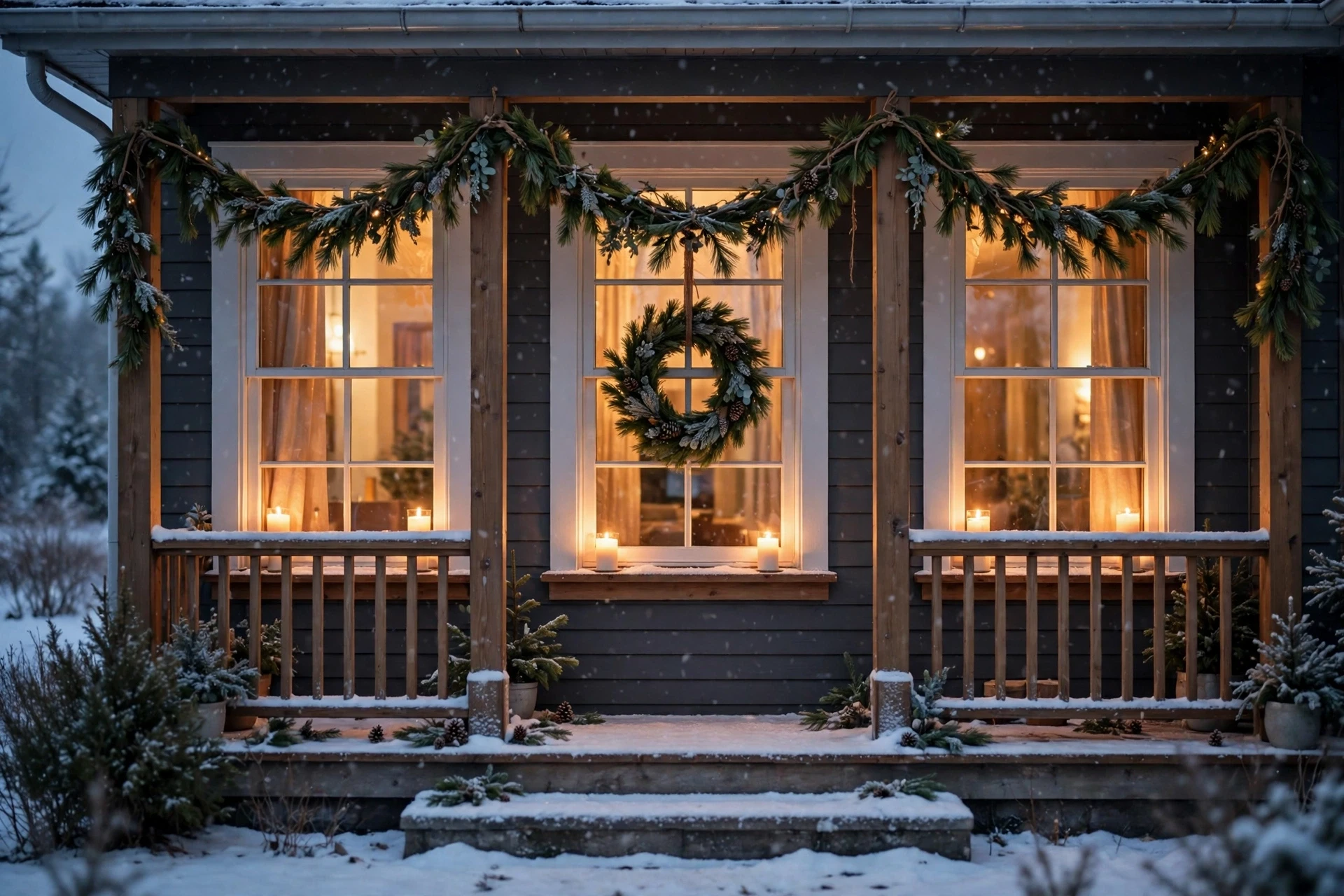
27 Christmas Window Decor Ideas That Make Your Home Glow From the Street
Intro: The Night My House Stayed Dark
Last December I drove home after dark and turned onto my street, and every house seemed to be glowing except mine. My neighbor had warm lights in every window, like little lanterns in a row. The house across the street had a simple pine wreath in one window and a candle in the other, and somehow that was enough to make the whole house look loved. My house was dark. Not because I did not love Christmas. I had a tree inside, I had gifts wrapped, I had a wreath on the door. But from the street, none of that showed. My windows were bare, and my house looked like nobody was home for the holidays.
I stood on the sidewalk that night, cold hands in my pockets, and really looked at my own house for the first time. The windows were the problem. They were big, dark rectangles. No light, no green, no story. The next weekend I did not buy a lot of stuff. I cleaned the glass, hung one garland, put three battery candles on the sill, and added a tiny pine wreath to the front window. That night I drove home again, slowly this time, and my house glowed. My kids noticed from the car. My neighbor waved. It was such a small change, and it changed how the whole house felt, inside and out.
That is what these christmas window decor ideas are about. Not a window full of stuff. A window with a plan. Every idea below follows the rule I use for every window in the house, which I call Light, Layer, Leave Air. Light means every window gets one glow source, a candle, a strand of lights, or a lit wreath, so it never goes dark. Layer means you build in three soft layers, green on the glass, light in the middle, and one object on the sill, instead of piling everything in one spot. Leave Air means you keep the center of the glass open, so daylight still comes in during the day and the glow has room to breathe at night. If an idea breaks that rule, IMO it looks busy from the street and dark from the sofa. Every idea below keeps the rule, and keeps the window feeling warm.
Before you hang anything, do what I call The Street Test. Wait until dusk, walk across the street, turn around, and look at your house. Squint a little. What do you see first? Is one window brighter than the rest? Is the glow even? Is there one clear focal point, or five things fighting for attention? The Street Test tells you the truth in ten seconds, and it is free. Do it before you start, and do it again after the first window is done, so the rest of the house matches it. Now, let us start at the glass.
Zone 1: Start at the Glass, Not at the Store (Ideas 1 to 5)
1. Clean the Glass First, and Thank Me Later
Nothing makes Christmas lights look better than clean glass. Wash the inside and the outside of the front windows, wipe the sills, and dust the frames before you hang a single thing. Dirty glass eats light. Clean glass lets warm light spill out onto the porch and the yard, and it makes garland green look richer. FYI, I do this on a dry, mild afternoon, with the windows open a crack if I can, so the glass dries fast and streak free. It takes twenty minutes, it costs nothing, and it is the difference between lights that glow and lights that look dull behind a film of dust.
2. Hang One Garland Swag, Not a Full Curtain of Green
Start with one pine garland swagged across the top of the window, dipping low in the middle, instead of framing the whole window in green. The swag gives you the Christmas shape right away, it leaves the center of the glass open for light, and it is easy to take down in January. Use two small clear hooks at the top corners, let the garland dip about a third of the way down in the center, and tuck the ends behind the trim. If the garland looks thin, twist two strands together, or add a few pine picks in the dip. One good swag beats four thin strands every time.
3. Try Frost Spray on One Corner Only
Frost spray, used lightly, makes a window look like a cold winter morning, even in a warm climate. Spray just the bottom corners and the outer edges, in short bursts, and leave the middle clear. Stand back often, because it builds fast. I like it on a side window or a bathroom window, where it gives privacy and a winter feeling at the same time. If you rent, test a tiny spot first, and use the kind that wipes off with warm water. One corner of frost, with a candle behind it, looks like a storybook. A whole window of frost just looks foggy.
4. Use Window Clings for Kids, Renters, and Quick Wins
Window clings are the fastest Christmas window decor ideas for a family with kids, or for anyone who cannot drill a hole. Snowflakes, stars, pine trees, and little reindeer cling to clean glass, peel off without a mark, and can be moved ten times before dinner. Let kids place snowflakes on the lower panes of a playroom or bedroom window, where they can reach, and keep the top panes for your lights. The trick is to keep the clings in one corner or along the bottom edge, not scattered all over the glass. A cluster of snowflakes in the corner reads as a snowstorm. Snowflakes everywhere read as clutter.
5. Let a Sheer Curtain Do the Glow Work
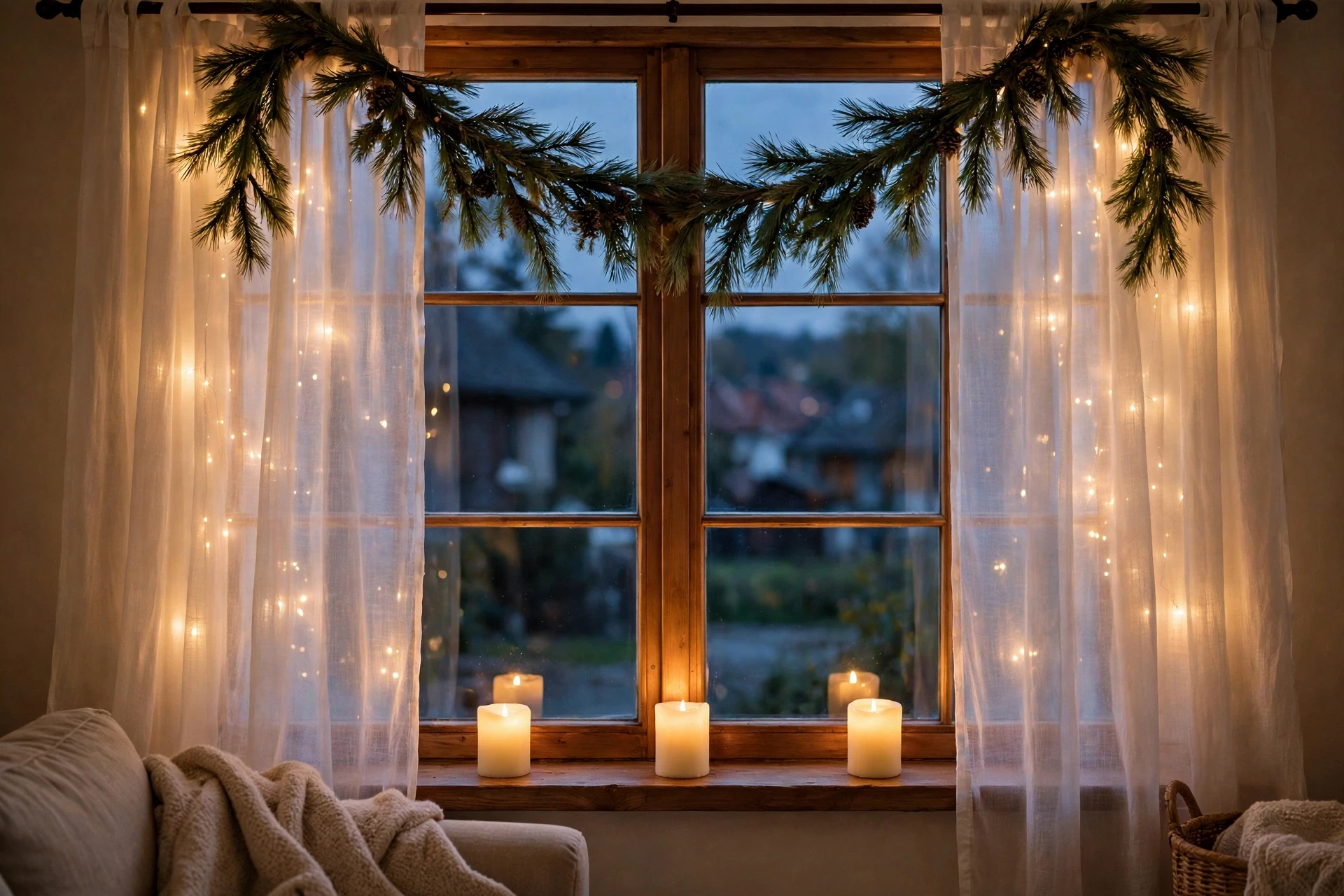
If you already have sheer white curtains, you already have a diffuser. Hang warm fairy lights just behind the sheer, on a tension rod or on small hooks inside the frame, and the whole window glows soft and even, like a lantern. No one sees the wire. No one sees the battery pack if you tuck it behind the curtain hem. This is my favorite trick for a bedroom window, where a bright strand would be too much, and for a street facing window, where you want glow without glare. Keep the lights warm white, around 2700K, and keep them behind the sheer, not in front of it.
Zone 2: Light That Does the Work After Dark (Ideas 6 to 10)
6. Put Three Candles on the Sill, All the Same Height
Three battery candles, all the same height, spaced evenly on the sill, is the classic window look for a reason. It reads from the street, it is calm from the inside, and it never looks messy. Use battery candles with a timer, so they come on at dusk and turn off while you sleep, and use the same warm tone in every window on the front of the house. If one window has tall tapers and the next has short pillars, the house looks uneven from the street. Same height, same color, same timer. That sameness is what makes a row of windows look intentional. For the full front of house picture, pair this with your Christmas front porch decor, so the porch lights and the window candles tell the same warm story.
7. Hang a Curtain of Fairy Lights, One Strand Deep
A curtain of fairy lights, hung in soft vertical drops from the top of the window, turns a plain window into a waterfall of light. Hang one strand across the top, then let drops fall at different lengths, longer at the sides, shorter in the middle, so the light has a shape. Keep it one strand deep. Two strands, one behind the other, tangle and look harsh. One strand, spaced about four inches apart, looks like falling snow. Use a timer, and use warm white. Cool white fairy lights can make a living room feel like a shop window, and that is not the feeling we want.
8. Add One Star Light, and Let It Be the Star
A single lit star in the center of a window is a whole decoration by itself. Hang it in the middle of the glass, on a clear suction cup or a thin line from the top frame, and let everything else stay simple. The star should be the brightest thing in that window, and the only star in that window. I put a paper star in our front bedroom window, and a smaller one in the kitchen window, and I leave the other windows to candles and garland. When every window has a star, no window has a star. One star, one window, one clear focal point. That is The Street Test, working for you.
9. Use Battery Lights With a Timer, Every Single Time
Battery lights with a built in timer are the quiet hero of Christmas window decor. Set them once, for six hours on and eighteen hours off, and forget them until January. No cords trailing down the wall. No hunting for an outlet behind the sofa. No remembering to turn them off. I keep spare batteries in the same box as the lights, and I change them on the first weekend of December, so I am not climbing on a chair on Christmas Eve. FYI, if a strand looks dim by the second week, it is usually the batteries, not the lights. Fresh batteries, same strand, glow restored.
10. Keep Warm White Everywhere, and Pick One Accent Color
Warm white lights in every window, and one accent color repeated in three places, is the palette that photographs best and feels calmest. The accent could be red, in a bow, a candle, and a berry pick. It could be gold, in a star, a ribbon, and a candle holder. What it should not be is red in one window, blue in the next, and green in the third, with multicolor lights on top. From the street, that reads as noise. From the sofa, it feels restless. Warm white everywhere, one accent in three small places, and the house looks like it was decorated by one person with one plan, because it was.
Zone 3: The Green Frame That Holds the Window (Ideas 11 to 14)
11. Use Fresh Pine Garland on the Front Windows Only
Fresh pine smells like Christmas the second you walk in, and it looks richer than faux green in photos. Use it on the front windows, where guests see it and where you see it from the sofa, and use good faux garland on the side and back windows, where no one will touch it. Fresh pine drops needles, so lay a thin towel on the sill while you hang it, and shake it outside first. It will last three to four weeks indoors if you keep it away from a heat vent and mist it lightly once a week. After Christmas, it goes straight to the compost or the yard waste bin. No storage, no guilt, and the best smell in the house for a month.
12. Mix Eucalyptus Into Pine for a Softer, Fuller Look
Pine alone can look stiff. Eucalyptus alone can look thin. Together, they look full and soft, like a real winter hedge. Tuck short eucalyptus stems into a pine garland, every six to eight inches, with the leaves pointing down and out. The silver green of eucalyptus softens the dark pine, and it dries nicely, so the garland still looks good in late December. I use this mix on our living room window, where the sofa faces the glass, because it looks good from both sides. From the street you see pine and light. From the sofa you see pine, eucalyptus, and the shape of the swag. Two views, one garland, both working.
13. String Dried Oranges on the Window for a Natural Glow
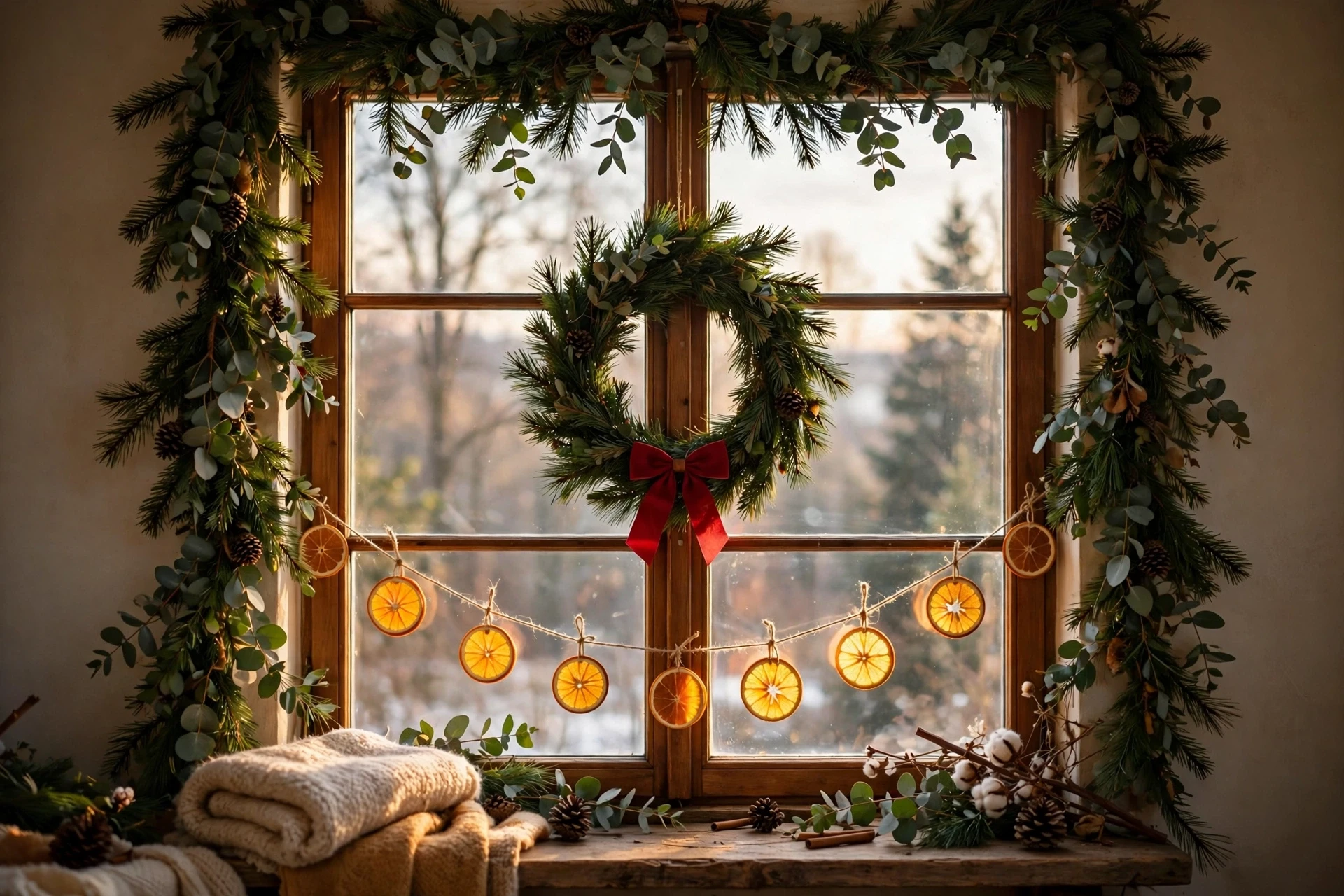
Dried orange slices, strung on twine and hung in front of a window, glow like stained glass when the sun hits them in the afternoon. Slice oranges thin, dry them low and slow in the oven until they are firm and translucent, let them cool completely, then thread them with a needle, leaving a small gap between each slice. Hang one strand per window, in front of the glass but behind the garland, so the light passes through. They smell faintly of citrus for a week, they cost almost nothing, and they pair beautifully with pine and cinnamon. Keep them away from steam, in a kitchen window, or they will soften and curl. A dry living room window is their happy place.
14. Hang a Wreath in the Window, Not Just on the Door
A wreath hung in the center of a window, on a clear suction cup or a ribbon looped over the top frame, is one of the simplest christmas window decor ideas, and one of the most loved from the street. Use a wreath that is a little smaller than the window, so there is glass showing all around it, and add a small bow at the bottom, not the top, so it does not hide the greenery. A plain pine wreath with a red bow works on almost any house. A wreath with berries and pinecones works on a house that already has a lot of color elsewhere. If you hang wreaths in two front windows, make them match, same size, same bow, same height. Symmetry from the street is what makes wreaths look expensive.
Zone 4: Color and Style Stories That Feel Like You (Ideas 15 to 19)
15. Go Classic Red and Gold, and Keep It Tidy
Red and gold is the Christmas palette most of us grew up with, and it still works, if you keep it tidy. Red bows on the garland, gold star lights in the window, red berries tucked into the pine, and warm white lights everywhere else. No more than three red things per window. No gold glitter on every surface. Classic means restrained, not bare. I use red and gold in our front windows, because it reads clearly from the street and it matches the wreath on the door. Inside, the same red shows up in a throw and a candle, so the window and the room feel like one thought. For the fireplace side of that same classic look, my Christmas mantel decor ideas use the same red and gold rule, so the mantel and the window do not fight.
16. Try a White Winter Woodland, All White and Pine
All white and pine, with no red at all, makes a window feel like a quiet snowy morning. White fairy lights, white paper stars, white candles, pine garland, and a few white bottle brush trees on the sill. The key is texture, because color is not doing the work. Mix matte and shiny whites, rough pine and smooth glass, soft candle glow and crisp star light, so the window has depth. This style suits a modern house, a house with white trim, or a bedroom where you want calm, not cheer. It also photographs beautifully in daylight, when red can look harsh. White and pine, done with texture, is never boring.
17. Add Burgundy Velvet Bows for a Rich, Grown Up Look
Burgundy velvet bows, tied at the ends of a garland swag and at the bottom of a window wreath, add instant richness. Velvet catches light differently than ribbon, soft and deep, and burgundy reads as warm from the street, not dark. Use two bows per window, no more, and make them the same size. Tie them with wired ribbon if you can, so the loops hold their shape for a month. I save velvet bows for the front windows and the living room, where I see them every day, and I use simpler bows elsewhere. One rich material, used sparingly, feels luxurious. The same material on every window feels like a costume.
18. Use Plaid and Pine for a Cozy Cabin Feeling
Plaid, in a ribbon, a small throw draped on the sill, or a candle wrap, plus pine garland and warm lights, gives a window a cozy cabin feeling in minutes. Pick one plaid, red and black, or green and cream, and use it in two places per window, not five. A plaid bow on the garland and a plaid candle wrap on the sill is enough. The rest of the window stays pine and light. Plaid works best in a family room or a kitchen window, where life is a little messier and a little warmer. It is forgiving, it hides a drooping garland, and it makes a window feel like someone lives there, in the best way.
19. Try Blue and Silver Frost for a Cool, Calm Window
Blue and silver, with frost spray on the corners and cool toned silver ornaments on the sill, makes a window feel like a frosty evening. Use it in one room, not the whole house, so it feels special. A bedroom or a guest room is perfect, because the cool palette feels calm at night. Keep the lights warm white, even with blue accents, or the window will look cold and distant. The warmth in the lights and the coolness in the color balance each other. Silver stars, blue glass ornaments, white candles, and pine: that is the whole recipe. Do The Street Test on this window at dusk, because blue can disappear from the street if the lights are too dim. One brighter candle, or one extra strand, fixes it.
Zone 5: Sill Scenes That Tell a Little Story (Ideas 20 to 23)
20. Build a Tiny Village on a Deep Sill
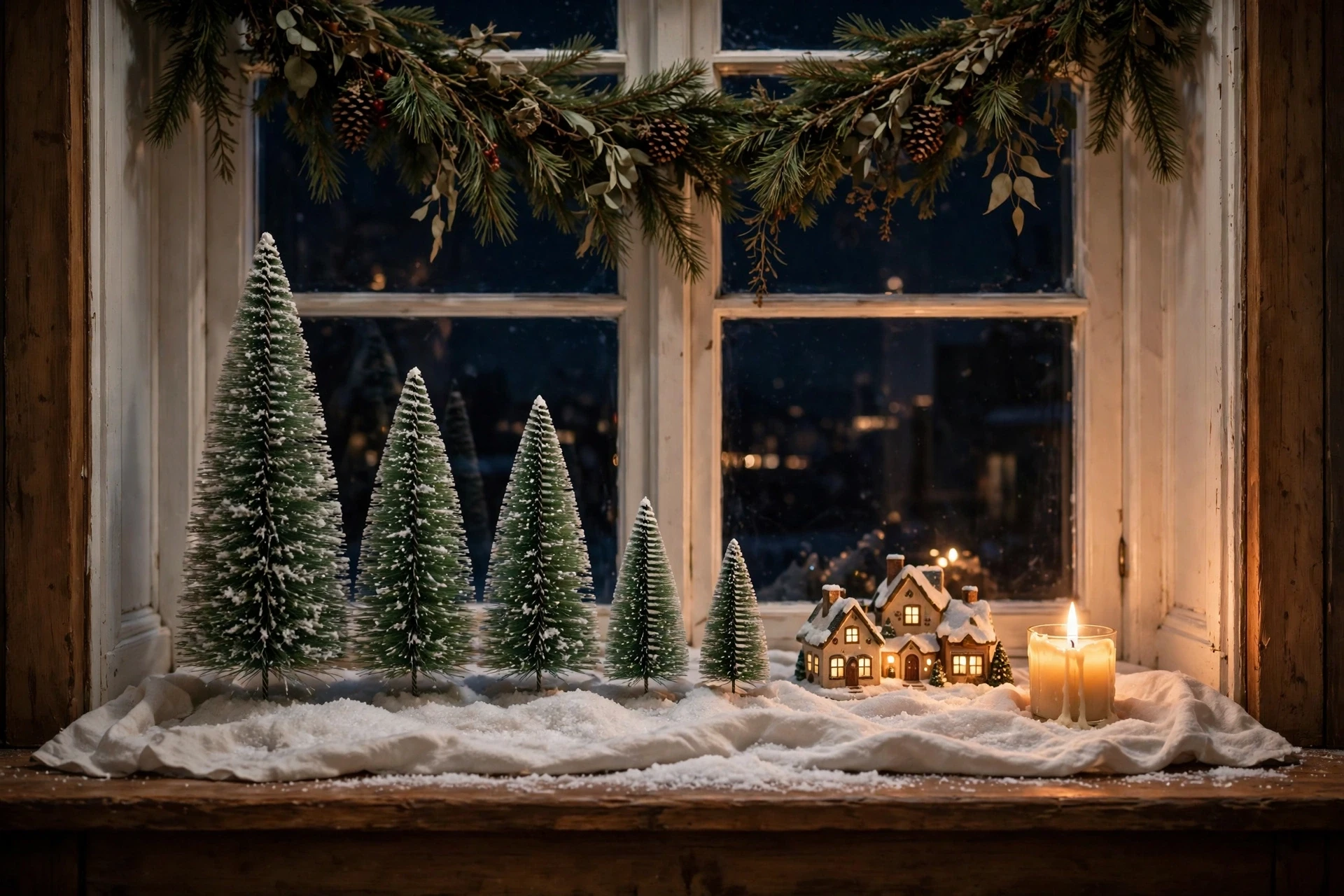
A deep windowsill is a stage. Build a tiny village there, three or four little houses, a few bottle brush trees, a dusting of fake snow on a white cloth, and one warm light behind the houses so the windows glow. Keep the village low, so it does not block the glass, and keep it to one sill, not every sill in the house. Kids love to rearrange a village, so use sturdy houses and keep the tiny pieces where little hands can reach them safely. At night, from the street, a lit village looks like a whole little town. From the sofa, it looks like a memory. That is a sill scene earning its place.
21. Line Up Bottle Brush Trees, Tall to Short
Bottle brush trees, lined up from tall to short along the sill, are the easiest sill scene there is. Three to five trees, in one color family, green, white, or frosted, with a little fake snow at the base, and one candle at the end. Vary the heights, but keep the tallest tree shorter than a third of the window, so the glass stays open. I group trees in odd numbers, three or five, because odd groups look natural and even groups look like soldiers. Add one tiny ornament, a star on the tallest tree, and stop. The restraint is the style.
22. Stack Books, a Candle, and a Pinecone on the Sill
For a window you live with every day, a sill scene should be useful, not just pretty. Stack two or three books, set a battery candle on top, lean a pinecone against the books, and tuck a small pine sprig behind it all. It looks like a still life, it holds a candle safely, and it does not block light. This is my kitchen window scene, because I can move the books to cook, and the candle is battery, so there is no flame near a curtain. Use books you actually like, with covers in your palette, and turn the spines in if the colors clash. A sill should look lived in, not staged, and books do that better than any ornament.
23. Make the Kitchen Window a Hot Cocoa Window
The kitchen window deserves its own Christmas idea, because it is the window you stand at most. Hang a small garland, set a mug tree or two favorite mugs on the sill, add a tiny pine sprig in a jar, and string one short strand of warm lights across the top. When the kettle boils and the window fogs a little, the lights glow through the steam, and the whole kitchen feels like a cafe. Keep everything away from the sink splash zone, and use a battery strand, so no cord hangs near water. This window pairs naturally with a cozy drink station nearby, and it is the window guests see when they come in for cocoa. Small, warm, and useful, that is a kitchen window done right.
Zone 6: Small Windows, Rentals, and Real Life (Ideas 24 to 27)
24. Dress One Small Window With Just a Wreath and a Candle
A small window does not need a garland, a strand, and a village. It needs one wreath in the glass and one candle on the sill, and it is done. The wreath should be about half the width of the window, so the glass frames it. The candle should sit to one side, not in the middle, so the wreath stays the focal point. This is the rule for bathroom windows, small bedroom windows, and the little window by the front door. One focal point, one glow, leave the rest alone. A small window, dressed simply, looks more expensive than a small window stuffed with stuff.
25. Use No Hole Tricks for Rentals and New Paint
Rentals, new paint, and fresh trim all mean the same thing: no holes. Use tension rods inside the frame for lights and sheer curtains, clear suction cups on the glass for wreaths and stars, removable hooks on the trim for garland, and battery candles on the sill for glow. Test a suction cup on a cold morning before you trust it, because cold glass can make a cup let go. Press it on clean, dry glass, hold it for thirty seconds, and check it the next day. Everything in this guide can be done with no holes, and everything comes down in January without a trace. That is how a rental window gets to glow, too. The same no hole approach works beautifully at the front door, and it is the same spirit as the Christmas entryway decor ideas, where removable hooks and a light touch keep the entry welcoming without damage.
26. Treat a Bay Window as Three Windows, Not One
A bay window is really three windows with a shared sill, and it should be dressed that way. Put a candle in each side window, and a small village or a group of trees in the center window. Run one garland across all three, swagged at each joint, so the three windows read as one. Keep the center sill clear enough to sit a plant or a stack of books, because a bay sill is the best seat in the house in December, with the lights on and the cold outside. Do The Street Test on a bay window from an angle, not just straight on, because a bay is seen from the side as people walk past. The side view should glow, too.
27. Do the Safety, Pet, and Kid Check Before You Call It Done
Before you call a window done, do the safety check. Battery candles, not real flames, near curtains and garland. Cords, if you must use them, tucked behind furniture and out of walkways, never across a sill a cat can pull down. Small ornaments and dried oranges out of reach of toddlers and curious pets. Suction cups and hooks checked after the first cold night. Plants that are safe if a pet nibbles a leaf. I check every window once, on the day I decorate, and once more a week later, after the first frost and the first time the heat kicks on. A beautiful window is only beautiful if it is safe, and this check takes five minutes per window, tops.
The Winter Window Check: Cold, Condensation, and Safety
Winter is hard on windows, and Christmas decor adds moisture, heat, and weight to the glass. Check for condensation every morning for the first week after you decorate. If the glass fogs, the room is too humid for a full garland, or the garland is trapping moisture against the glass. Pull the garland an inch away from the glass, open the window a crack for ten minutes a day, and wipe the sill dry. If a suction cup keeps falling, the glass is too cold or too dirty for it. Warm the glass with a dry cloth, clean it again, and press the cup on firmly. If a battery candle looks dim, change the batteries, do not add a second candle to compensate. One bright candle beats two dim ones, every time.
Keep fabric, paper stars, and dried oranges away from heat vents and radiators under the window. Heat dries out garland, curls paper, and fades ribbon fast. If a vent sits under your front window, hang the garland higher, keep the sill clear of paper, and use glass and wood on that sill instead. Check the outside, too. A garland hung outside a window needs to be rated for outdoor use, or the first rain will soak it and the first wind will drop it. Inside garland stays inside. Outside garland stays outside. That simple rule saves a lot of January cleanup.
Buy Once vs Refresh Each Year: A Window Budget That Works
Buy once, and buy well: good faux pine garland, a set of battery candles with timers, clear suction cups and removable hooks, one good wreath, and a warm white light strand that will last five Decembers. These are the bones of every window in this guide, and they are worth spending a little more on, because you will use them every year. Refresh each year, and keep it cheap: fresh pine picks, eucalyptus stems, dried oranges, a new ribbon color, a few window clings, and one new small thing for the sill, a tiny house, a new star, a thrifted mug. That split keeps the budget honest. The bones stay the same, the fresh bits change, and the window never looks like last year, even though most of it is.
As a guide, a whole house of windows, front and living room and kitchen, should cost under 75 dollars if you already own the bones, and under 150 dollars if you are starting from scratch with good garland and candles. Start with the front windows, where The Street Test matters most. Add the kitchen and bedroom windows next. Leave the back windows for last, or dress them simply with candles only. A house that glows at the front and is calm at the back looks intentional. A house that is half decorated everywhere looks unfinished.
Small Windows, Rentals, and Second Floor Windows
Small windows want less, not more. One wreath, one candle, one small green pick, and stop. If the window is narrow, hang the garland vertically, down one side, instead of across the top, so the glass stays open. Rentals want removable everything, and that is fine, because the best window tricks in this guide are removable by design. Tension rods, suction cups, removable hooks, battery lights, and sill scenes that sit, not hang, will all come down clean in January. Second floor windows want the same glow as the ground floor, but with simpler shapes, because no one sees the details from the street. A candle and a strand, or a wreath and a candle, is enough up high. Save the tiny village and the dried oranges for the windows you see up close. From the street, simple and bright wins, every time. For a staircase window, the same rule applies, and it should match the glow on the stairs below, like the Christmas staircase decor ideas, so the climb to bed feels warm, not dark.
Troubleshooting: 6 Christmas Window Fixes That Actually Work
1. The lights look cold and harsh, not warm
Swap cool white for warm white, around 2700K, and put the strand behind a sheer curtain or a layer of garland. The sheer softens the light, and the green filters it. If you cannot swap the strand, add one warm candle to the sill, and the eye will read the window as warm overall.
2. The garland droops in the middle by week two
Add a third hook in the middle, hidden behind a bow or a pine pick, and twist the garland tighter at the dip. Fresh garland droops as it dries, so hang it a little higher than you want it to end up, and mist it lightly once a week, away from the glass.
3. The suction cup wreath keeps falling
Clean the glass with warm water and dry it completely, warm the cup in your hands, press it on and hold for thirty seconds, and hang the wreath from a ribbon looped over the top frame as a backup. If it still falls, the wreath is too heavy for the cup. Use a smaller wreath, or a hook instead.
4. The window fogs up every morning
Pull garland and fabric an inch away from the glass, open the window a crack for ten minutes a day, and wipe the sill dry each morning. If fog persists, the room is very humid. Move the fabric sill scene to another window, and keep just lights and glass on the foggy one.
5. One window is brighter than all the rest
Match the glow, not the number of lights. Use the same candle height, the same light color, and the same timer in every front window. If one window still outshines the rest, dim it by putting its strand behind the sheer, or move one candle to a side window. The Street Test will tell you when it matches.
6. The sill looks cluttered, not styled
Take three things off the sill, and leave one group of three, a candle, a tree, and a pinecone, or a village, a tree, and a light. Clear sills are not empty sills. They are sills with room to breathe, and they let the window itself be the decoration.
FAQs: Christmas Window Decor Ideas
How do I hang Christmas garland on a window without damaging the trim?
Use removable clear hooks on the trim, a tension rod inside the frame, or ribbon looped over the top of the window. All three hold a pine garland well, and all three come off clean in January with no holes and no paint damage.
What color lights look best in a Christmas window?
Warm white lights, around 2700K, look best in almost every window, because they glow like candlelight and read warm from the street. Keep one accent color, like red or gold, in three small places, and keep the lights themselves warm white everywhere.
Can I use real pine garland inside a window?
Yes, on the front windows where you will enjoy the smell, for three to four weeks, if you keep it away from heat vents and mist it lightly once a week. Use good faux garland on side and back windows, where the smell matters less and the garland needs to last longer.
How do I stop a wreath from falling off a cold window?
Clean and dry the glass, warm the suction cup in your hands, press and hold it for thirty seconds, and add a ribbon looped over the top frame as a backup. If the wreath is heavy, use a smaller wreath or a removable hook instead of a suction cup alone.
What is the easiest Christmas window decor for a rental?
One wreath on a suction cup, battery candles with a timer on the sill, and a strand of warm lights on a tension rod behind a sheer curtain. No holes, no damage, and the whole window comes down in January in under ten minutes.
One Comment