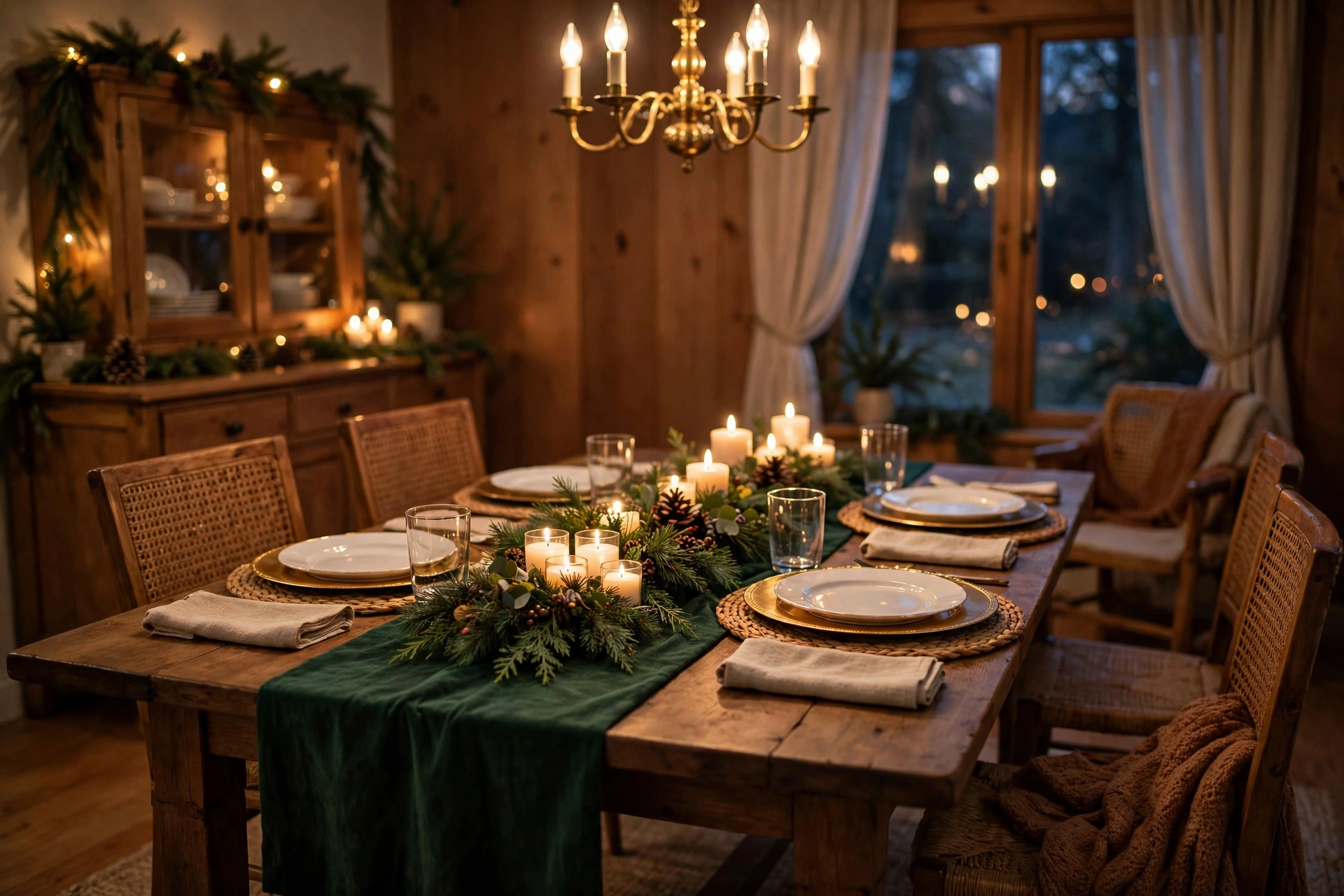
27 Christmas Dining Room Decor Ideas That Make Holiday Dinners Feel Truly Special
27 Christmas Dining Room Decor Ideas That Make Holiday Dinners Feel Truly Special
Intro: The Christmas Dinner When Nobody Could See Each Other
Three Christmases ago, I hosted dinner for eleven people, and I was so proud of the table that I took a photo before anyone sat down. It looked like a magazine spread. Tall gold candlesticks, a huge pine centerpiece, a runner in deep red, and a forest of little trees marching down the middle. Then everyone sat down, and the problems started. My aunt could not see my uncle across the table because a candlestick was exactly at face height. My cousin reached for the potatoes and knocked a pinecone into the gravy. The centerpiece was so wide that the serving dishes had to live on the sideboard, which meant I spent dinner doing laps. The photo was beautiful. The dinner was awkward. And I spent the whole meal thinking about the table instead of the people at it. That dinner is why these christmas dining room decor ideas start with the food and the faces, not the photo.
That night taught me the lesson behind every idea in this post. A Christmas dining room is not a photo set. It is a room where people eat, talk, pass dishes, spill a little wine, and stay too long because nobody wants the evening to end. Christmas dining room decor ideas should make that evening easier and warmer, not harder and prettier. IMO, the best dining room at Christmas is the one where the candles glow, the food is within reach, and you can see every face at the table. Everything else is a bonus, and this post keeps the bonuses in their place.
This post has 27 christmas dining room decor ideas, organized the way I actually style our dining room now: the table first, then the centerpiece, then the light, then the chairs, walls, and sideboard, then the color and personality choices, then the small room, rental, and last minute versions. I also share the two frameworks I use every December, the Table, Light, Layer formula and the Sit Down Test, plus a candle and durability check, a buy once versus refresh budget, and the fixes for the six mistakes I made first. Every idea works in a real dining room, with real serving dishes, real kids, and a real budget. No idea here needs a remodel, and most of them cost less than one nice bottle of wine.
If your dining room already has a table you love, start with the centerpiece and light zones. If your dining room is currently the room where the laundry basket lives until guests arrive, start at the table and work outward, and do not apologize for it. We have all been there. The goal is not a perfect table. The goal is a room where people sit down, sigh in the good way, and stay. That sigh is the whole point, and it starts with a table you can actually eat at.
Table, Light, Layer: My Christmas Dining Room Decor Ideas Formula
Before we get to the 27 ideas, here is the formula that keeps this room from turning into a centerpiece with nowhere to put the food. Table, Light, Layer. The table must be ready to serve dinner first, with clear space for dishes, elbows, and glasses. The light must glow at face height, warm and low, so people look good and the room feels like evening. The layer must add texture and color in three heights, low, middle, and high, without blocking a single face. If those three are right, every ribbon and ornament after them is a bonus. If those three are wrong, no amount of garland fixes the room. FYI, I learned this the hard way, because my first Christmas table had a beautiful centerpiece and no room for the turkey. My family remembers the turkey on the sideboard. They do not remember the centerpiece.
The second framework is the Sit Down Test, and I want you to actually do it. Set the table exactly as you plan it for Christmas dinner, then sit in every chair. Look across the table. Reach for an imaginary serving dish. Set down a full glass. Walk around the table with a plate in each hand. You will find three things in ten minutes that a month of looking at the table never showed you. I found a candlestick at eye level, a runner that slid under the serving platter, and a chair that could not pull out because the sideboard was too close. All fixed in one evening, all invisible until I sat down. Do the test. It is free, and it is the most honest decorating advice in this post. For more table-first thinking, my Christmas dining table decor ideas post goes deeper on place settings and tablescapes, while this post covers the whole room around the table.
Zone 1: The Table First, Because Dinner Is the Point
A dining table should look inviting from the doorway and work beautifully at 7 p.m. when eleven people sit down. That means a flat, stable surface for serving, clear space for dishes, and decorations that leave room for the food. Start here, spend the most care here, and let the rest of the room be simpler if it has to be.
1. Start With a Bare Table and One Clear Rule: Food First
Before a single decoration goes on the table, set out the serving dishes you actually use, the platter, the bowls, the gravy boat, and the water pitcher, and mark their places with tape or sticky notes. Everything you add after that must fit around the food, not the other way around. I use a wood table with no tablecloth most years, because a bare wood surface forgives spills, holds hot dishes without a panic, and looks warm under candlelight. If your table scratches easily, use a thin felt pad under a washable cloth, and skip the stiff formal cloth that slides every time someone reaches for bread. The rule is simple: if the food does not fit, the decoration does not stay. Write it on a sticky note if you must. I did, for one whole December, and it saved me from myself.
2. Choose a Runner That Stays Put and Leaves Room at the Ends
A runner in deep green, warm red, or a simple plaid, laid straight down the center, gives the table its Christmas spine. Choose one that ends at least six inches before each end of the table, so the end chairs have a clear place for a plate, and use rug tape or a non-slip pad underneath so it does not travel when someone pulls a dish toward them. I learned the tape trick after a runner migrated three inches during dessert and took a candle with it. A runner with a woven texture, like a nubby cotton or a linen blend, hides crumbs and reads richer than a shiny satin one. If you love a long dramatic runner, fold the extra length under at the ends or let it hang only on a table that never has an end chair. IMO, a runner that stays put beats a runner that looks dramatic for ten minutes.
3. Layer Placemats Over the Runner, Not Under It
Placemats in woven seagrass, warm wood, or simple linen, placed on top of the runner at each seat, define each place and protect the table from hot plates and wet glasses. The contrast matters: a dark runner with light placemats, or a plaid runner with plain cream placemats, keeps the table from turning into one flat block of pattern. Round placemats soften a long rectangular table, and rectangular ones suit a round table by giving each place a clear edge. Keep the mats at least an inch from the table edge so elbows rest on wood, not on a mat edge that curls. Washable mats win at Christmas, because someone will spill cranberry sauce, and it will be the person you least expect.
4. Mix One Good Set of Plates With One Fun Christmas Layer
You do not need a full Christmas china set. Use the everyday plates you already own, white or cream, and add one festive layer: a charger in gold, deep green, or wood, or a salad plate in a Christmas pattern, or a single ornament on each plate as the place marker. The everyday plate keeps the table calm and the food looking good, and the one festive layer carries the season. I bought six gold chargers years ago, and they have served every Christmas since, under white plates, under plaid plates, and once under paper plates at a very chaotic family dinner. If you buy one table item this year, make it chargers. They store flat, they never go out of style, and they make an ordinary Tuesday dinner feel like an occasion too.
5. Set the Table the Night Before, Then Walk Away
Set the full table the night before Christmas dinner, plates, glasses, flatware, napkins, and all, then leave the room and come back in the morning with fresh eyes. You will spot the crooked place setting, the glass too close to the edge, and the chair that blocks the doorway, while there is still time to fix them calmly. Cover the set table with a clean sheet overnight if you have pets or small kids, and uncover it an hour before guests arrive. This one habit turned my Christmas mornings from frantic to calm, because the biggest job was already done. It also means the Sit Down Test gets a second run in the morning, with coffee, when you are thinking clearly. A table set in a rush shows. A table set the night before glows.
Zone 2: The Centerpiece, Kept Low and Generous
The centerpiece is the heart of the Christmas dining room, and also the thing most likely to ruin dinner if it gets too tall or too wide. Keep it low, keep it narrow, and keep it generous with texture. A centerpiece should frame the conversation, not sit in the middle of it like a wall.
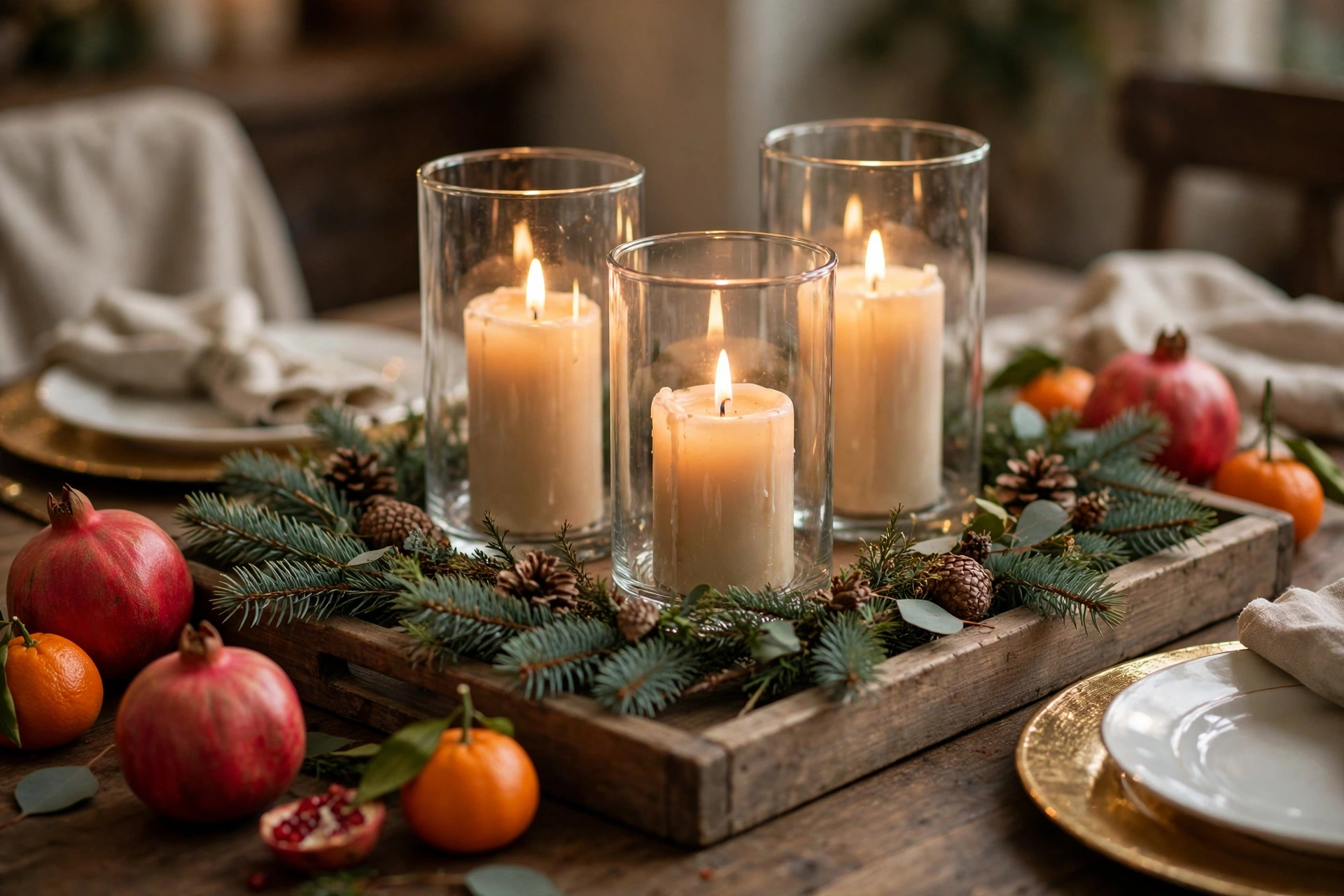
6. Build the Centerpiece on a Tray So It Moves in One Lift
Start with a long wood tray, a marble board, or a woven runner tray down the center of the table, and build everything on it. When dinner is served, the whole centerpiece lifts off in one move, leaving a clear table for the food, and it goes back on just as fast for dessert. I use a tray that is about two thirds the length of the table, which leaves serving space at both ends and keeps the centerpiece from sprawling. The tray also catches pine needles, wax drips, and stray cranberries, which means cleanup is one wipe, not a table scrub. Choose a tray with low sides, so it reads as a base and not a box, and keep it in a natural material, wood, rattan, or stone, so it works in January too.
7. Use a Low Pine Garland as the Base, Not a Tall Arrangement
A fresh or faux pine garland, laid flat down the center of the tray, is the easiest Christmas centerpiece base there is. It stays under eight inches tall, it smells wonderful if it is fresh, and it forgives a wobbling serving dish in a way a tall vase never will. Fluff the garland so it looks full, tuck in a few pinecones and dried orange slices, and leave gaps where the candles and serving dishes will sit. If you use fresh garland, lay a thin plastic liner under it on the tray, mist it lightly every other day, and keep it away from the oven vent, or it will dry out and shed by Christmas Eve. IMO, a flat garland beats a tall bouquet every time at a dinner table, because nobody has to talk around a bouquet.
8. Add Three Candle Clusters Instead of One Tall Candlestick Row
Three small clusters of pillar candles, in groups of three at different heights, give you glow across the whole table without a single candle at face height. Use glass hurricanes or simple wood risers to vary the heights, keep every flame at least twelve inches from the garland, and use battery candles inside the garland itself if you worry about dry pine. I mix real pillar candles in hurricanes with battery tapers in the garland, and nobody has ever noticed the difference once the room lights go low. Trim real wicks to a quarter inch before lighting, so the flame stays steady and does not smoke, and never leave candles burning in an empty room. Three clusters also mean the table still glows if one cluster gets moved for a serving dish, which it will.
9. Fill the Gaps With Fruit, Not More Stuff
Once the garland and candles are placed, fill the remaining gaps with what the season already gives you: pomegranates, clementines, red apples, and a few sprigs of rosemary or eucalyptus. Fruit adds color, scent, and a sense of abundance, and it costs almost nothing compared to another decorative object. A bowl of clementines at each end of the tray doubles as a snack for kids waiting for dinner, and pomegranates look like ornaments until someone cuts one open for a salad. Keep fruit off the tablecloth itself if it weeps or stains, and keep it on the tray where a little juice wipes clean. This is the centerpiece trick I use most, because it looks generous, it smells like Christmas, and it never blocks a face.
10. Put One Personal Touch in the Middle, and Only One
One personal touch, a small framed photo from last Christmas, a handmade ornament from a child, a tiny stack of handwritten place cards, or a single heirloom bowl, makes the centerpiece yours. Only one, because two personal touches compete and five turn the table into a display shelf. I put a small wooden reindeer my daughter made in third grade at the center of our tray every year, slightly off center, where I can see it from my chair. It is not beautiful in a magazine sense. It is ours, and it starts a conversation every single year. Choose the one thing that makes your family smile, put it where the light hits it, and let everything else stay simple. A table with one story beats a table with ten decorations, every time.
Zone 3: Light and Glow, Because Evening Is the Whole Mood
Christmas dinner happens in the evening, and the light is what makes it feel like Christmas instead of just dinner. Aim for warm, low, and layered: a dimmed main light, candle glow on the table, and one soft accent somewhere in the room. If you get the light right, almost everything else can be simple.
11. Dim the Overhead Light and Let the Table Glow
If you have a dimmer, use it. If you do not, swap the overhead bulbs for warm 2700K bulbs and turn off half the fixtures, so the room reads as evening, not as a bright kitchen. The dining room should feel like a restaurant at 7 p.m., not like a showroom at noon. I put our chandelier on the lowest setting that still lets people see their food, and the candles do the rest. Test the level the night before, at the same hour as dinner, because daylight lies about how a room will look after dark. A room that is too bright shows every fingerprint and every wrinkle in the tablecloth. A room that is too dark makes people squint at the food. Aim for the middle, where faces glow and the table reads clearly, and write down the dimmer position so you can find it again next year.
12. Hang the Chandelier or Pendant at Conversation Height, Not Ceiling Height
A chandelier or pendant hung 30 to 34 inches above the table surface lights faces beautifully and leaves a clear view across the table. If yours hangs higher, lower it for December with an adjustable chain or a simple hook and chain extension, and raise it again in January. If it hangs lower than 30 inches, tall guests will bump it and the light will glare in their eyes, so raise it a few inches and add table candles to make up the glow. I measured ours with a tape measure, because guessing cost me one Christmas of my brother-in-law ducking under a pendant every time he stood up. Add a simple greenery swag or a ribbon bow to the fixture itself, kept well clear of bulbs, and the light becomes part of the decoration instead of just a fixture above it.
13. Add Fairy Lights in One Place Only, on a Timer
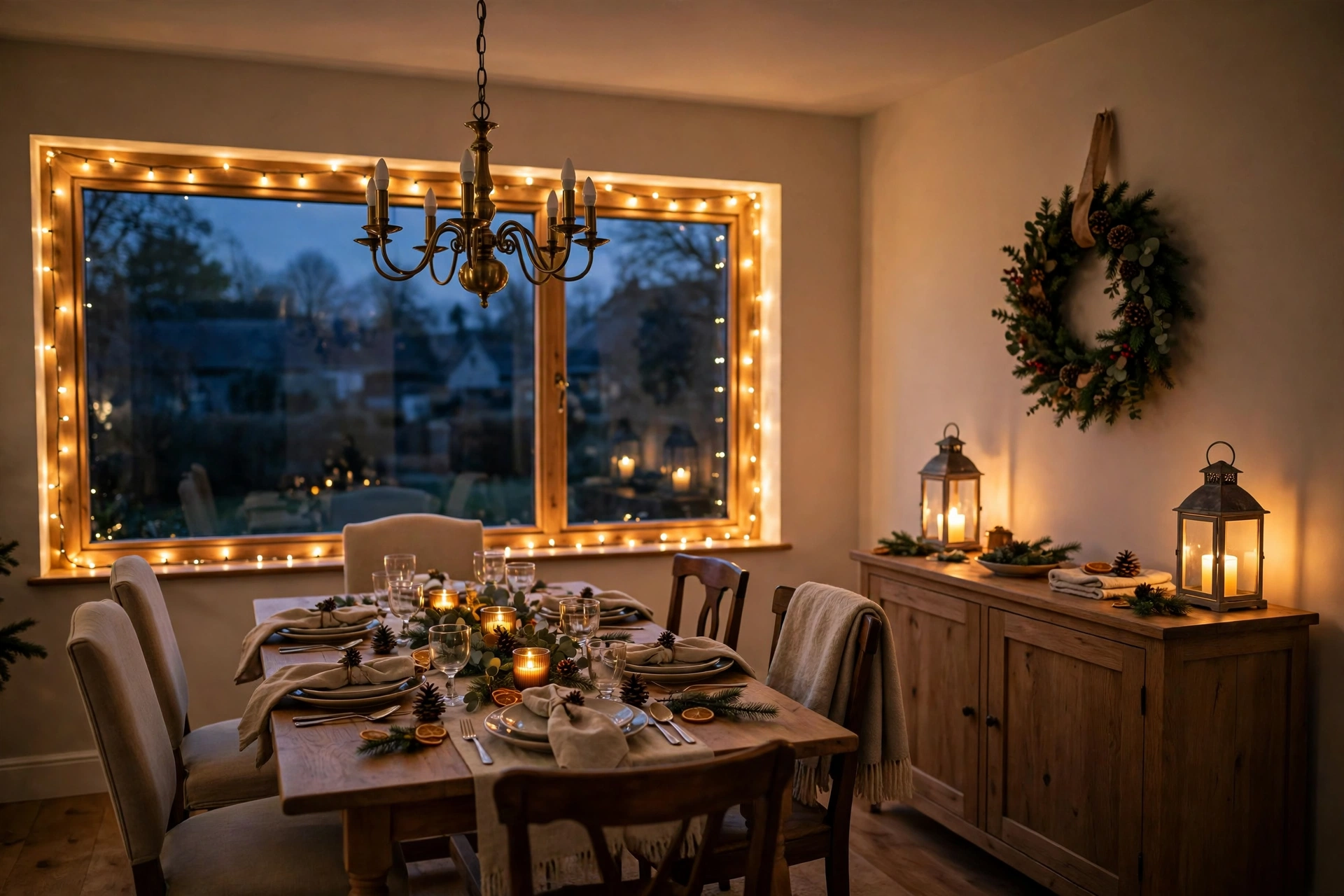
One warm strand of fairy lights, along a window frame, around a mirror, or draped on the sideboard, gives the room its Christmas sparkle without turning it into a light show. Put the strand on a timer plug set to come on an hour before dinner and off at bedtime, so the room glows when guests arrive and you never hunt for a plug behind the furniture. Keep the lights warm white, not cool blue, because cool light makes food look gray and faces look tired. Battery fairy lights work beautifully inside a glass cloche or a lantern on the sideboard, where no cord shows. One strand is enough. Two strands compete, and three make the room look like a shop window. Pick the one spot the eye lands on first when you walk in, and light only that.
14. Put a Lantern or Two on the Sideboard, Not on the Table
Lanterns with pillar candles, real or battery, on the sideboard or on a window sill, add glow at the edges of the room and keep the table clear for food. A large lantern anchors one end of the sideboard, a smaller one anchors the other, and the space between them holds the serving dishes, the drinks, or the dessert plates. Use lanterns with glass panels and a handle, so they read as Christmas and not as camping gear, and keep the flame inside glass, away from curtains and garland. I move our lanterns to the table only for dessert, when the serving dishes are gone, and back to the sideboard before anyone notices. Edge light makes a room feel bigger and warmer at the same time, because the corners glow instead of disappearing into shadow.
Zone 4: Chairs, Walls, and the Sideboard, Where the Room Breathes
The table gets the attention, but the chairs, walls, and sideboard decide whether the room feels finished or crowded. Keep these surfaces calm, useful, and easy to move around, because dinner service happens here, not just decoration.
15. Tie One Simple Bow or Sprig on Each Chair, and Nothing Else
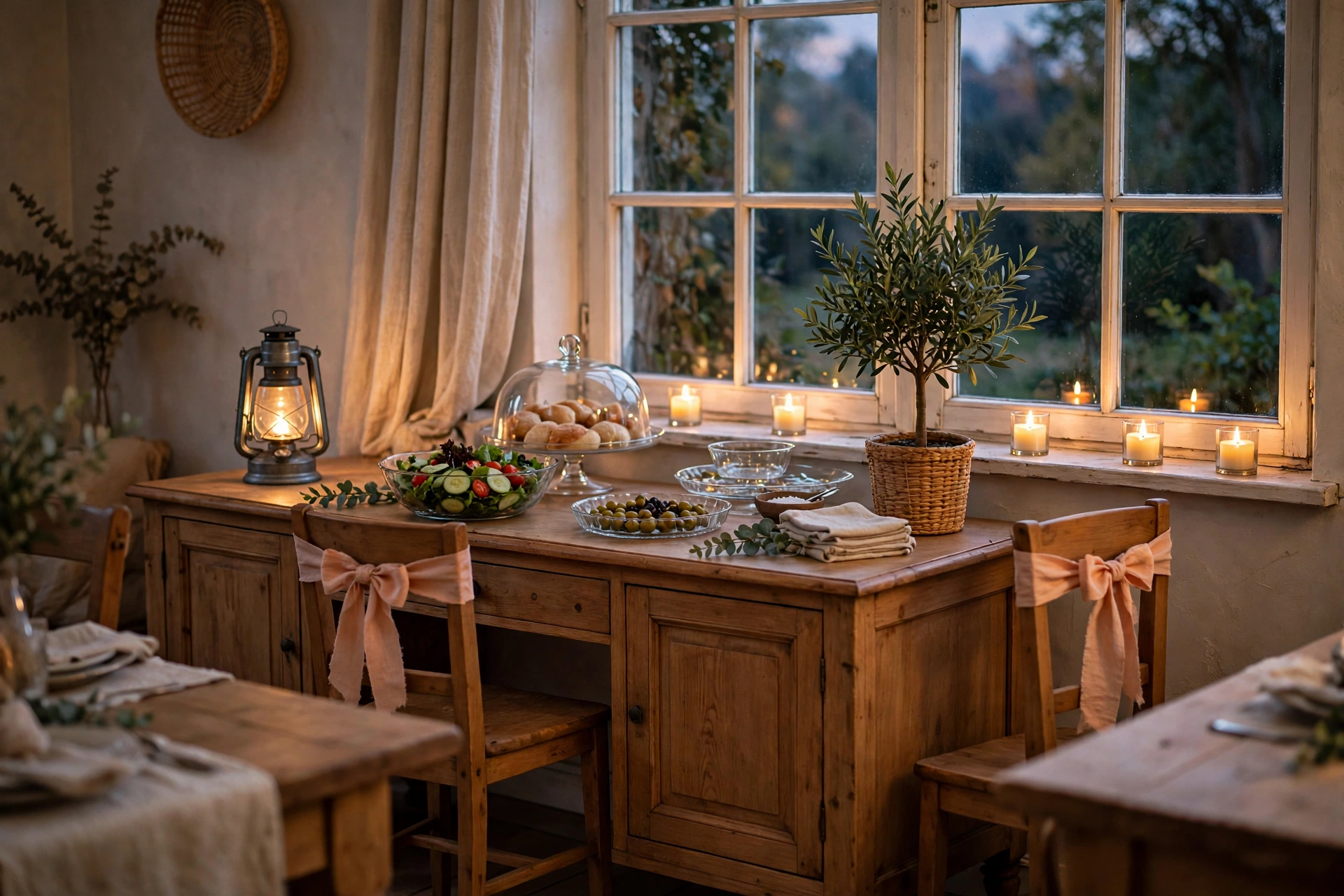
A single velvet ribbon bow, a sprig of pine tied with twine, or a small ornament hung from the back of each chair, turns ordinary chairs into Christmas chairs in five minutes. Tie it at the top rail, where it shows above the table line, and keep it flat, so it does not catch on sweaters or swing into the person behind. I use deep green ribbon on our wood chairs, tied in a simple loop, no fancy bow, because a simple loop survives kids, coats, and chair pulling in a way a big bow never does. If your chairs have upholstered backs, use a removable clip or a loose drape instead of a pin, so the fabric stays safe. One touch per chair is plenty. Two touches per chair look fussy, and fussy chairs are the first thing guests notice when they sit down.
16. Hang a Wreath on the Dining Room Wall, at Eye Level From the Table
One wreath, hung on the wall you face while eating, gives the room its Christmas anchor without touching the table at all. Hang it at eye level from a seated position, about 58 inches to the center, so it reads as art, not as a high decoration you crane to see. A simple pine wreath with a velvet bow suits a dining room better than a busy wreath, because the table already carries the detail. If your dining room has a mirror, hang the wreath on the mirror instead, with a removable hook and a ribbon over the top, and the wreath doubles in the reflection. For wreath ideas that pair with this room, the Christmas mantel decor post uses the same greenery logic on the fireplace, and the two rooms echo each other nicely when guests move between them.
17. Style the Sideboard as the Serving Station, Not a Display Shelf
The sideboard is the hardest working surface in the room at Christmas, so style it to serve dinner first. Clear the middle for serving dishes, drinks, or dessert plates, and decorate only the ends: a lantern on one end, a small tree or a vase of branches on the other, and a stack of extra plates in the middle where they are easy to grab. Leave the top at least one third clear at all times, because someone will need that space, probably for the turkey platter, probably at the worst moment. I keep a folded stack of linen napkins and a spare serving spoon on the sideboard all December, in a small basket, so I am never hunting through a drawer mid-dinner. A sideboard that serves dinner beats a sideboard that photographs well, and guests remember the host who was calm, not the host with the perfect vignette.
18. Give the Window One Treatment: Garland, Candles, or Curtains, Not All Three
A dining room window at Christmas needs one treatment, chosen well. A pine garland across the top, battery candles on the sill, or deep curtains tied back with ribbon, any one of these makes the window glow after dark. All three together fight for attention and block the light that makes the room feel open. I use battery candles on our window sill, three in a row, on a timer, because they glow from the street and from the table, and they cost nothing to run. If your window faces the street, the sill candles are the decoration your neighbors see too, which is a lovely bonus. Keep the window treatment clear of the curtain hem and the radiator, and keep real candles off the sill entirely, where a curtain can drift into a flame.
19. Leave a Clear Path Around the Table, Even If It Means Less Furniture
Measure the path around the table and keep at least 36 inches clear on every side, so chairs can pull out and a person carrying a platter can pass without turning sideways. If a plant stand, a bar cart, or an extra chair eats that path, move it to another room for December. I move our bar cart to the living room every Christmas, and nobody misses it, because the drinks live on the sideboard instead. A clear path is invisible when it works and miserable when it does not, and it is the difference between a dinner that flows and a dinner where everyone apologizes for bumping each other. Do the walk around with a plate in each hand, just like the Sit Down Test, and move whatever your elbows find.
Zone 5: Color, Pattern, and the Personality Choices
Color and pattern are where the room stops being generic Christmas and starts being yours. Pick one palette, repeat it three times, and let one pattern lead. Everything else stays calm, so the room feels collected, not decorated by a committee.
20. Pick One Palette and Repeat It in Three Places
Choose one palette, classic red and green, cream and gold, deep green and wood, burgundy and brass, or blue and silver, and repeat it in exactly three places: the table, the sideboard, and the wall or window. Three repeats make a palette feel intentional. One repeat looks like an accident, and five repeats look like a theme park. I use deep green, cream, and brass most years: green on the runner and the wreath, cream on the plates and napkins, brass on the chargers and the lanterns. The palette also guides every purchase, because if it does not match the palette, it does not come home. Write the palette on a sticky note and take a photo of it on your phone before you shop, so the store does not talk you into a fourth color. A room with one palette photographs beautifully and feels calm in person, which is rarer than it sounds.
21. Let One Pattern Lead and Keep the Rest Quiet
One pattern leads the room, plaid on the runner, stripes on the napkins, a botanical print on the placemats, or a tartan on the chair bows, and every other pattern stays quiet or absent. The lead pattern should be the biggest one in the room, and the quiet patterns should be small, tonal, and few. I let a green and cream plaid runner lead, with plain cream napkins, plain wood chargers, and no other pattern anywhere, and the room reads as festive without buzzing. If you love two patterns, put one on the table and one in another room, not side by side, because patterns that compete at the same table make the food look busy. IMO, one bold pattern and a lot of calm beats three pretty patterns fighting for the same table, every single time.
22. Bring in Natural Texture: Wood, Linen, Pine, and One Metal
Natural texture is what makes a Christmas dining room feel warm instead of plastic. Wood on the table and the tray, linen on the napkins, pine on the garland and the wreath, and one metal, brass or gold, on the chargers and the candle holders, give the room depth without adding a single new color. Run your hand over each surface before you buy it, because texture is a touch sense, not just a look. A rough wood tray, a soft linen napkin, and a smooth brass charger feel different in the hand, and guests notice that difference even if they never name it. Skip the glitter and the tinsel on the table itself, because glitter ends up in the food and tinsel sheds into the gravy. Keep the sparkle to the metal, and let the natural materials do the rest.
23. Add One Vintage or Heirloom Piece and Let It Tell the Story
One vintage or heirloom piece, a grandmother’s gravy boat, a set of old silver napkin rings, a wooden bowl from a family cabin, or a chipped ornament that has survived forty Christmases, gives the room a story no store can sell. Put it where people will see it and ask about it, at the center of the tray or on the sideboard end, and tell the story once, briefly, when someone asks. I put my grandmother’s cut glass candy dish on our sideboard every December, filled with clementines, and every year someone asks about it, and every year I tell the same two sentence story. That dish is the most valuable thing in the room, and it cost nothing. If you do not own an heirloom, a thrifted brass candlestick or a vintage tablecloth from a secondhand shop does the same job. The point is not age. The point is a piece with a past, in a room full of new things.
Zone 6: Small Rooms, Rentals, and the Last Minute Christmas Dinner
Not every dining room is a big formal room with a sideboard and a chandelier. Small rooms, rentals, and last minute dinners need the same three things, just smaller, lighter, and faster. These four ideas keep the formula working when space, time, or a landlord says no to the big version.
24. Make a Small Dining Room Feel Bigger With Light Walls and One Mirror
In a small dining room, keep the walls light, the table surface clear, and one mirror on the wall opposite the window, so light bounces and the room reads twice as big. Use a narrow centerpiece, a single garland line with no tray, and chairs that tuck fully under the table, so the floor stays visible. Skip the sideboard if it eats the path, and serve from a small cart in the hallway or from the kitchen counter instead. A mirror also doubles the candlelight, which means fewer candles and the same glow. I styled a dining nook this way for two Christmases in a rental, with a mirror from a thrift shop and a table that seated four, and guests said the room felt generous, not small. Small rooms do not need less Christmas. They need less furniture and more light.
25. Style a Rental Friendly Dining Room With Hooks, Not Holes
Rentals need the same room with no damage: removable hooks for the wreath, a garland draped over a mirror instead of nailed to a wall, battery candles on the sill, and a table runner held with rug tape instead of staples. Use freestanding pieces, lanterns, a small tree in a basket, a tray centerpiece, that move with you in January and leave no trace. Check your lease for real candles before you buy any, and default to battery candles if the answer is unclear, because a deposit is worth more than a flame. The Christmas kitchen decor post uses the same rental friendly logic for the room next door, and the two rooms share the palette so the whole floor feels like one celebration. A rental room can still feel like home at Christmas. It just needs hooks, tape, and pieces that stand on their own.
26. Turn a Kitchen Table Into a Christmas Dining Room in One Evening
If your dining room is the kitchen table, treat it like one for a single evening: clear everything off, lay a runner and placemats, build the tray centerpiece, dim the kitchen light, and add the candle clusters and the one strand of fairy lights. Eat in the kitchen, with the oven warm and the smell of dinner in the air, and let the kitchen be the celebration instead of apologizing for it. A kitchen table dinner is often warmer than a formal dining room dinner, because people linger where the food is. Keep the centerpiece narrow, because a kitchen table is usually narrower than a dining table, and keep the serving dishes on the counter within reach. The best Christmas dinner I ever hosted was at a kitchen table for six, with a pine garland, three candles, and a turkey that barely fit the oven. Nobody asked for a dining room. They asked for seconds.
27. Do the One Hour Christmas Dining Room Refresh When Time Runs Out
When time runs out, do the refresh in this order, and stop when the hour is up: clear the table completely, lay the runner and placemats, set the plates and glasses, build the tray centerpiece with garland and candles, hang one wreath, tie one bow per chair, dim the light, and light the candles. That is the whole room, in one hour, and it covers Table, Light, and Layer in the order that matters. Skip the sideboard styling, skip the window treatment, and skip any idea that needs a shop trip. Borrow the garland from the mantel if you must, and use fruit from the kitchen bowl as the centerpiece filler. The Thanksgiving table decor post taught me this same ruthless order, and it works at Christmas too: sleep and food first, sparkle last. A room refreshed in one hour, with the table ready and the light low, beats a room half decorated in three hours, every time.
The Christmas Dining Room Decor Ideas Candle and Durability Check: Heat, Wax, Kids, and Wine
Before guests arrive, run the candle and durability check, because a dining room at Christmas mixes open flame, hot dishes, red wine, and small hands in one small space. Keep every flame at least twelve inches from garland, curtains, and paper, keep candles in glass hurricanes or on stable holders, and never place a candle where a sleeve or a napkin can brush it. Use battery candles inside the garland and near kids, and save real candles for the hurricanes on the tray, where you can see them. Put a trivet under every hot dish, a coaster under every glass, and a damp cloth in a drawer for the spill that will happen, because a host who wipes calmly keeps the evening calm. Test the table surface with a hot plate the day before, so you know whether it marks, and use a pad under the cloth if it does. Check the chair legs and the rug for wobble, because a wobbling chair at a full table spills more wine than any toast. Do this check once, write down what you fixed, and the same list serves you next December.
Budget: Buy Once, Refresh Each Year
A Christmas dining room does not need a big budget, but it does need a smart one. Buy once: the tray, the gold chargers, the lanterns, the quality garland, and the linen napkins, because these last for years and carry every December after this one. Refresh each year: the fresh pine, the fruit, the candles, and one small new touch, a ribbon color, a new ornament, a different fruit, because the refresh is what makes the room feel new without a new budget. Most rooms cost 150 to 280 dollars for the lasting backbone, plus 25 to 45 dollars a year for the refresh, and a 50 dollar version with a tray you own, battery candles, fruit from the kitchen, and one wreath still feels deeply festive. I track our spending on one sticky note, stuck inside the decoration box, so next December I know exactly what we already own and what we actually need. The sticky note has saved me from buying a third set of napkin rings three years running. Buy once, refresh yearly, and let the room get richer every December instead of more expensive.
Troubleshooting: Six Dining Room Fixes I Learned the Hard Way
The centerpiece blocks faces. Lower it, narrow it, or move it to the tray ends and leave the middle clear. If you can see every face from every chair, it is low enough. If you cannot, it is not, no matter how pretty it is.
The runner slides under the serving dishes. Rug tape underneath, a non-slip pad under the tray, and a runner that ends six inches before each table end. Test it with a full platter before guests arrive, not during dinner.
The room is too bright and feels like noon. Dim the overhead, turn off half the fixtures, and let the candles and one fairy light strand do the work. Test at dinner hour the night before, and write down the dimmer position.
The candles smoke or gutter. Trim wicks to a quarter inch, keep candles out of drafts from doors and vents, and switch the garland candles to battery. A smoking candle is a wick or draft problem, not a candle problem.
There is no room for the serving dishes. Lift the tray centerpiece off for the meal, serve from the sideboard, or move one decoration to another room. Food space is non-negotiable. Decorations are not.
The chairs cannot pull out. Move the bar cart, the plant stand, or the extra chair to another room for December, and keep 36 inches clear around the table. Do the plate-in-each-hand walk before dinner, and move whatever your elbows find.
FAQs: Christmas Dining Room Decor
How do I decorate a dining room for Christmas without blocking conversation?
Keep the centerpiece under eight inches tall and narrower than the tray, use low candle clusters instead of tall candlesticks, and sit in every chair to check that you can see every face before guests arrive.
What is the best centerpiece for a Christmas dinner table?
A low pine garland on a movable tray, with three candle clusters and fruit in the gaps, is the best centerpiece, because it lifts off in one move for serving and never blocks a face or a serving dish.
How do I light a dining room for Christmas dinner?
Dim the overhead to a warm glow, add candle clusters on the table and lanterns at the edges, and put one warm fairy light strand on a timer in the spot your eye lands on first when you walk in.
What colors work best for Christmas dining room decor?
Classic red and green, cream and gold, deep green and wood, or burgundy and brass all work, as long as you pick one palette, repeat it in three places, and let one pattern lead while the rest stays quiet.
How much should I budget for Christmas dining room decor?
Most rooms cost 150 to 280 dollars for the lasting backbone, plus 25 to 45 dollars a year for the refresh, and a 50 dollar version with a tray you own, battery candles, and fruit from the kitchen still feels deeply festive.