25 Warm Neutral Living Room Decor Ideas That Make Your Home Feel Calm and Cozy
Our living room used to be the coldest-feeling room in the house, and I do not mean the temperature. The walls were a cool grey, the sofa was a cool grey, the rug was a cool grey with a cool grey pattern, and every photo I took in there looked like it had been shot inside a refrigerator. I kept buying throw pillows to fix it, and every pillow I bought was grey too, because grey was what the store told me was safe. One February evening I sat on that grey sofa with a cup of tea, looked around, and realized the room had no warmth in it at all. Nothing in the room looked like it had ever been touched by sunlight.
The next weekend I started over, slowly, one warm piece at a time. A biscuit-colored throw blanket. A terracotta pot with a real plant in it. A wood coffee table that showed its grain instead of hiding under paint. Within a month the room felt like a different house, and the funny part is I barely spent anything. Warmth is not about buying more stuff. It is about choosing the right tones, layering them the right way, and letting natural texture do the heavy lifting. This guide has 25 warm neutral living room decor ideas that work in real living rooms, the kind with kids, dogs, coffee rings, and a television. Most of them cost under $50, most take an afternoon or less, and every one of them makes the room feel warmer the day you do it.
The 60-30-10 Warm Rule: My System for a Room That Feels Warm, Not Washed Out
Before we get to the ideas, here is the system that keeps a warm neutral room from sliding into beige boredom. I call it the 60-30-10 Warm Rule, and it is the reason some neutral rooms feel like a hug while others feel like a waiting room.
Sixty percent of the room is your warm base, the big surfaces your eye reads first. Warm white walls, a biscuit or oat sofa, a light wood floor or a large warm rug. The base should be light and warm, never cool grey and never stark white. If your base is cool, nothing you layer on top will fix it. This is the one place where getting the undertone right matters more than getting the color right, because a warm base makes every single thing you add later look better.
Thirty percent is your mid-tone layer, the pieces that give the room its depth. This is where terracotta, camel, warm taupe, and honey wood live. Your coffee table, your accent chair, your curtains, your biggest pillows. The mid-tone layer is what stops the room from looking flat, and it is where most people quit too early. One terracotta pillow is not a mid-tone layer. Three or four mid-tone pieces, spread around the room so your eye travels, that is a layer.
Ten percent is your deep accent, the small dark notes that keep the room from floating away. A walnut bowl, a black metal lamp base, a deep chocolate throw folded over the arm of the sofa, a dark wood frame. You do not need much, but you need some, because without a dark note a warm neutral room looks washed out in photos and a little sleepy in person. IMO, the deep accent is the difference between a room that looks styled and a room that looks beige.
Most warm neutral rooms that disappoint break the rule in the same way. All base and no mid-tone looks empty. All mid-tone and no base looks muddy. And no deep accent at all looks like the color got tired halfway through. Sixty, thirty, ten, in that order, and the room almost styles itself. Keep those numbers in mind as you read the ideas, and pick at least one idea from each layer.
Warm Neutral Living Room Decor Starts With the Big Pieces
The big pieces set the temperature of the room before you buy a single pillow. Get these five right and everything else is easy. Get them wrong and you will spend years trying to warm up a room that fights you. These five ideas cover the sofa, the rug, the tables, and the chair, the pieces you touch every day.
1. Choose a biscuit or oat sofa, not a grey one
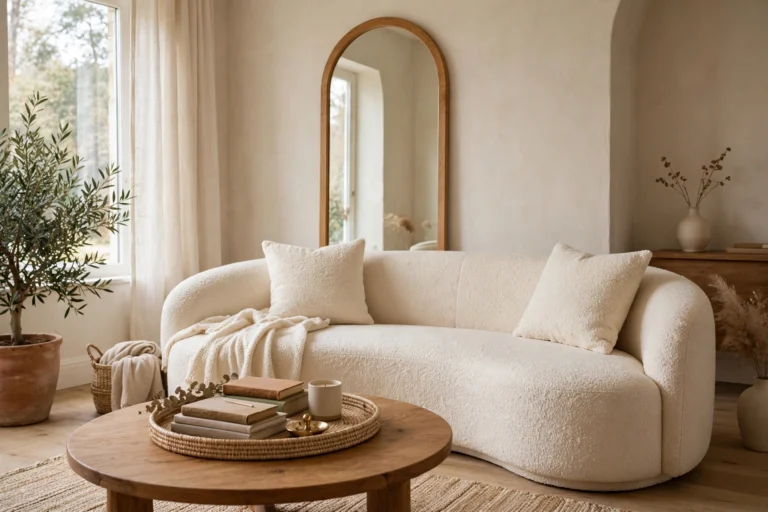
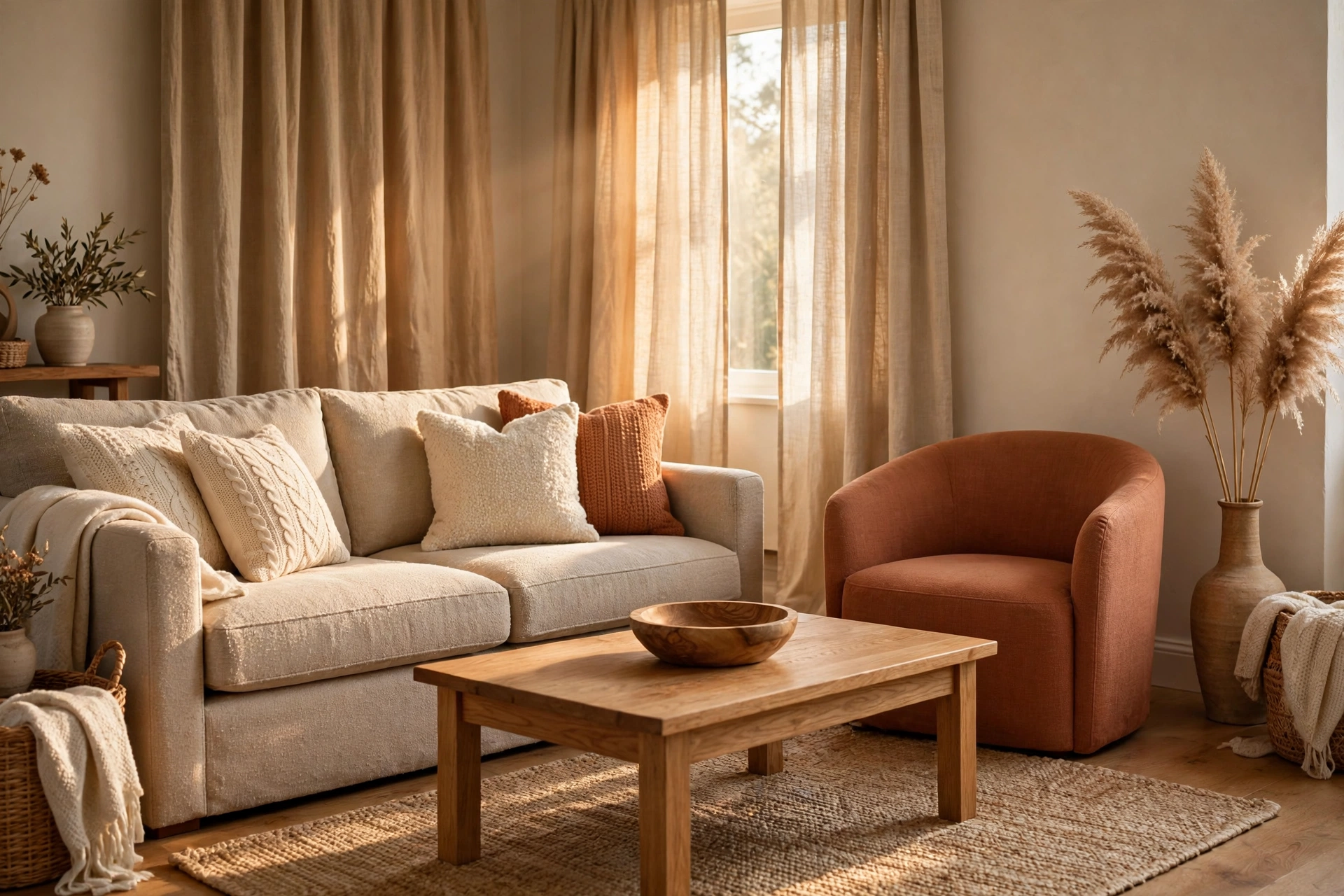
The sofa is the biggest piece of furniture in the room, so it is also the biggest color decision you will make. A biscuit or oat sofa, that warm creamy beige that looks like fresh bread, changes the whole room the day it arrives. Grey sofas photograph well and feel cold in real life. A warm biscuit sofa does the opposite, it looks a little plain in a photo and feels wonderful to sit on. If you are buying new, look for fabrics with a warm undertone and a little texture, like a linen blend or a nubby boucle, because flat smooth beige can read as boring. If you are keeping your current sofa, a washable oat slipcover costs a fraction of a new sofa and does the same job. FYI, washable slipcovers are the single best purchase I have made for a living room with kids, because you can throw the whole thing in the wash after spaghetti night and the room is new again by morning.
2. Lay down a rug with warmth in the weave
A rug covers more floor than any other single item, so it is the fastest way to warm up a cold room. Look for rugs with warm fibers and warm patterns, a jute rug with a thick weave, a wool rug in oat or camel, or a vintage-style rug with terracotta and rust in the pattern. The rug should be big enough that the front legs of the sofa and chairs sit on it, because a rug that floats in the middle of the floor like an island makes the room feel smaller and colder. My rule is simple, if the rug does not reach the furniture, it is too small. Layer a smaller patterned rug over a big plain jute rug if you want pattern without committing to a busy floor. The two textures together, rough jute under soft wool, feel warm under bare feet in a way one rug never does.
3. Bring in one honest wood coffee table
Wood is the fastest warmth there is, and the coffee table is where you see it most. Pick a table that shows its grain, a warm oak, a honey walnut, a reclaimed pine with knots and all. Painted or lacquered tables reflect light and feel cold, but real wood absorbs it and gives it back as warmth. A round table softens a square room and leaves no sharp corners for little kids to find. A rectangular table gives you more surface for books, trays, and the coffee cups that actually live there. Either way, keep the top mostly clear, one tray, one stack of books, one small plant, because a wood table covered in clutter hides the very grain you bought it for. Our curved furniture living room decor guide has a whole section on round tables and soft shapes, and the same logic applies here, curves and warm wood belong together.
4. Add a terracotta or camel accent chair
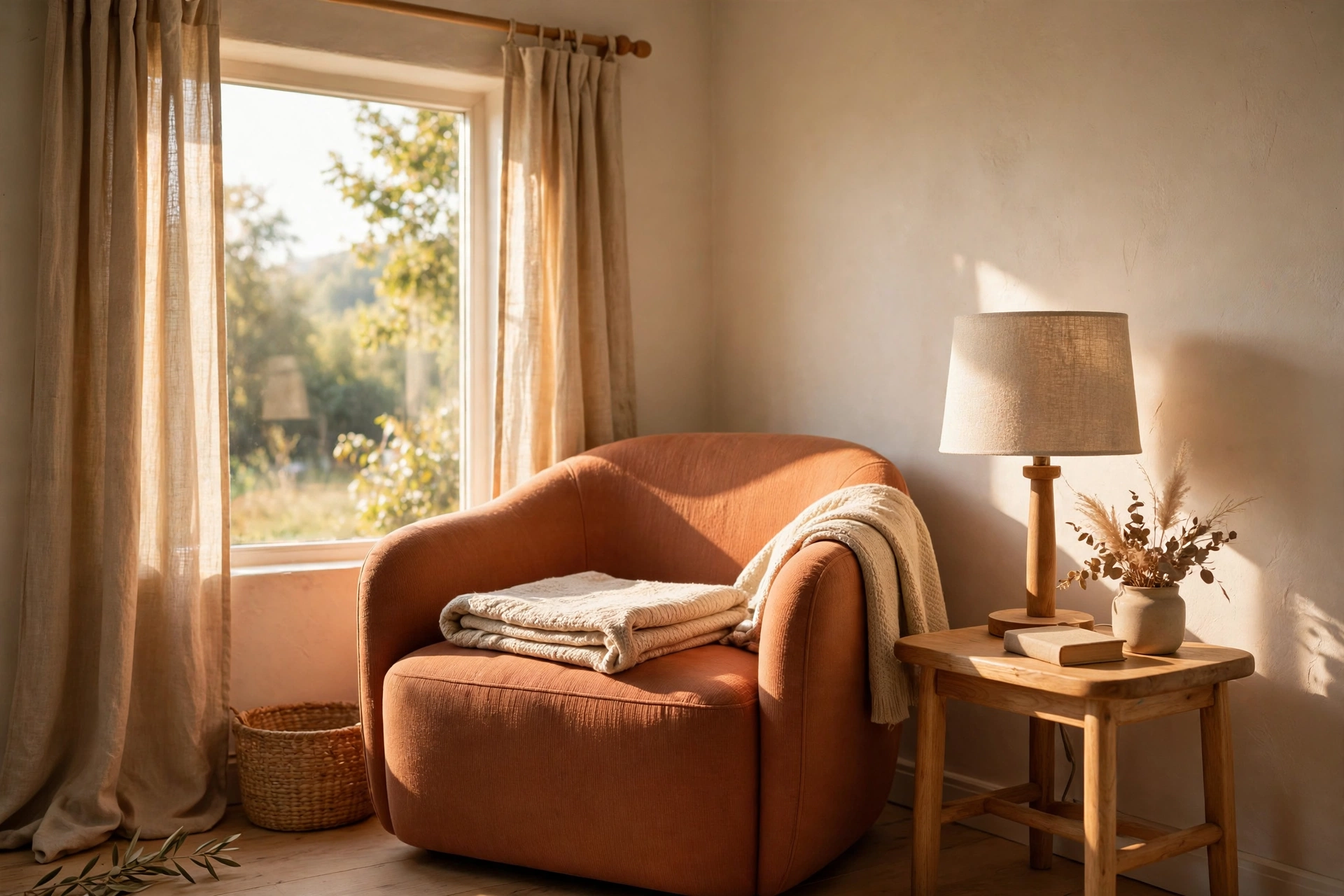
One accent chair in a warm mid-tone is the 30 percent layer doing its job. Terracotta is my first pick, that dusty clay color that looks like a pot left in the sun, because it pairs with almost every neutral and never looks trendy in a bad way. Camel is the quieter choice, and it works when the rest of the room is already warm and you want the chair to blend instead of shout. Put the chair where it catches the light, near a window or across from the sofa, and give it a small side table and a lamp so it becomes a reading corner instead of a lonely chair against a wall. A chair nobody sits in is decoration. A chair with a book and a lamp on a table beside it is an invitation.
5. Swap the cool curtains for warm linen
Curtains are the biggest piece of fabric on the wall, and cool grey or sheer white curtains can undo all the warmth you built elsewhere. Warm linen curtains in oat, natural flax, or a soft camel change the light itself, because the sun comes through them tinted warm instead of blue. Hang them high, close to the ceiling, and let them puddle just a little on the floor, because short curtains that stop at the windowsill make the room feel unfinished. Linen wrinkles, and that is fine, the wrinkles are part of the charm. If your windows are small, hang the rod wider than the window so the curtains frame the wall instead of covering the glass, and the room looks bigger and warmer at the same time.
Layer Textiles the Warm Way
Textiles are where warm neutrals live or die. A room with the right sofa and the wrong pillows still feels cold, because pillows and throws are what you actually touch. These four ideas are about layering fabric the way you layer clothes, different weights, different textures, all in the same warm family.
6. Pile on linen throw blankets in two warm tones
One throw blanket is decoration. Two throws in two warm tones is a system. Drape an oat linen throw over the back of the sofa and fold a terracotta or rust throw over the arm of the chair, and the room instantly looks lived in and warm. The trick is the tones, both warm, one light and one a little deeper, so they read as a pair instead of a random pile. Linen is my favorite throw fabric because it looks good wrinkled and gets softer every time you wash it. Fold the throws instead of stuffing them in a basket, because a folded throw on the arm of a sofa is an invitation to sit down and a stuffed basket is a chore. And keep one throw where you actually sit, not just where it photographs well, because a blanket nobody uses is just laundry waiting to happen.
7. Mix boucle, knit, and linen pillows on the same sofa
A sofa full of pillows in the same fabric looks like a furniture showroom. A sofa with three different textures looks like a home. Put a nubby boucle pillow next to a chunky knit pillow next to a smooth linen pillow, all in warm neutrals, and the sofa suddenly has depth you can feel with your eyes closed. My formula is simple, two large pillows in the corners, two medium pillows in front of them, and one small lumbar pillow in a deeper tone right in the middle. The lumbar pillow is where the terracotta or camel lives, the small dark note that ties the whole sofa to the rest of the room. Skip the pillow that says a clever phrase on it, because words on pillows are the fastest way to make a calm room feel noisy. Let the texture do the talking.
8. Add a knit pouf or floor cushion for soft seating
A pouf is the most useful piece of furniture nobody plans for. It is a footrest when you are reading, an extra seat when friends come over, and a coffee table when you put a tray on top of it. A chunky knit pouf in cream or camel adds warmth and texture at floor level, which is exactly where most rooms are coldest, because the floor is where the hard surfaces live. Pick one with a removable cover you can wash, and keep it near the sofa instead of shoved in a corner, because a pouf in the corner is a decoration and a pouf by the sofa is a seat. If you have kids, a pouf is also the safest extra seat in the house, no corners, no hard edges, and it survives being dragged across the room a hundred times a day.
9. Layer curtains over a woven shade for depth
One window treatment is flat. Two window treatments is a room with depth. Hang warm linen curtains over a natural woven shade, bamboo or rattan, and the window gets two layers of warmth, the shade filters the light and the curtains frame it. During the day the shade stays down and the curtains stay open, and the light comes in golden instead of white. At night the curtains close and the room feels wrapped up. This combination also solves the privacy problem without heavy blackout curtains, which can make a warm room feel dark and closed in. The woven shade does the privacy work, the linen does the beauty work, and neither one has to do a job it is bad at.
Warm Up the Walls
Walls are the biggest surface in the room, and blank white walls are the reason so many neutral rooms feel cold. You do not need to paint every wall terracotta. You need one warm thing on the wall that your eye lands on, and a few small warm things that keep it company. These four ideas cover art, frames, and texture.
10. Hang one oversized piece of warm art
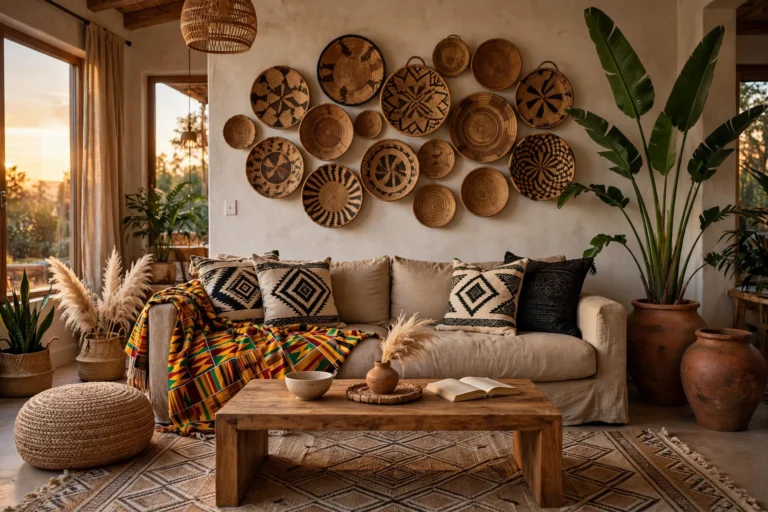
One big piece of art does more for a room than ten small ones. Look for art with warm tones in it, ochre, rust, honey, warm brown, even if the subject is simple, a landscape, an abstract wash of color, a sun-bleached photograph. The size matters as much as the color, because a small frame on a big wall makes the wall feel bigger and emptier. My rule is the art should be about two thirds as wide as the sofa below it, and it should hang so the center sits at eye level when you are standing. If you cannot afford original art, a large framed print works just as well, and a simple wood frame in a warm tone beats a fancy metal frame every time in a warm neutral room. Our Afrohemian living room decor guide has a great section on bold warm art, and the same idea works here at a quieter volume, one strong warm piece instead of a loud wall.
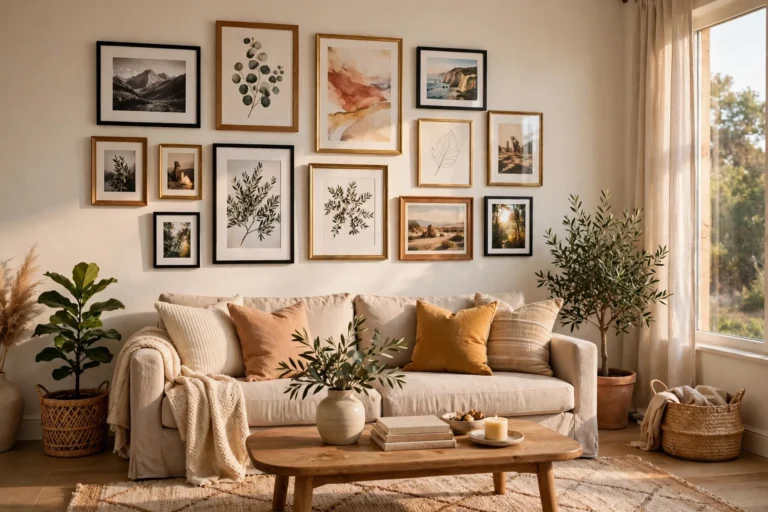
11. Build a gallery wall in warm wood frames
If one big piece feels too simple for you, a gallery wall in matching warm wood frames is the answer. The matching frames are the secret, because they make a dozen different pictures feel like one collection instead of a dozen random frames. Mix family photos with prints and a small woven piece or two, and keep the spacing tight, about two inches between frames, so the wall reads as one composition. Warm wood frames in oak or walnut beat black frames in a warm neutral room, because black frames are a cold note and this wall already has enough going on. Start on the floor, lay the frames out, take a photo, move things around, and only pick up the hammer when the floor version looks right. A gallery wall planned on the floor takes an hour. A gallery wall planned on the wall takes a weekend and a lot of spackle.
12. Add a wood slat accent wall behind the sofa
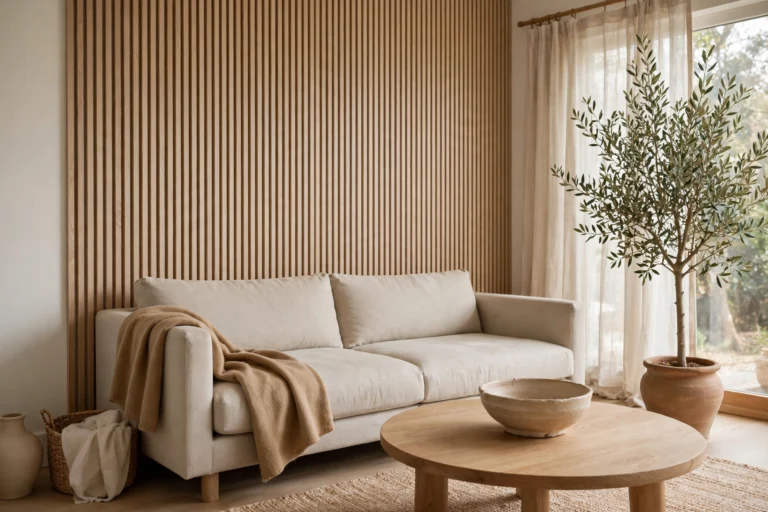
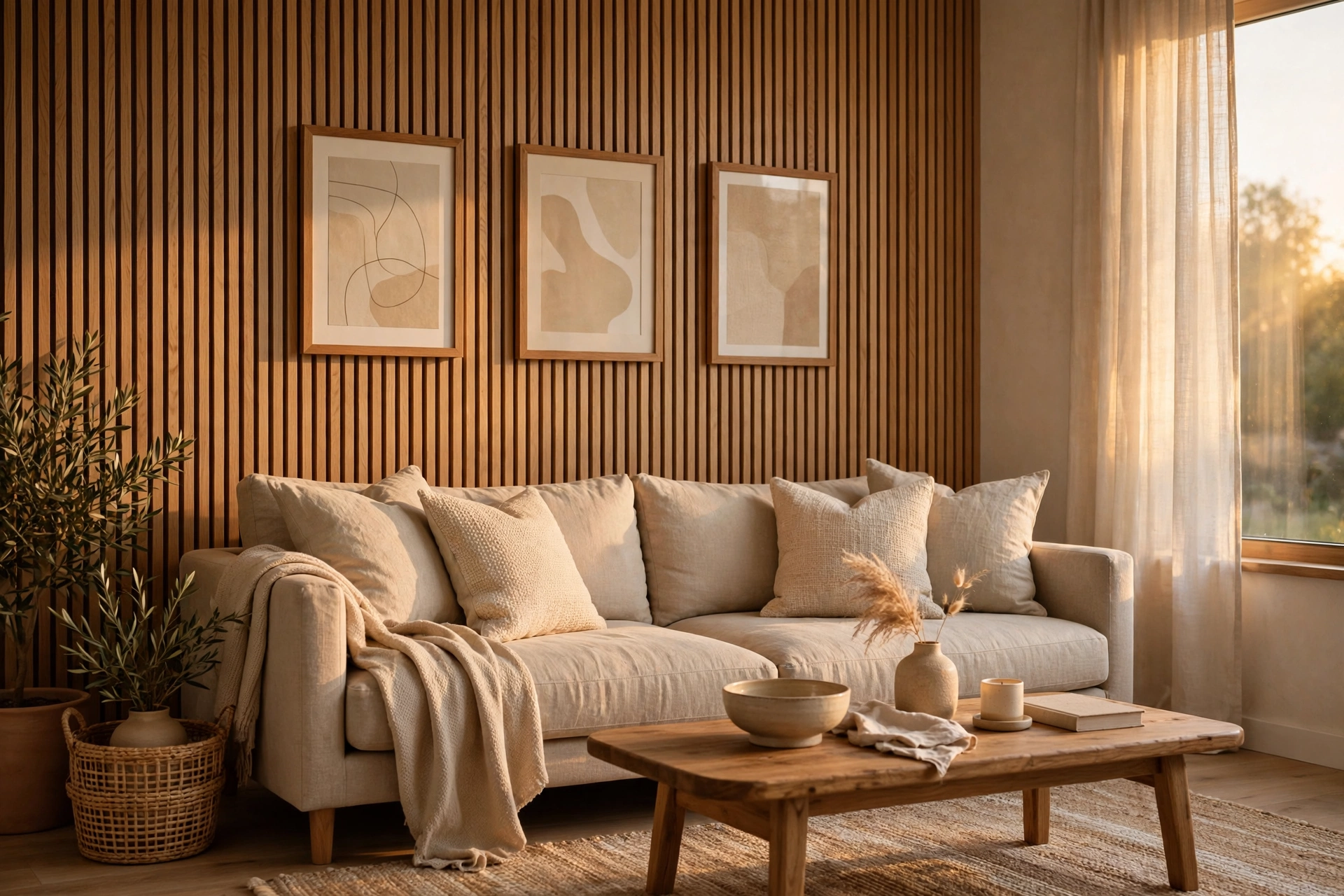
A wood slat wall is the warmest thing you can do to a flat wall, and it is easier than it looks. Thin vertical wood slats, spaced a finger-width apart, glued or nailed to one wall behind the sofa, turn a plain wall into a warm textured backdrop for everything in front of it. The slats catch light and shadow all day, so the wall changes as the sun moves, which is the opposite of flat paint. Use a warm wood, oak or cedar, and keep the slats vertical, because vertical lines make the ceiling feel taller. This is a weekend project and a beginner can do it with a saw, a level, and some construction adhesive. If a whole wall feels like too much, do a half wall behind the sofa, just wide enough to frame it, and the effect is almost as strong for half the work. Our Japandi living room decor guide leans on slatted wood too, and it works in a warm neutral room for the same reason, wood grain is warmth you can see from across the room.
13. Try a plaster or limewash finish on one wall
If paint feels too flat and wallpaper feels too busy, a plaster or limewash finish is the middle path. Limewash paint goes on like regular paint but dries with soft cloudy movement in it, so the wall looks like it has depth instead of sitting flat. In a warm white or pale clay tone, a limewash wall glows in a way flat paint never does, especially in the evening when the lamps come on. It is forgiving to apply, the unevenness is the point, so you do not need a perfect technique. One wall is enough, the wall behind the sofa or the fireplace wall, and the rest of the room stays in regular paint. The cost is about the same as good paint, and the difference in how the room feels is out of proportion to the effort, which is my favorite kind of project.
Warm Neutral Living Room Decor Lighting: Make It Glow, Not Glare
Light is the ingredient most people forget, and it matters more than the furniture. Cool white bulbs make warm neutrals look grey and tired. Warm light makes the same room look golden and expensive. These four ideas are about getting the light right, and none of them require an electrician.
14. Switch every bulb to warm white, 2700K or lower
This is the cheapest idea in the whole guide and the one with the biggest payoff. A 2700K warm white bulb makes biscuit walls look creamy and wood look rich. A 4000K cool white bulb makes the same walls look grey and the same wood look washed out. Go through the room and check every bulb, ceiling lights, lamps, the bulb in the hallway that spills into the living room, and replace anything above 2700K. The difference is visible the second you flip the switch, and the whole project costs less than a single throw pillow. FYI, if a lamp still feels harsh after the swap, the problem is the shade, not the bulb. A linen or fabric shade softens light. A bare bulb or a glass shade throws it straight into your eyes.
15. Hang a paper lantern or rattan pendant
Overhead light from a bare ceiling fixture is the enemy of a warm room, because it throws hard light straight down and leaves the corners dark. A paper lantern or a rattan pendant fixes it by spreading the light sideways and softening it at the same time. Paper lanterns are almost free, they come flat in an envelope and take five minutes to hang, and the glow they give off is the closest thing to candlelight you can get from a ceiling. A rattan pendant does the same job with more texture, and the woven pattern throws pretty shadows on the ceiling at night. Hang it low enough to feel intentional, about seven feet off the floor, and put it on a dimmer if you can, because a warm light you can dim is the single best mood tool in a living room.
16. Put linen-shaded lamps on both sides of the sofa
Two matching table lamps, one on each side of the sofa, is the oldest decorating trick there is, and it works because it balances the light. Linen shades are the key, because they warm the bulb and spread the light softly instead of throwing a hard cone on the wall. Pick lamps with a warm base, ceramic in a warm tone, wood, or brass with a patina, and skip chrome or nickel, which are cold notes in a warm room. The lamps do not have to match exactly, but they should be the same height and the same shade shape, or the sofa will look lopsided. Turn them on every evening, even if the ceiling light is on too, because lamps at eye level are what make a room feel like evening instead of an office.
17. Use real candles in clusters, not one lonely candle
One candle on a coffee table looks like you forgot to finish decorating. Three candles of different heights on a tray looks like a ritual. Cluster pillar candles, taper candles in brass holders, and one big jar candle on a wood tray, and light them in the evening when the lamps go on. The flicker is the point, it moves, it warms the wall behind it, and it makes the whole room feel alive in a way electric light cannot. Keep the tray on the coffee table or the mantel where it is easy to reach, and use flameless candles if you have small kids or a cat that climbs. The glow matters more than the flame, and a good flameless candle in a real wax pillar fools almost everyone from across the room.
Bring in Nature and Texture
Warm neutrals need nature to feel real instead of staged. A room with no plant and no natural fiber feels like a showroom, no matter how good the colors are. These four ideas bring the outdoors in, and they are the cheapest warmth in the guide.
18. Style dried pampas or wheat in a tall vase
A tall vase of dried pampas grass or wheat stems is the fastest way to add height and softness to a corner that feels empty. The stems are cheap, they last for years, and they move a little when someone walks past, which makes the room feel alive. Put the vase on the floor in an empty corner, or on a console table behind the sofa, and let the stems arc naturally instead of forcing them straight. One warning, pampas sheds, so keep it away from the sofa and give it a light shake outside once a month. If pampas feels too trendy for you, wheat stems or dried eucalyptus do the same job in a quieter way, and a bundle of wheat in a terracotta vase is one of the oldest warm neutral looks there is.
19. Put a wood bowl on the coffee table and actually use it
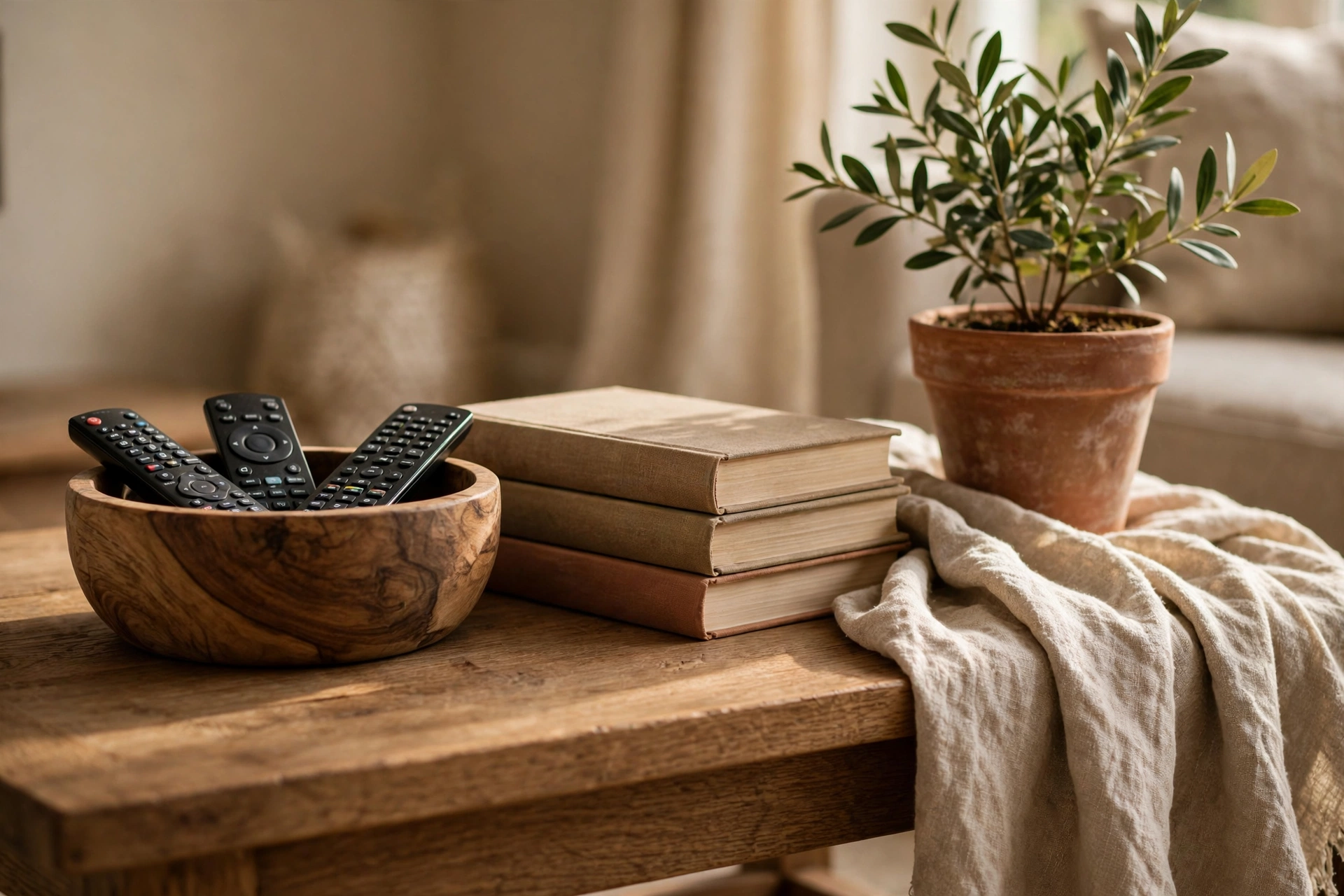
A wood bowl is the hardest-working small object in a warm living room. It holds the remote controls, the reading glasses, the little things that otherwise scatter across the coffee table, and it does it while looking like a piece of sculpture. Pick a bowl with visible grain, olive wood or acacia, big enough to hold the remotes without looking crowded, and keep it in the center of the tray on the coffee table. The rule is the bowl has to earn its place by holding something real. An empty bowl on a table is decoration. A bowl full of the things your family actually reaches for is a home. And when guests come over, the bowl is the thing they pick up and turn over in their hands, because real wood feels good and people notice.
20. Weave in baskets for blankets, toys, and clutter
Every living room has clutter, and baskets are how you hide it in plain sight. A big seagrass basket by the sofa holds the throw blankets. A lidded basket under the console holds the toys. A small woven basket on the shelf holds the charging cables. The texture of the weave adds warmth at floor level and shelf level, which is where most rooms are coldest, and the clutter disappears without the room looking staged. Buy baskets with lids for the things you want to forget about, and open baskets for the things you reach for every day. One basket is storage. Three baskets in different sizes, spread around the room, is a decorating system, and it is the cheapest system in this guide.
21. Add one real plant in a terracotta pot
A real plant is the one thing in this guide that is actually alive, and the room knows it. A fiddle leaf fig in the corner, a snake plant by the sofa, a trailing pothos on a shelf, any of them adds a green note that makes the warm neutrals around it look richer. Terracotta is the right pot, because the clay color is already in the room’s palette and the porous clay breathes in a way plastic pots do not. Pick a plant you can keep alive, because a dead plant in a pretty pot is worse than no plant at all. Snake plants and pothos survive almost anything, including a week without water and a room with one window. Water it on the same day every week, Sunday morning with the coffee, and it becomes a habit instead of a chore.
The Finishing Layer
The last five ideas are the small things, the layer you add after the big pieces are in place. None of them cost much, none of them take long, and all of them are the difference between a room that is warm and a room that feels finished.
22. Stack books by color, not by size
Books are free decoration if you already own them, and the way you stack them changes the whole shelf. Sort a small stack by warm color, creams and tans and rusts together, and put the stack on the coffee table or the shelf with the spines facing out. A stack of books in cool blues and greys cools the room down, so move those to the bedroom and keep the warm ones where you can see them. Put a small object on top of the stack, a candle, a little plant, a smooth stone from a trip, and the stack becomes a vignette instead of a pile. IMO, three books is the right number, two looks like an accident and five looks like a library sale.
23. Style one tray and let it do the work
A tray is a frame for the small things, and one well-styled tray on the coffee table makes the whole table look intentional. The formula is simple, something tall, something short, and something alive. A tall candle, a short stack of books, and a small plant, all on a wood or woven tray, and the coffee table is done. The tray also has a practical job, it corrals the things that would otherwise spread across the whole table, and you can lift the entire tray off when you need the surface for dinner or a board game. Pick a tray in a warm material, wood, rattan, or leather, and skip the mirrored tray, because mirrors are a cold note and this table already has enough going on.
24. Frame family photos in warm wood and hang them low
Family photos in cold black frames on a white wall can make a warm room feel like a hallway. The same photos in warm wood frames, hung at eye level where you actually look at them, make the room feel like your family lives there. Print the photos in warm tones, not the cool blue cast that phone cameras add, and mix sizes, one big one and two small ones, in a loose cluster near the reading chair or above the console. Hang them low, the center of the cluster at about five feet off the floor, because photos hung too high feel like they belong to the ceiling. And print them, do not just leave them on a phone, because a printed photo on the wall is a memory and a photo on a phone is a file.
25. Finish with scent, the warmth you cannot see
Scent is the last layer because it is invisible, and it is the layer guests notice first without knowing why. A warm scent, cedar, amber, vanilla, sandalwood, makes a warm neutral room feel complete in a way no pillow can. Use a candle, a reed diffuser on the console, or a linen spray on the sofa cushions, and keep it subtle, because a room that smells like a candle shop is worse than a room that smells like nothing. One scent, one source, in the spot where people sit down. The diffuser on the side table by the front door is my favorite, because the first thing a guest smells when they walk in is the room itself, warm and welcoming, before they see a single thing in it.
The Everyday Test: Will Warm Neutrals Survive Real Life?
A living room has to survive kids, dogs, coffee, and sunlight, and warm neutrals have a reputation for showing every mark. The reputation is only half true. Light warm fabrics do show stains, but they also hide dust, pet hair, and crumbs far better than dark colors do, and that trade is worth it in a room you actually live in. The trick is choosing the right materials for the spots that get used hardest. Washable slipcovers on the sofa, performance fabric on the accent chair, a rug you can spot clean with a damp cloth, and a coffee table with a finish that forgives a wet glass. Keep a small bottle of upholstery cleaner under the sink and deal with a spill the day it happens, because a stain that sits for a week is a stain forever, and a stain you catch in five minutes is a story you tell once and forget.
Sunlight is the other enemy. Warm neutrals fade in direct sun, and a terracotta pillow in a south-facing window will be a pale peach pillow by next summer. Rotate the pillows every few months, keep the linen curtains drawn during the harshest afternoon hours, and put the deepest colors, the terracotta and the camel, on the side of the room that gets the least direct sun. The pale colors, the oat and the biscuit, can take the sunny spots, because they have less color to lose. And accept that some fading is part of the look. A sun-softened terracotta throw looks loved, not ruined, and a room that is too perfect to sit in is a room nobody enjoys.
Buy Once vs Refresh Each Season: A Realistic Budget
Warm neutral rooms are kind to a budget, because the expensive pieces last for years and the cheap pieces do the seasonal work. Buy once, and buy well, the sofa, the rug, the coffee table, and the lamps. These are the pieces you touch every day, and a good one costs less over five years than a cheap one you replace twice. A solid wood coffee table, a wool rug, a linen slipcover, and a pair of ceramic lamps will still be in this room in five years, and they will look better then than they do now, because wood and wool and linen age gracefully.
Refresh each season, and refresh cheap, the pillows, the throws, the candles, and the small decor. A new lumbar pillow in a deeper tone for winter, a lighter linen throw for summer, a fresh candle when the old one burns down, a new plant when the old one gives up. Budget about $25 a month for the refresh layer and the room will never feel stale, and you will never face a $2,000 redo. The 60-30-10 Warm Rule helps here too, because the refresh layer is the 10 percent, the small deep accents that change the mood of the room without changing the room. Swap the accent, keep the base, and the room feels new for the price of a pillow.
Small Living Room Variations
A small living room does not need fewer warm neutrals, it needs smarter ones. The same palette works in a small room, but the pieces have to earn their floor space. Pick a sofa with legs instead of a skirt, because you can see the floor underneath and the room feels bigger. Pick a round coffee table instead of a rectangular one, because you gain walking space at the corners and lose nothing in surface. Hang the curtains high and wide, past the window frame, so the window looks bigger than it is. And use the lightest warm tones on the biggest surfaces, the walls and the rug, and save the deepest terracotta and camel for the small pieces, the pillows and the throw, so the room feels warm without feeling crowded. Our winter living room decor guide has a whole section on small and cozy rooms, and the same logic applies here, light base, deep accents, and nothing on the floor that does not earn its place.
Troubleshooting: Quick Fixes for Common Problems
The room still feels grey. Check the bulbs first, then the curtains. A cool bulb or a grey curtain can undo everything else, and both are a ten minute fix.
The terracotta looks orange, not warm. You bought a terracotta with too much red in it. Swap it for a dustier, browner terracotta, the color of a clay pot, not a traffic cone, and the room calms down instantly.
The pillows keep sliding off the sofa. The sofa fabric is too smooth. Add a knit or boucle pillow, which grips, and tuck a lumbar pillow in front of the others to hold them in place.
The rug looks dirty after a month. You bought a rug that is too light for your floor traffic. Layer a smaller washable rug over it in the high traffic spot, or move the light rug to the reading corner and put a darker jute rug where feet actually land.
The gallery wall looks messy. The frames do not match. Take everything down, put them all in the same warm wood frame, and hang them again with tight even spacing. Matching frames fix almost every gallery wall.
The room feels warm but dark. You need more light, not more color. Add a lamp, switch the bulbs to warm white, and hang a mirror across from the window to bounce the daylight deeper into the room.
The Sunset Test: My Finishing Framework
Here is the final check I do before I call a room done, and it takes about ten seconds. Stand in the doorway at sunset, when the lamps are on and the daylight is fading, and look at the room. If it glows, if the wood looks richer and the textiles look softer and the whole room looks like a place you want to sit down in, it is done. If it looks flat, or grey, or like the color drained out of it when the sun went down, something is missing, and it is almost always one of three things, a deep accent, a lamp, or a warm bulb. Add one of those three, stand in the doorway again, and check. I call it the Sunset Test, because sunset is when a room tells the truth about its warmth. A room that passes the Sunset Test in November will pass it in July too, because warmth is not about the season, it is about the light, the texture, and the tones, and those do not change with the weather. When your room passes, stop decorating. A finished room is a gift to yourself, and the best thing you can do with it is sit in it.
Frequently Asked Questions
What colors count as warm neutrals for a living room?
Warm neutrals are the creamy, earthy side of the neutral family, biscuit, oat, cream, camel, warm taupe, terracotta, honey wood, and soft clay. They all have a yellow, red, or orange undertone, which is what makes them feel warm. Cool neutrals like grey, blue grey, and stark white have a blue undertone, and they fight a warm room even in small amounts.
Can I mix warm neutrals with the grey sofa I already own?
You can, but the grey sofa will always be the coldest thing in the room, so you have to work around it. Cover it with a warm slipcover if you can, or layer it with warm throws and pillows until the grey is mostly hidden. Warm wood, terracotta pillows, and warm lighting help a lot, but a grey sofa in a warm room is like a cold spot, and the slipcover is the honest fix.
How do I keep a warm neutral living room from looking boring?
Boring comes from one texture, not one color. Mix boucle with linen, knit with wood, woven baskets with smooth ceramic, and the room gets interesting even though the colors stay calm. The 60-30-10 Warm Rule helps too, because the deep accent gives your eye somewhere to land. A room with three textures and one color is interesting. A room with one texture and three colors is busy.
Are warm neutral living rooms good for small spaces?
Yes, and they are often better than dark or bold colors in a small room, because light warm tones make the walls feel farther away. Keep the base light, biscuit walls and an oat rug, and put the deep colors in small doses, one terracotta pillow, one camel throw. A small room with a light warm base and a few deep accents feels cozy, not cramped.
How often should I refresh a warm neutral living room?
Refresh the small layer every season, the pillows, the throws, the candles, and the little decor pieces, and leave the big pieces alone for years. A new throw and a new candle each season costs very little and keeps the room feeling current. The sofa, the rug, and the coffee table should last five years or more, and they will look better with age if you bought real wood, wool, and linen.