
27 Japandi Living Room Decor Ideas That Make Your Home Feel Calm and Beautiful
The first time I walked into a real Japandi living room, I thought the owners had just moved in. The room had a low sofa, a wooden coffee table, one plant in the corner, and a single framed print on the wall. That was almost it. No gallery wall, no throw pillow mountain, no sideboard covered in candles and books and little ceramic birds. I had seen japandi living room decor all over Pinterest, but I had never actually sat in it, and my first honest thought was a little rude: where is the rest of the furniture?
Then I sat down. The sofa was low enough that my feet rested flat on the rug, the wood of the coffee table was warm under my hand, and the afternoon light came through sheer linen curtains and landed soft on everything. I stayed for two hours and I did not pick up my phone once. That is when I understood what Japandi actually is. It is not an empty room. It is a room where everything left in it earned its place, and everything you took out was just noise.
Japandi is Japanese minimalism married to Scandinavian warmth. From Japan it takes the low lines, the natural materials, and the idea that empty space is part of the design, not a problem to fix. From Scandinavia it takes the cozy part: warm wood, soft textiles, and light that makes you want to stay awhile. The result is a living room that feels calm the second you walk in, and calm is the most luxurious thing a room can offer.
These 27 japandi living room decor ideas come from that afternoon on my friend’s low sofa, plus three years of slowly turning my own living room into a calmer place, one swap at a time. Some cost nothing. A few are weekend projects. All of them work in a real living room with real kids, real pets, and a real budget. Before we start, here is the rule I use for every Japandi decision in this house: Low, Light, Natural. Low means furniture that sits close to the floor, so the room feels grounded and the ceiling feels taller. Light means pale warm colors and soft daylight, never harsh white and never a dark cave. Natural means real materials you can touch: wood, linen, wool, stone, paper, clay. When all three show up, the room calms down by itself. IMO, this little formula fixes more living rooms than any shopping spree ever will.
My Low, Light, Natural Rule for Japandi Living Room Decor
Here is how the rule works in practice. Stand in your doorway and look at your living room. Is the tallest thing in the room the sofa back or a bookshelf stuffed to the ceiling? Does the light feel soft, or does it bounce hard off white walls and glossy surfaces? Can you name the materials in the room, wood, linen, wool, or is everything plastic and printed to look like something it is not?
If the room feels busy, pick the one of the three that is missing and fix that first. A room that is too tall and top heavy just needs lower furniture. A room that feels cold just needs warmer light and one real wood piece. A room that feels fake just needs one honest material swapped in, a linen throw, a wool rug, a clay vase. You need one honest change, then live with it for a week and see what the room asks for next.
Start Low: Sofas and Seating That Ground the Room
Japandi starts at floor level, literally. Low furniture is the fastest way to make a room feel calm, because it opens up the wall space above it and makes the ceiling feel higher. If you only do one thing from this whole list, start here.
1. A Low-Profile Sofa in Warm White or Oatmeal
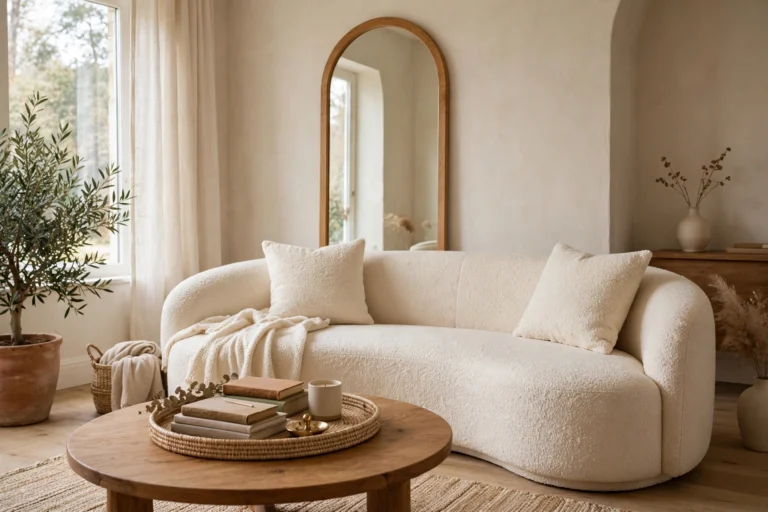
A low sofa is the anchor of a Japandi living room, so choose it like it matters, because it does. Look for a seat height around 15 to 17 inches, arms that sit low and straight, and short wooden legs, or no legs at all. Warm white, oatmeal, or a soft greige keeps the room light without going hospital white. FYI, a washable slipcover is worth every extra dollar if you have kids or a dog. My rule: if you cannot wash it, do not buy it in white.
2. A Floor Cushion Corner for Slow Mornings
One corner of the room should invite you to sit on the floor. A big floor cushion or two, a low woven tray for a mug, and a small stack of books is all it takes. This is the most Japanese idea in the whole list, and it is the one my kids use the most. They do their homework there, I drink my coffee there on slow Saturday mornings, and guests always end up there by the end of the night.
3. A Wooden Bench Instead of a Second Sofa
Two sofas facing each other is the default living room layout, and it is also the fastest way to make a room feel crowded. Try a low wooden bench on one side instead. It holds people when you need it, it holds a tray and two mugs when you do not, and it leaves the sight line open across the room. Light oak or ash works best, with a simple slab top and no carving or ornament.
4. One Sculptural Accent Chair, Not a Matching Set
A matching sofa and loveseat set is the enemy of a Japandi room, because it makes the room look like a showroom floor. One accent chair with a real shape does more work than a whole set. Look for a curved back, a woven seat, or a bent plywood shell in warm wood. Keep it in the same color family as the sofa so it belongs, but let the shape be the interesting part. Place it at an angle to the sofa, not parallel, so the seating feels like a conversation, not a waiting room.
5. A Low Coffee Table You Can Reach From the Floor
Your coffee table should be low enough to reach comfortably from a floor cushion, which usually means 12 to 14 inches high. A solid wood top with visible grain is the classic choice, and it doubles as the warmest surface in the room. Keep the top nearly clear: one tray, one book, one small vase. The empty wood is the point. If the table starts collecting mail and remote controls, give those things a real home somewhere else, or the calm leaks out of the room one object at a time.
Warm Wood and Honest Materials
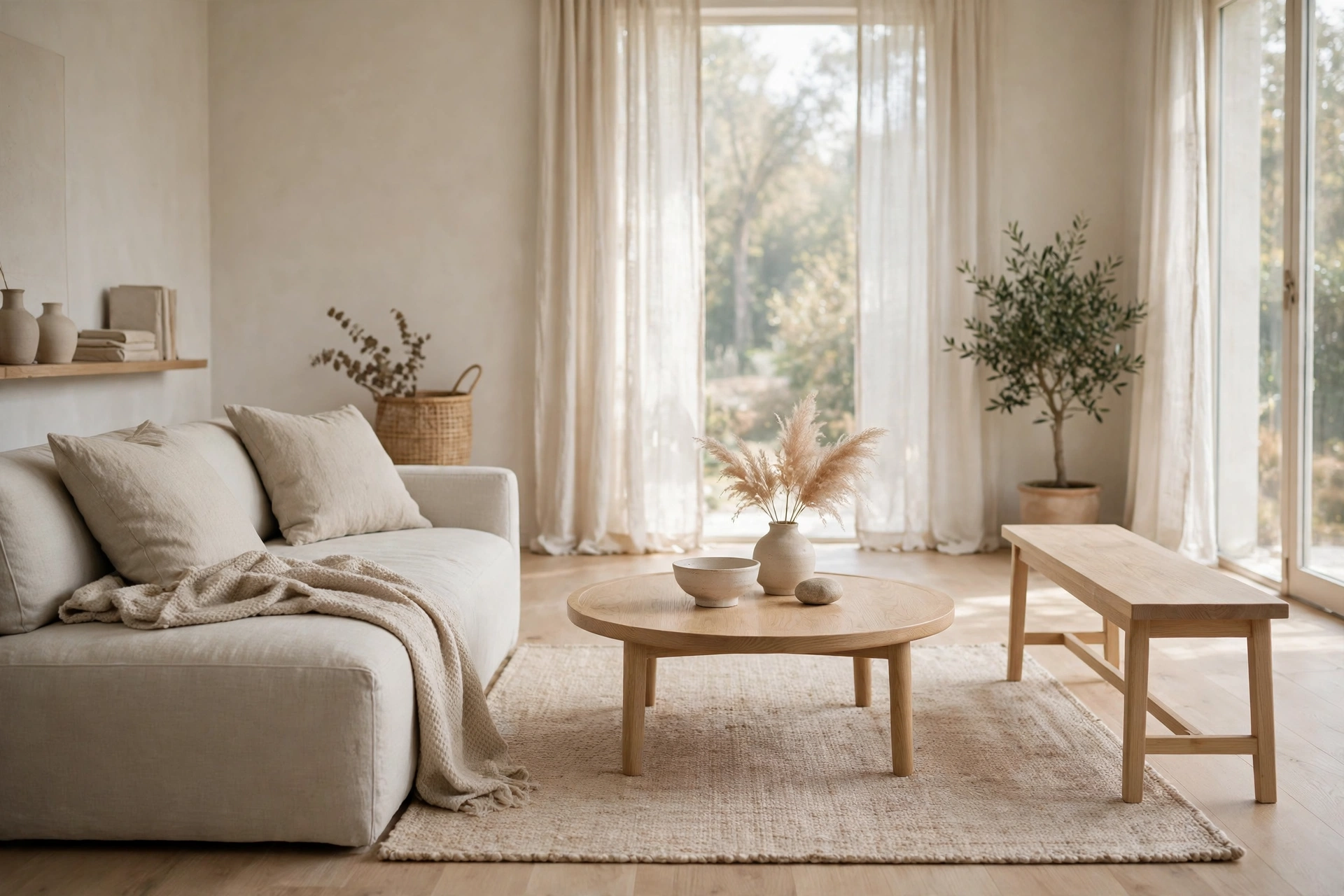
If Low is the shape of a Japandi room, wood is its heartbeat. Warm wood does what no paint color can do: it makes a pale room feel warm instead of cold. The trick is to use real wood with visible grain, in a small number of tones, and let it repeat around the room.
6. Light Oak or Ash Wood as the Base Tone
Pick one light wood tone and let it be the base for the whole room: light oak, ash, or pale beech. Use it for the coffee table, the bench, the TV stand, and the shelf brackets, and the room will feel pulled together even if nothing matches exactly. Avoid mixing a honey oak with a grey washed pine and a dark walnut all in one room, because three wood tones competing is the fastest way to make a calm room feel restless. One base tone, plus one dark accent wood at most, is the whole rule.
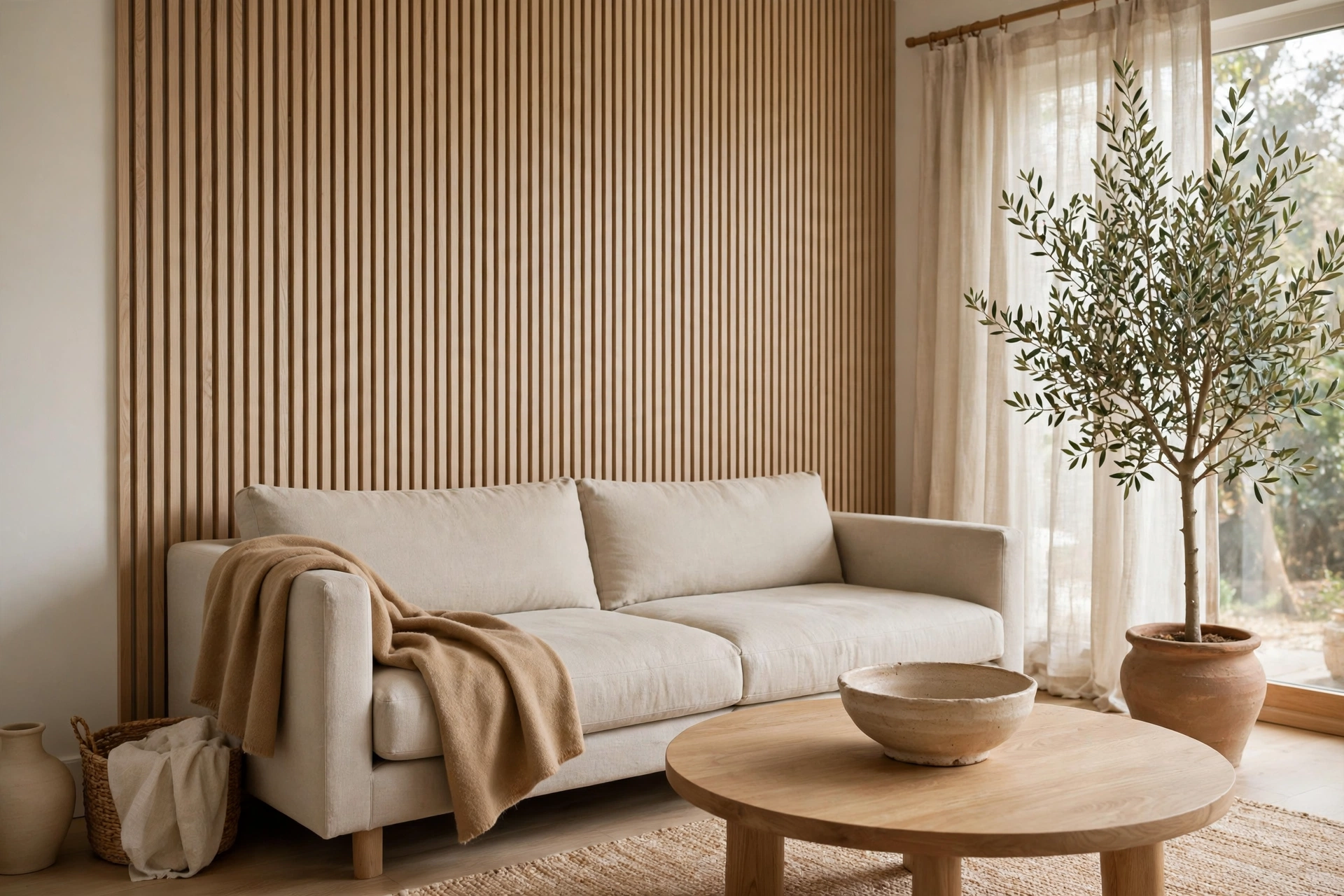
7. A Slatted Wood Panel Behind the Sofa
A slatted wood panel behind the sofa is the single most Japandi thing you can put on a wall, and it costs less than a gallery wall. Thin vertical slats of light wood, spaced a finger width apart, turn a blank wall into texture without adding any clutter. You can buy ready made panels now, or build one in a weekend with pine battens and a level. Keep it to one wall, behind the sofa, and let the rest of the walls stay quiet.
8. A Live-Edge Side Table With Visible Grain
One piece with visible, honest grain makes the whole room feel more real. A small live-edge side table, where you can see the curve of the tree in the edge, is my favorite version of this. It does not need to be expensive. A local woodworker or a reclaimed timber shop will often have offcuts for a fraction of a new table, and the imperfections are the feature, not the flaw. Put it next to the accent chair with nothing on it except a book you are actually reading.
9. Blackened Steel or Dark Bronze Accents, Used Sparingly
Japandi needs a little dark contrast, or the pale wood and white linen start to blur into one soft nothing. Blackened steel or dark bronze is the right kind of dark: matte, quiet, and a little bit industrial in a Japanese way. Use it in small doses, a lamp base, a picture frame, the legs of the coffee table, the handle on a cabinet. One or two dark accents ground the room. Ten dark accents turn it into a different style entirely. They should be the quiet bass note, not the melody.
10. Woven Baskets That Hide the Clutter
Every calm room has a secret, and the secret is baskets. A big woven basket beside the sofa hides the throw blankets. A smaller one under the bench hides the kids’ toys. A tall one in the corner hides the yoga mat. Seagrass, rattan, or jute all work, and the texture of the weave adds the natural material the room needs. Buy them in one material family so they read as a set, even if the sizes are all different.
Soft Layers: Textiles That Make It Feel Lived In
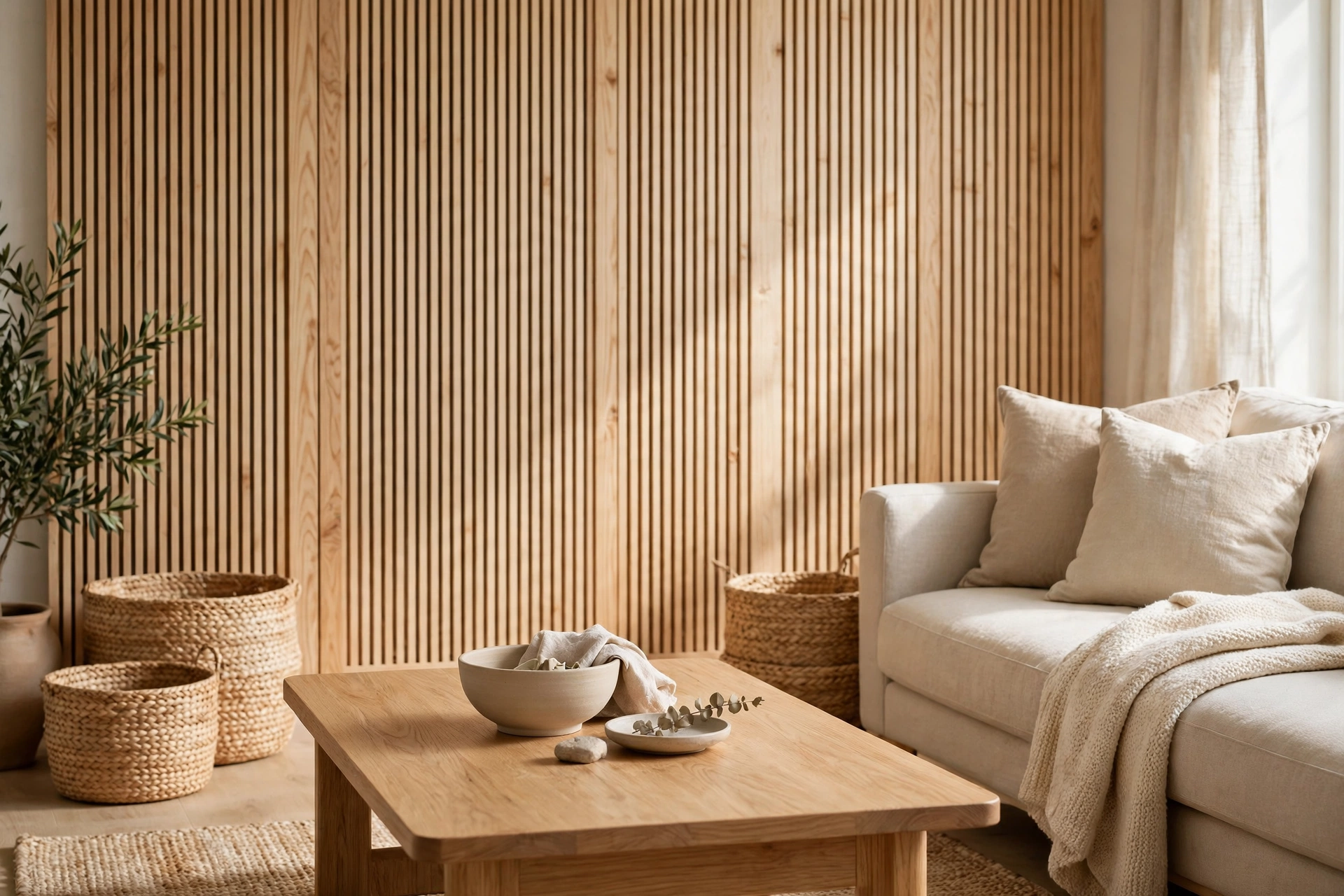
A Japandi room without textiles feels like a furniture store. Textiles are where the Scandinavian half of the style does its work: linen, wool, and cotton in warm neutrals, layered just enough that the room feels soft when you sit down. The rule is three textures in one color family, not ten colors in one texture.
11. Linen Slipcovers You Can Actually Wash
Linen is the Japandi textile, full stop. It wrinkles, it softens, it looks better after a year than it did on day one, and it tells the truth about being a natural material. Slipcovers in washed linen, in oatmeal or warm white, are the practical way to get the look on a sofa you already own. The wrinkles that stay are not a flaw, they are the texture. If linen feels too precious for your house, a linen cotton blend gives you most of the look with half the worry, and nobody will know the difference from the doorway.
12. A Wool Throw in One Warm Neutral
One good wool throw does more than three cheap ones. Pick a single warm neutral, camel, oatmeal, or a soft mushroom grey, and drape it over one arm of the sofa or the back of the accent chair, never both. The throw should look like someone just used it, not like it was styled by a store. Fold it in thirds, let one end hang a little longer than the other, and leave it alone. Wool throws also survive pets and kids far better than thin acrylic ones, and they do not pill into sad little balls after one winter.
13. A Flat-Weave Rug in Undyed Wool or Jute
The rug is the biggest textile in the room, so it sets the tone for everything else. A flat-weave rug in undyed wool, jute, or a wool jute blend is the Japandi choice, because it adds texture without adding pattern. Size it generously: the front legs of the sofa and the accent chair should both sit on the rug, or the rug will look like a postage stamp in the middle of the floor. FYI, jute sheds for the first few months and hates spills, so with a toddler or a red wine habit, undyed wool is the safer buy.
14. Cushions in Three Textures, One Color Family
Cushions are where most living rooms go wrong, because it is so easy to buy ten of them in ten different colors. Japandi cushions follow a strict little recipe: three textures, one color family. Try one linen, one wool boucle, and one cotton canvas, all in warm white, oatmeal, and soft greige. Three cushions on a three seat sofa is plenty, two on a loveseat, one on an accent chair. Fluff them once a week and rotate them, because a flat cushion in the wrong place is the first thing your eye finds in a calm room. For the full cold weather version of this layering, my winter living room decor post uses the same low, light, natural rule with heavier wool and deeper textures.
Light and Air: The Window Wall
Japandi light is soft, warm, and indirect. The goal is a room that glows in the late afternoon, not a room that blinds you at noon. Most of the work happens at the window wall, and most of it is about what you take away, not what you add.
15. Sheer Linen Curtains That Filter, Not Block
Heavy blackout curtains kill a Japandi room, because they kill the light that makes the room work. Sheer linen curtains, hung high and wide, filter the sun into a soft glow and keep your privacy without turning the room into a cave. Hang the rod close to the ceiling and let the curtains fall to the floor, a half inch of puddle at most. One layer is enough, no sheers plus blackouts plus a valance. If you need darkness to sleep, that is what the bedroom is for. The living room deserves the light.
16. One Big Mirror Opposite the Window
One big mirror opposite the window doubles the light in the room, and it does it without adding a single object to style. Choose a simple frame, light wood or thin black metal, and hang it at eye level, not tilted, not leaning unless the room is genuinely big enough for a leaning mirror. The mirror should reflect the window and the sky, not the TV and the clutter. Before you hang it, stand where you will sit and check what it reflects. If it reflects a blank wall, move it. If it reflects the plant and the light, you have found the spot.
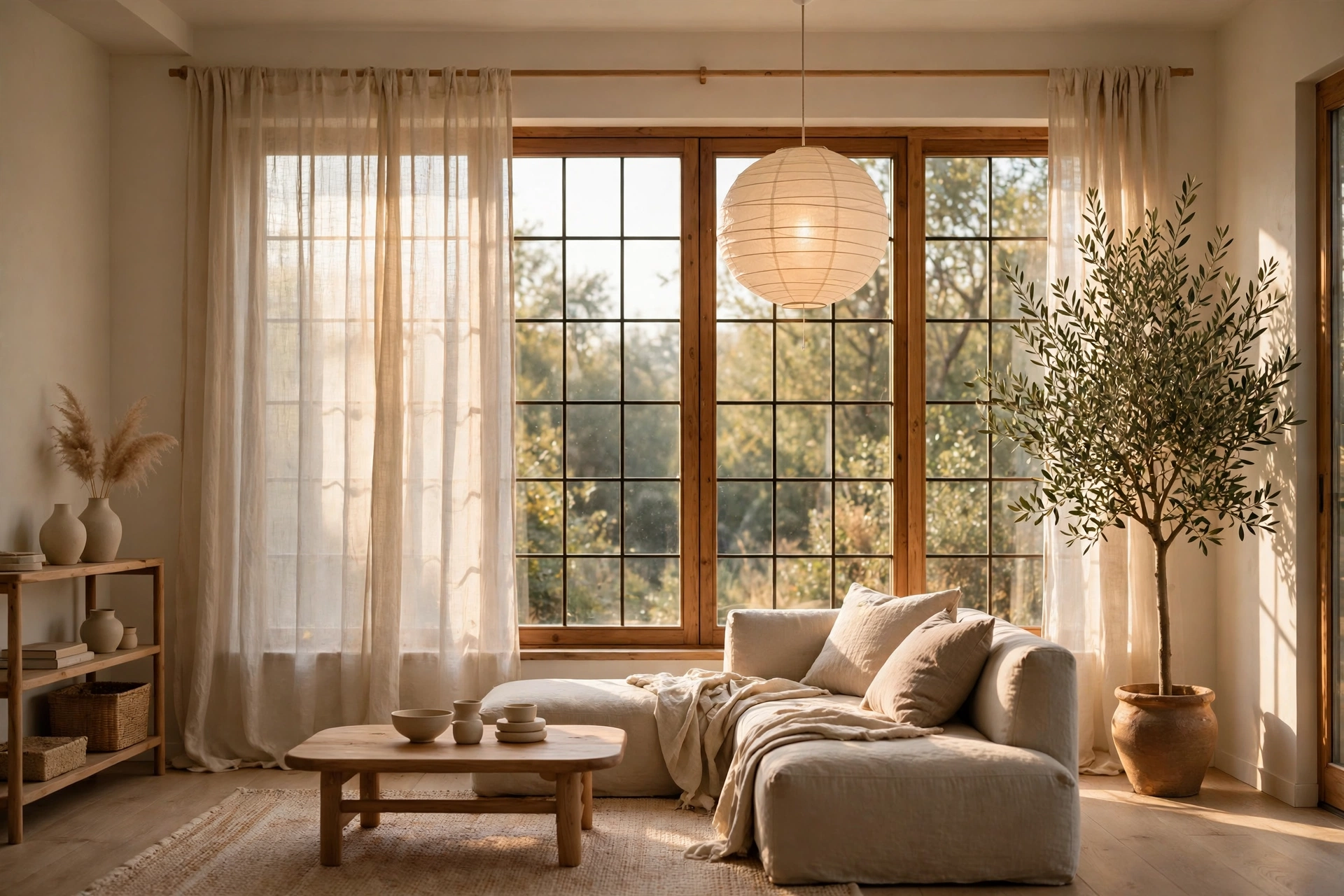
17. A Paper Lantern Pendant for Soft Evening Light
When the sun goes down, a paper lantern pendant is the Japandi answer to evening light. It glows like a small moon, it throws no harsh shadows, and it costs less than almost any other pendant. Hang it low over the coffee table, about 30 inches above the tabletop, so the light pools where people sit instead of blasting the ceiling. Put it on a dimmer if you can, because a paper lantern at full brightness is a different, louder light than a paper lantern at half.
18. Plants That Earn Their Spot: One Statement Tree
A Japandi room needs a plant the way a sentence needs a verb, but it needs exactly one big one, not twelve small ones. A fiddle leaf fig, an olive tree, or a tall snake plant in a simple clay or stone pot is the classic choice. Put it in the corner with the worst light problem, because a tall plant fills a dead corner better than any furniture. One statement tree plus one small trailing plant on a shelf is the full plant budget for the room. If every surface has a plant, you have a greenhouse, not a Japandi living room.
Shelves, Art, and the Quiet Corners
This is the section where most people overdo it, because shelves and walls feel like they are asking to be filled. In a Japandi room, the empty space on a shelf is doing as much work as the objects on it.
19. Open Shelves With Breathing Room: The 70 Percent Rule
Open shelves in a Japandi living room follow one rule: fill 70 percent, leave 30 percent empty. Three books lying flat, one vase, and an empty stretch of shelf is a styled shelf. Ten objects crammed edge to edge is a storage unit. Group things in odd numbers, leave a hand width of air between groups, and let the wall color show through. If you already have crowded shelves, take everything off, put back only the pieces you actually love, and live with the empty space for a week before you add anything back.
20. One Large Piece of Art Instead of a Gallery Wall
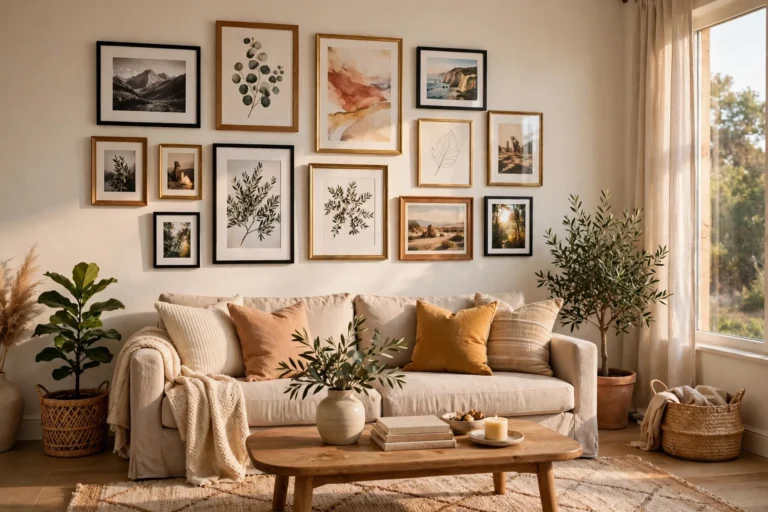
A gallery wall is the opposite of Japandi, because it asks your eye to look at twelve things at once. One large piece of art, hung at eye level on the main wall, asks your eye to look at one thing, and then rest. Choose something with a lot of empty space in it: a landscape with a big sky, an abstract in two or three warm neutrals, a simple ink drawing. The frame should be thin and quiet, light wood or black, and the art should be big enough that it does not look like a postage stamp on the wall. If you love the gallery look, save it for the hallway. If you want ideas for arranging a gallery wall in another room, my gallery wall decor post walks through the whole layout step by step.
21. A Reading Nook With a Floor Cushion and a Low Shelf
Every Japandi living room deserves one corner that belongs to one person and one book. A floor cushion, a low shelf with five or six books, and a small lamp is the whole nook. It does not need a chair, it does not need a side table, and it definitely does not need a sign that says READ. Put it in the corner with the best afternoon light, near the window if you can, and keep the book stack small on purpose. For more ideas on styling a quiet corner like this, my cozy reading nook decor post has the full setup.
22. A Single Ceramic Vase With One Branch
This is the smallest idea on the list and the most Japandi one of all. One handmade ceramic vase, one branch, on a shelf or a side table, and nothing else next to it. A cherry branch in spring, eucalyptus in summer, a bare branch with a few seed pods in winter. The branch changes with the season, the vase stays the same, and the room gets a tiny fresh moment four times a year for almost no money. Buy the vase from a local potter if you can, because the small wobbles in handmade clay are exactly what makes it feel alive.
The Finishing Touches That Make It Feel Done
These are the last five ideas, and they are all small, cheap, and fast. Do them on a Saturday morning and the room will feel finished by lunch. They are the details your eye finds when the big pieces are already right.
23. A Handmade Ceramic Bowl on the Coffee Table
A handmade ceramic bowl on the coffee table is the Japandi version of a centerpiece. Not a tray with five things on it, not a stack of coasters and a candle, just one bowl. Leave it empty most of the time, or put three smooth stones in it, or a few dried seed pods in winter. The bowl should be heavy enough that it feels good to pick up, with a glaze that has some variation in it.
24. Books Stacked Flat, Spines Turned In
If you keep books on the coffee table or the shelf, stack them flat in groups of two or three, and turn the spines inward so you see the pages, not the titles. It sounds strange, and it looks wonderful, because the soft cream of the page edges becomes part of the room’s color palette instead of a row of loud colors fighting for attention. This is a trick straight from Japanese interiors, where the book is an object first and a title second.
25. A Scent You Can Barely Notice: Cedar or Hinoki
A Japandi room should smell like almost nothing, and the almost nothing should be wood. Cedar, hinoki, or sandalwood, in a small diffuser or a few drops on a wooden bead, is enough. No plug in air freshener, no candle burning all day, no spray. The scent should be something you notice when you walk in and forget five minutes later, the same way you notice fresh air. If a guest can name the scent from the doorway, it is too strong.
26. Cords Hidden, Remotes in a Wooden Box
Nothing breaks the calm of a Japandi room faster than a tangle of black cords behind the TV stand. Spend one evening on cord management: a cable sleeve behind the TV, a power strip mounted under the stand, and a small wooden box on the coffee table for the remotes. The box is the key, because remotes left loose on the table are visual noise, and remotes in a box are just a box. Choose a box with a lid that closes easily, in a wood tone close to the coffee table, and make putting the remotes away part of the evening routine, like turning off the lights.
27. One Personal Object, Not Ten
A Japandi room is not a museum and it is not a blank box, it is a room with one personal thing in it that could only belong to you. A photo of your grandparents in a simple frame. A bowl you made in a pottery class. A stone your kid brought home from the beach. Pick one, give it the best spot in the room, and let it be the only sentimental object on display. One personal object makes the room feel like yours. Ten personal objects make it feel like a storage shelf for your life, and that is not calm, that is clutter with feelings attached.
Real Life Check: Kids, Pets, and Sunlight
Japandi looks delicate in photos, so here is the honest part: it has to survive your actual life, or it is just a photo. The good news is that most natural materials are tougher than they look. The real enemies are three: sunlight, water rings, and claws.
Sunlight fades linen and bleaches light wood over time, so if your window wall faces west, those sheer curtains are doing real work, not just looking pretty, and you should rotate the rug once a season so it fades evenly. Water rings come from mugs on bare wood, so coasters are not optional in a Japandi room, they are part of the design. Buy wooden coasters that match the table and keep them on the table, not in a drawer. Claws are the hardest one. If you have a cat that scratches, a jute rug will not survive, so choose undyed wool and keep a scratching post in the room, near the sofa, where the cat actually wants to scratch. It needs to feel calm at 7 PM when everyone is finally sitting down, and that is a much easier bar to clear.
Buy Once vs Refresh Each Season: The Budget
Japandi can be the cheapest style to live with, or the most expensive, and the difference is what you buy once and what you refresh. Buy once: the sofa, the rug, the coffee table, the pendant light, the big mirror. These are the bones of the room, and a good one lasts ten years.
Refresh each season: the branch in the vase, the throw on the sofa arm, the cushion covers, the scent in the diffuser. These are the small things that make the room feel alive, and they should cost almost nothing. A new branch is free from the garden. A cushion cover is fifteen dollars. The whole seasonal refresh should stay under fifty dollars. For a fresh start angle on the rest of the house, my new year living room decor post covers the January reset room by room.
Small Spaces and Rentals: Make It Work Anyway
Japandi was practically invented for small spaces and rentals, because it asks you to own less, not more. In a small living room, the low furniture rule matters even more: a low sofa and a low table make a twelve foot room feel like a sixteen foot room. Skip the bench and the accent chair, keep the sofa and one floor cushion, and let the empty floor do the work.
In a rental, you cannot put up a slatted wood panel or change the light fixture, and that is fine. The renter version of this list is: sheer curtains on a tension rod, a big mirror leaned against the wall, a rug that covers most of the floor, linen slipcovers on the sofa you already own, and one plant. None of it touches the walls, all of it moves with you, and the room still reads as Japandi, because the style is in the materials and the empty space, not in the renovation.
6 Troubleshooting Fixes When Your Japandi Living Room Decor Feels Off
Sometimes you do everything on the list and the room still feels wrong. It is almost always one of these six problems, and every one of them has a five minute fix.
The room feels cold and empty, not calm. You need warmth, not more stuff. Add one warm wood piece, a wooden tray on the coffee table, or swap a white cushion for a camel one.
The room feels cluttered even though it is not full. Look for visual noise: cords, remotes, chargers, mail, the TV remote collection. Hide the cords, box the remotes, and the room will feel emptier without removing a single piece of furniture.
The sofa looks like it is floating in the middle of the room. The rug is too small. The front legs of the sofa need to sit on the rug, and the rug needs to reach at least to the coffee table.
The room feels beige and boring. You need one deep note, not ten new colors. A charcoal cushion, a dark bronze lamp, or a single black frame on the wall gives the pale palette something to lean against. One dark thing, used once, is enough.
The light feels harsh at night. Your bulbs are too white. Swap to warm white, 2700K, on a dimmer, and put the paper lantern on the lowest setting that still lets you read.
The room feels like a showroom, not a home. Add the personal object from idea 27, and use the room. Sit on the floor cushions, leave a book open on the table, let the throw stay wrinkled.
The Barefoot Test: Your Final Check Before You Call It Done
Here is the second framework I promised, and it is the one I use every time I finish a room. Take your shoes off and walk through the living room barefoot, slowly, like a guest seeing it for the first time. Feel the rug under your feet and sit on the sofa. Do your feet reach the floor? Look around from sitting height, not standing height, because that is how you will actually live in the room. Is there one thing you can see that you love? Is there anything your eye keeps catching that bothers you, a cord, a cluttered shelf, a cushion that has gone flat?
If the room passes the barefoot test, it is done. If it fails, fix the one thing that bothered you and test it again tomorrow. The room is not a project to complete, it is a place to come home to, and it should feel a little more like home every time you walk in.
Frequently Asked Questions
What is Japandi style in simple terms?
Japandi is Japanese minimalism mixed with Scandinavian warmth. It means low furniture, natural materials like wood, linen, and wool, warm neutral colors, and a lot of empty space on purpose.
Is Japandi expensive to do?
It does not have to be. The cheapest way in is to declutter first, then add linen slipcovers, a wool throw, and one wood piece. The big costs are usually the sofa and the rug, and both last for years.
What colors work best in a Japandi living room?
Warm whites, oatmeal, soft greige, and light wood tones, with one deep accent like charcoal, moss green, or dark bronze. Avoid bright white and cool grey, because they make the room feel cold instead of calm.
Can Japandi work in a small living room?
Yes, it is one of the best styles for a small room. Low furniture makes the ceiling feel taller, light colors open the space up, and owning fewer pieces means the room never feels crowded.
How do I keep a Japandi living room from feeling cold or empty?
Warmth in a Japandi room comes from texture, not from stuff. Add warm wood, a wool throw, a linen cushion, and soft evening light from a paper lantern. Keep one personal object on display and use the room every day.



One Comment