27 Afrohemian Living Room Decor Ideas That Make Your Home Feel Warm, Bold, and Beautiful
The first time I walked into a truly Afrohemian living room, I stopped in the doorway and just stood there for a minute. It belonged to my friend Amara, who had just moved into a plain little rental with white walls and beige carpet, the kind of place that looks like every other apartment on the street. Three weeks later, that same room felt like a warm hug. A basket wall climbed one whole side of the room. A mudcloth throw in black and cream was draped over the back of her sofa like it had always lived there. A big terracotta pot held a plant that was taller than me. Nothing matched in the way a furniture store tells you things should match, and yet everything belonged together. That is the whole secret of afrohemian living room decor, and it is why I love it so much.
Afrohemian is African soul meets bohemian ease. Think bold mudcloth patterns next to soft linen, handwoven baskets beside carved wood, terracotta and ochre warmed up by brass and candlelight. It is collected, not decorated. It is the opposite of a showroom, and IMO it is the most forgiving style there is, because imperfection is the whole point. A basket that hangs a little crooked? That is character. A pillow that does not quite match the rug? That is the look.
This guide has 27 afrohemian living room decor ideas, organized room by room so you can start wherever your room needs the most help. You do not need a big budget or a big room. Most of these ideas cost less than a takeout dinner, and a few of them cost nothing at all except moving something you already own into a better spot. Let’s make your living room feel like somewhere you actually want to live.
The Sofa Comes First: Layer It Like You Mean It
Your sofa is the biggest piece in the room, so it sets the tone. In afrohemian living room decor, the sofa is never left bare. It gets layered, the same way you would layer a good outfit, until it looks soft, collected, and impossible to walk past without sitting down.
1. Start with mudcloth pillows in black and cream
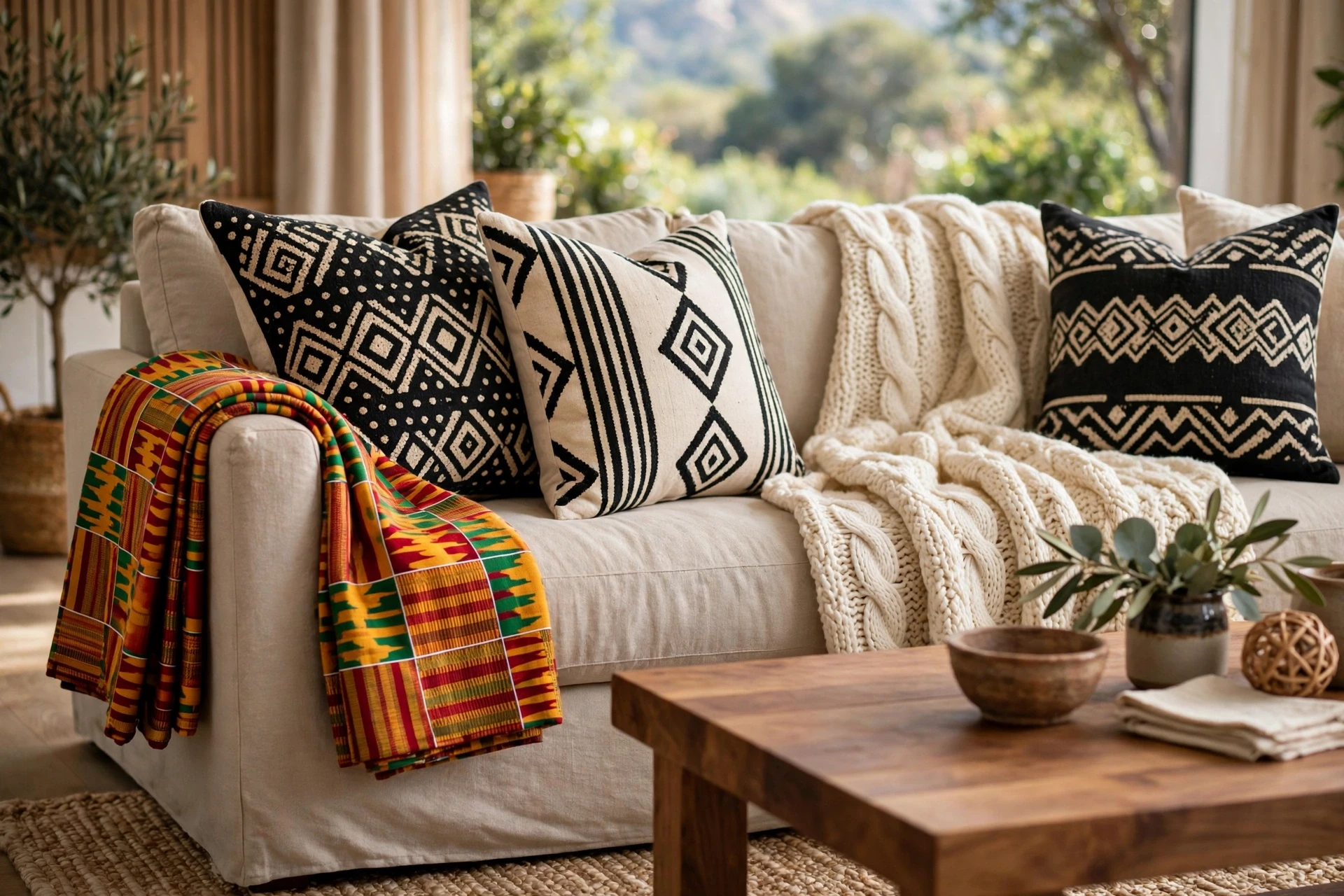
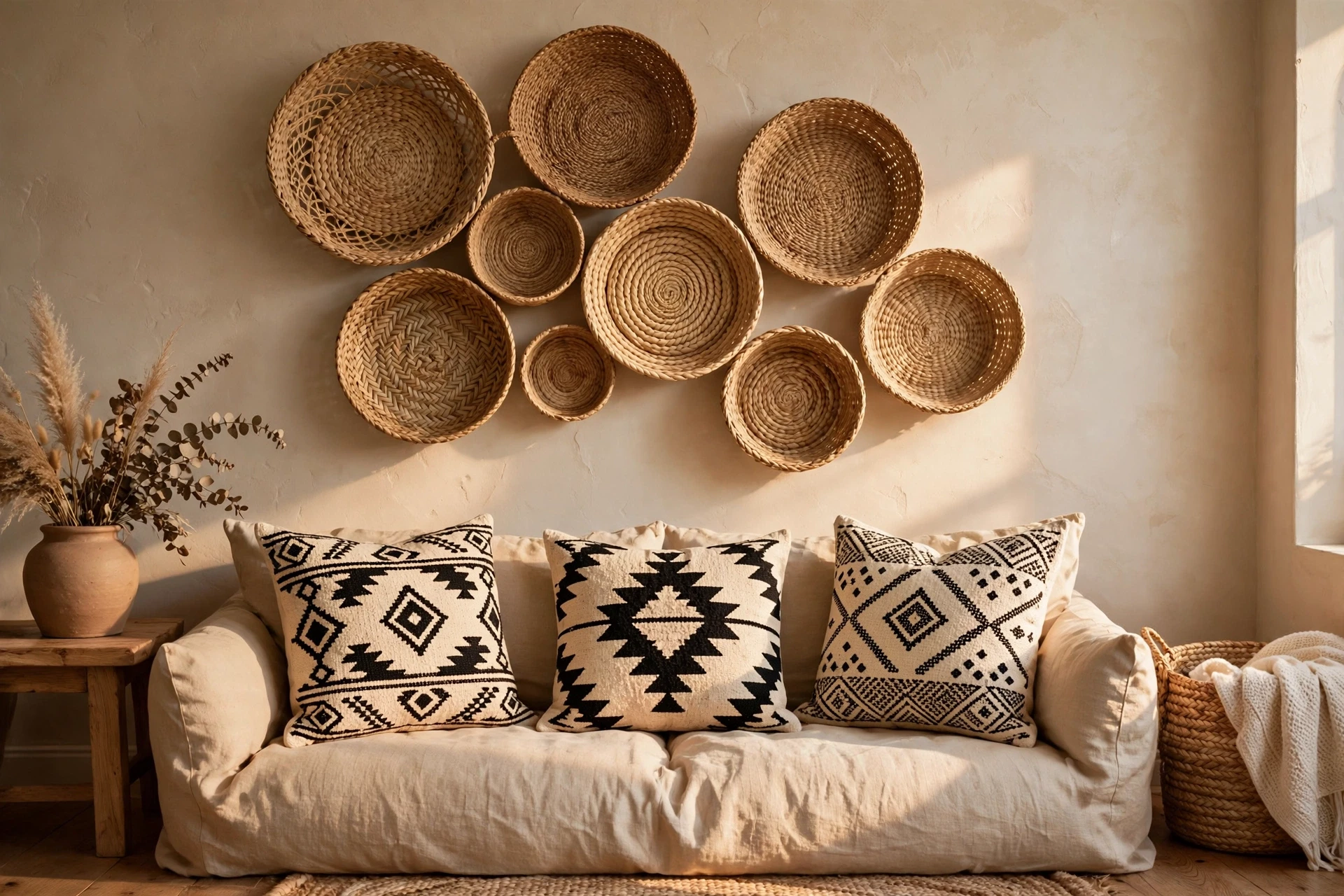
Mudcloth, or bogolan, is the single fastest way to make a plain sofa look Afrohemian. Two or three pillows in black and cream mudcloth patterns change the whole room in about thirty seconds. I put one on each end of my sofa and one in the middle, and suddenly the beige sofa I had been apologizing for looked intentional. FYI, the real hand-dyed cloth costs more, but good printed mudcloth pillow covers start around ten dollars and look just as good from across the room.
2. Drape a kente throw over one arm, not the whole back
A kente cloth throw is pure colour and pattern, so a little goes a long way. Fold it in thirds and drape it over one arm of the sofa, or across the back corner. It reads as a deliberate accent instead of a blanket pile, and the bright stripes pull the eye across the room. If the real thing is out of budget, a kente-inspired woven throw in the same red, gold, green, and black palette does the same job.
3. Add a leather pouf that doubles as a footrest and a spare seat
A round leather pouf in cognac or dark brown is the hardest working piece in an Afrohemian room. It is a footrest during movie night, a spare seat when friends drop by, and a little side table when you set a tray on top. The worn leather gets better looking every year, which is exactly the kind of buy-once piece this style is built around.
4. Layer a woven throw blanket over the sofa back for texture
Texture is what keeps bold patterns from feeling loud. A chunky woven throw in cream or warm sand, draped loosely over the sofa back, softens the mudcloth and kente and gives your hands something soft to reach for. Choose cotton or wool, not shiny polyester, because natural fibres are what make the room feel warm instead of staged.
5. Ground the sofa with a low wooden coffee table
A low coffee table in warm wood, acacia, mango wood, or even a thrifted piece you sand and oil yourself, anchors the whole seating area. Keep the top mostly clear: a stack of two books, a small tray, and one object you love. The table should feel used, not styled for a photo shoot.
Walls That Tell a Story: Baskets, Art, and Collected Pieces
Blank walls are the enemy of this style. Afrohemian walls are meant to be full of things with a story: baskets you wove or bought from a maker, art that means something to you, pieces you picked up on a trip or at a flea market.
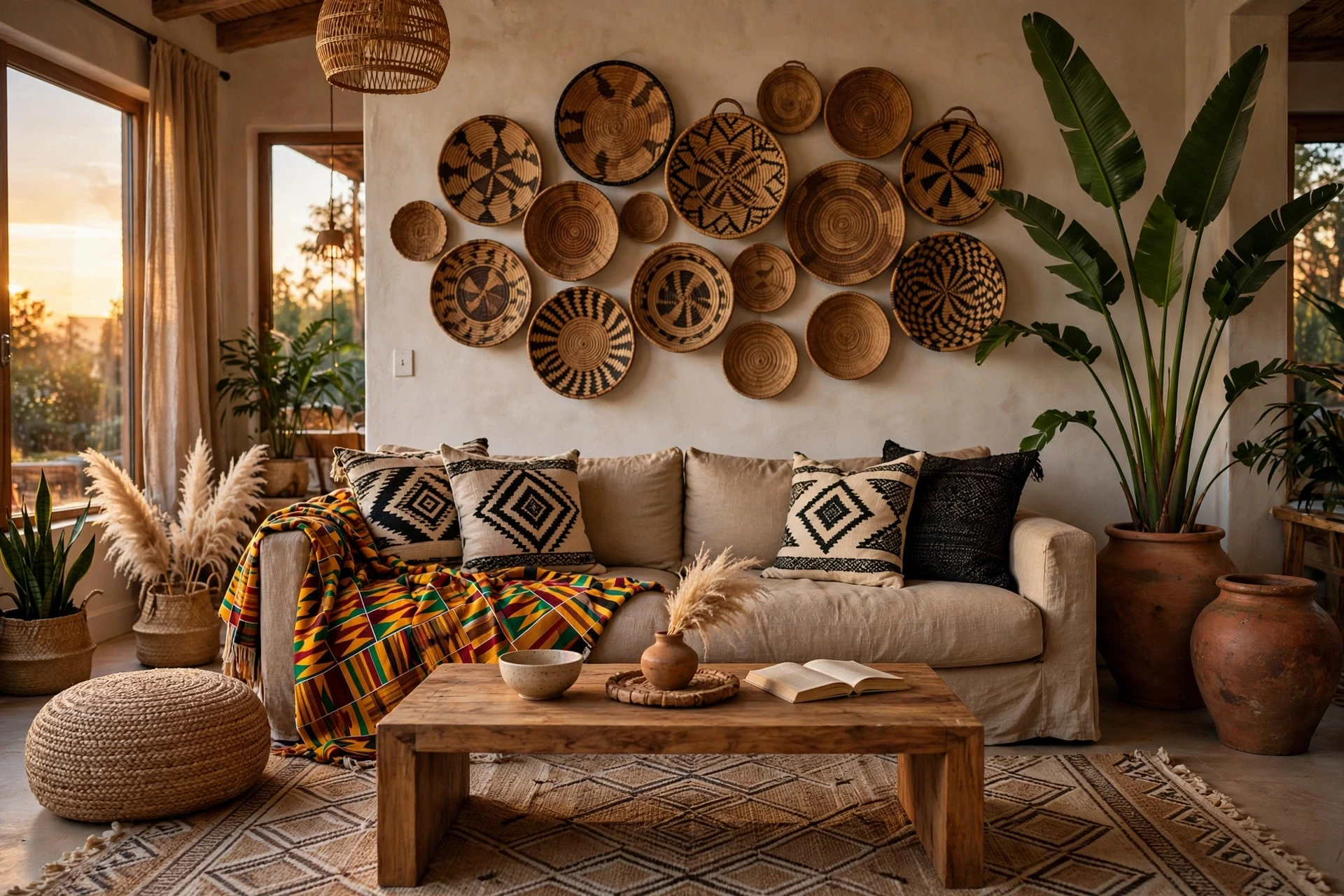
6. Build a basket wall above the sofa
This is the signature move, and it costs less than one framed print. Collect five to nine flat woven baskets in different sizes, sisal, seagrass, raffia, and arrange them in a loose cluster above the sofa. Start with the biggest basket in the middle and work outward. I hung mine with small picture nails and a level, and the whole wall took one Saturday afternoon. If you are renting, removable hooks hold the light ones just fine.
7. Hang one big mudcloth wall hanging as a statement piece
If a whole basket wall feels like too much, one large mudcloth wall hanging does the same work in a single move. Hang it on a wooden dowel or a simple curtain rod behind the sofa or on the room’s longest wall. The black and cream pattern reads almost like modern art from a distance, and up close you can see the hand of the maker in every line.
8. Lean a carved wooden mask or sculpture on the mantel or shelf
One carved piece, a mask, a figure, a wooden bowl, gives the room a focal point that no mass-produced decor can match. You do not need a whole collection. One beautiful object, placed where the light hits it, is enough. Look for fair-trade shops and local makers first, because the story behind the piece is half the decoration.
9. Mix your travel photos into a gallery wall with woven frames
A gallery wall in an Afrohemian room should look like a scrapbook, not a grid. Mix framed photos from your trips and your life with woven frames, small mirrors, and one or two textile pieces. The frames do not need to match. In fact, they should not. Keep the spacing tight, about two inches between frames, and let the wall feel full and loved.
10. Add a woven tapestry for softness on a hard wall
A woven wall tapestry in warm earth tones softens a big blank wall and soaks up echo in a room with hard floors. Hang it beside the basket wall or on the wall opposite the sofa, where you see it every time you walk in. If you love the look but not the price, a large piece of patterned fabric on a dowel gives you the same effect for a fraction of the cost.
The Colour, Craft, Comfort Rule
Here is the first of the two frameworks in this guide, and honestly it is the only rule you need. Every Afrohemian room that works follows it, whether the person who made it knows the rule or not. Colour, Craft, Comfort. Three words, in that order, every time you are deciding whether something belongs in the room.
11. Pick your colour: terracotta, ochre, and indigo lead
Start with a warm base, terracotta, warm sand, or deep cream, then add two accents: ochre or mustard for warmth, and indigo or deep teal for depth. That trio shows up in mudcloth, kente, baskets, and rugs, so the whole room ties together without you having to think about it. If you are nervous about colour, put the boldest shade in the smallest thing, a pillow or a vase, and let it earn a bigger spot over time.
12. Pick your craft: one handmade piece beats five factory pieces
Craft is what separates Afrohemian from generic boho. A handwoven basket, a hand-dyed textile, a carved bowl, a piece of pottery with a thumbprint in the glaze, these are the pieces people ask about. You do not need many. One or two handmade pieces per zone of the room is plenty, and they are worth saving up for.
13. Pick your comfort: soft layers everywhere hands and feet land
Comfort is the test that keeps the room livable. Every seat should have something soft within reach, a pillow, a throw, a cushion. Every bare foot should land on something warm, a rug, not cold floor. If a corner of the room looks beautiful but nobody ever sits there, it is failing the comfort test, and it needs a pillow or a better light.
14. Repeat the trio in exactly three places
This is the trick that makes the rule work. Whatever your colour, craft, and comfort choices are, repeat each one in three places around the room. Terracotta shows up in the rug, a vase, and a pillow. Baskets show up on the wall, under the coffee table, and holding a plant. Three repeats and the room looks intentional. One repeat looks like an accident, and five looks like a theme park.
Underfoot and Overhead: Rugs, Light, and Warmth
If you love this layered warmth in winter too, our winter living room decor guide leans into the same cozy idea with heavier textures and deeper colours.
The floor and the ceiling do more work than people think. A bare floor makes even the prettiest sofa look cold, and a single harsh ceiling light flattens every colour in the room. Fix these two things and the whole room gets warmer overnight.
15. Layer a patterned rug over a big natural-fibre base
Start with a large jute or sisal rug that covers most of the seating area, then layer a smaller patterned rug on top, slightly off centre, under the coffee table. The base rug adds warmth and texture, the top rug adds pattern and colour, and the layering itself is the Afrohemian look. This also lets you buy a smaller, cheaper patterned rug and still get the full effect.
16. Choose a jute rug that can handle real life
Jute is beautiful and affordable, but it sheds for the first few weeks and it hates standing water. Put a rug pad underneath so it does not slide, vacuum it without the beater bar, and keep it out of the splash zone by the front door. If you have a dog that sheds or a toddler with juice boxes, a flat-weave cotton rug in a dark pattern is the more forgiving cousin, and it looks just as good.
17. Hang a rattan pendant light over the coffee table
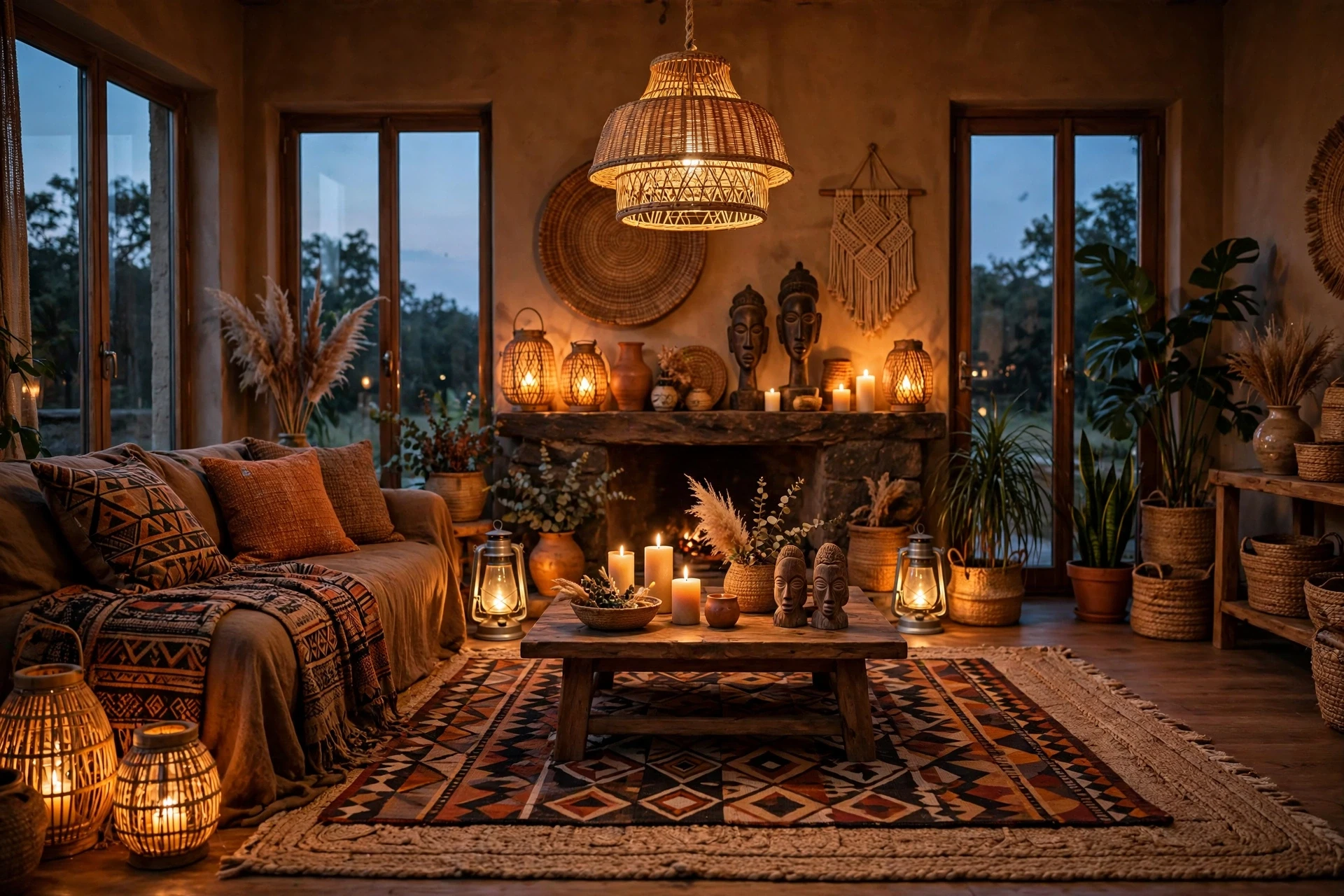
One rattan or woven pendant light changes the whole mood after dark. The woven shade throws soft patterned shadows on the ceiling, and the warm bulb inside makes terracotta and ochre glow instead of glare. Hang it low enough to feel intimate, about 30 inches above the coffee table, and put it on a dimmer if you possibly can.
18. Set out lanterns and candles for the evening glow
Lanterns are the Afrohemian answer to overhead lighting. A big metal or glass lantern on the floor by the sofa, two or three small ones on the mantel or a shelf, and a few pillar candles on the coffee table give you layers of warm light you can adjust to the mood. Use real candles where it is safe, and flameless ones with a timer where it is not, because the glow matters more than the flame.
19. Add floor cushions for the sit-on-the-floor nights
A couple of big floor cushions in mudcloth or kilim patterns, stacked in a basket or leaning against the wall when they are not in use, turn a corner into a cozy reading nook where people actually gather. Kids love them, guests love them, and they cost less than one dining chair. They are also the easiest way to add pattern without committing to anything permanent.
Corners, Plants, and the Details That Make It Yours
The last layer is the personal one. This is where the room stops being a style and starts being yours: the plant you kept alive for three years, the books you actually read, the tray that holds your coffee every morning.
20. Let one big plant be the room’s living sculpture
A fiddle leaf fig, a monstera, or a tall snake plant in a big terracotta pot is the single best investment in an Afrohemian room. The green against terracotta and ochre is the colour combination the whole style is built on, and a living plant makes the room feel alive in a way no object can. If you kill plants, start with a snake plant. It forgives almost everything.
21. Put smaller plants in woven baskets instead of pots
Woven baskets make the best planters in this style, and they hide the ugly plastic nursery pots perfectly. Drop the nursery pot inside a seagrass basket, add a plastic saucer at the bottom so water does not leak, and you have a planter that looks like it cost forty dollars for about eight. Group three small ones together on a windowsill or a shelf for the best effect.
22. Stack books you actually love on the coffee table
A stack of two or three books, the ones with beautiful covers and the ones you actually open, is the most honest decoration there is. Put the biggest book on the bottom and the smallest on top, and set a small object on the very top, a candle, a stone, a tiny plant. Skip the books you bought just for the colour of the spine. People can tell, and your room deserves better.
23. Keep a wooden tray on the coffee table to corral the small stuff
A round or rectangular wooden tray is the difference between a coffee table that looks collected and one that looks cluttered. Remotes, coasters, a candle, and your reading glasses all live on the tray, and the tray lifts off in one move when you need the whole table for a board game or a big dinner spread. Acacia wood is my pick, because it is warm, sturdy, and it only looks better with use.
The 5-Second Warmth Test and the Final Layers
This is the second framework, and it is the one you use when you think the room is done. Stand in the doorway, look at the room for five seconds, and ask one question: does it feel warm? Not does it look good, not is it finished, but does it feel warm, like a place you want to walk into and stay. If the answer is yes, you are done. If the answer is not quite, the last four ideas are usually what is missing.
24. Add scent: candles, incense, or a simmer pot on the stove
Afrohemian is a full-senses style, and scent is the sense most people forget. A candle in amber glass, a stick of incense in a carved holder, or a little pot of water with orange slices and cinnamon simmering on the stove before guests arrive makes the room feel warm before anyone even sits down. Keep it subtle. One scent at a time, not three competing ones.
25. Put one personal object where only you know its story
Every room needs at least one thing that only makes sense to you: a stone from a beach trip, your grandmother’s brass tray, a photo of your family in a frame that does not match anything else in the room. These are the objects that make guests lean in and ask questions, and they are the ones you will never get tired of looking at.
26. Swap one textile with the seasons to keep the room alive
You do not need to redecorate four times a year. Just swap one thing: a lighter throw in summer, a heavier one in winter, a different pillow cover when the light changes. That one swap keeps the room feeling fresh, and it gives you a reason to keep collecting textiles you love instead of buying a whole new look every year.
27. Leave one surface empty on purpose
This is the hardest idea in the whole list, and the most important. Leave one shelf, one side table, or one corner of the mantel completely empty. A room with no breathing room feels like a shop, not a home. The empty spot is what makes everything else look collected instead of crowded, and it gives you somewhere to put the next beautiful thing you find. If your taste runs calmer than this layered look, japandi living room decor shows the same natural materials with a quieter hand.
Will It Last? The Real-Life Durability Check
Before you spend money on anything, run the durability check, because Afrohemian pieces are often handmade and natural, and natural materials have opinions about real life.
Sunlight is the biggest enemy. Mudcloth, kente, and dyed textiles fade in direct sun, so keep your boldest textiles out of the sunniest window, or rotate them every few months. Baskets dry out and get brittle in very dry heated air, so a light wipe with a damp cloth once a month keeps them supple. Jute rugs shed, and they stain if you let a spill sit, so blot spills immediately and never use a steam cleaner on jute. Leather poufs and wooden tables get better with age, but they need the occasional wipe with a leather conditioner or a wood oil, about twice a year, to stay soft and rich.
Kids and pets are not a reason to skip this style. They are the reason to choose the washable versions: cotton mudcloth-look pillow covers with zippers, a flat-weave rug you can actually clean, and baskets hung high enough that a toddler cannot pull them down. Put the fragile carved pieces up on a shelf and the sturdy ones down low where little hands can touch them. A room that survives your real life is a room you will actually love living in.
Buy Once or Refresh Each Season? A Real Budget
You can build an Afrohemian living room for under 100 dollars, or you can spend a thousand. The trick is knowing which pieces are buy-once and which ones are refresh.
Buy once: the rug, the sofa, the coffee table, the pendant light, and one really good handmade basket or textile. These are the bones of the room, and they last for years. Spend the most here, and buy the best you can afford, even if it means waiting a month.
Refresh: pillow covers, throws, candles, small plants, and the little objects on your shelves. These are the pieces that change the mood of the room for twenty dollars or less, and they are where thrift stores and flea markets shine. My rule is simple: if it costs less than twenty dollars and it makes me smile, it comes home, because the refresh pieces are how the room stays yours instead of turning into a museum.
A starter kit that actually works: two mudcloth pillow covers, one woven throw, three small baskets for the wall, one big plant in a terracotta pot, and a set of pillar candles. That is about 75 to 100 dollars if you shop thrift and discount stores, and it will make a plain living room look completely different by tonight.
Small Living Room? Afrohemian Was Made for It
Small rooms are where this style shines, because Afrohemian is about layering, not about owning more stuff. A basket wall works just as well with five small baskets as with nine big ones. A single mudcloth pillow on a loveseat does the same work as five pillows on a sectional. A floor cushion stacks in a corner when you need the floor back.
Renters, this style is your best friend. Nothing in this guide needs a drill or a paintbrush. Baskets hang on removable hooks. Textiles drape instead of being nailed up. A rug covers the floor you do not love, and a throw covers the sofa you did not choose. When you move, everything you bought packs into two boxes and comes with you, which is more than you can say for a gallery wall full of nail holes.
If your living room is also your dining room or your office, use the rug to draw the line. The rug says this side is the living room, and everything on it belongs to the living room, even if the dining table is three feet away. It is the cheapest room divider there is, and it looks better than any screen.
6 Afrohemian Mistakes and the 5-Minute Fixes
Mistake 1: Too many patterns fighting each other. Fix: pick one bold pattern, mudcloth or kente, and let everything else be solid or subtle. One star, the rest are the supporting cast.
Mistake 2: Everything is brown and nothing pops. Fix: add one deep accent, indigo pillows, a teal vase, or a dark green plant pot. The warm neutrals need one cool note to feel intentional.
Mistake 3: Baskets hung too high or too far apart. Fix: the centre of the basket wall should sit at eye level, about 57 inches from the floor, and the gaps between baskets should be two to three inches, not six. Take a photo from the doorway to check.
Mistake 4: A rug that is too small for the sofa. Fix: the rug should be wide enough that the front legs of the sofa sit on it. If it is too small, layer a bigger jute rug underneath and keep the patterned one on top.
Mistake 5: Lighting that is all overhead and all white. Fix: turn off the ceiling light, switch the bulbs to warm white, and add two lanterns or candles at seating height. Warm light at eye level is the whole mood.
Mistake 6: Buying everything at once from one store. Fix: stop after the first three pieces and live with them for a week. The room will tell you what it still needs, and the pieces you find slowly are always the ones you love longest.
Frequently Asked Questions
What is Afrohemian decor?
Afrohemian decor blends African design, mudcloth, kente, handwoven baskets, carved wood, and bold earthy colour, with relaxed bohemian layering. It feels collected and warm, like a home full of pieces with stories, rather than a matched furniture set.
What colours work best in an Afrohemian living room?
Start with a warm base of terracotta, warm sand, or deep cream, then add ochre or mustard for warmth and indigo or deep teal for depth. Black and cream mudcloth patterns tie the palette together, and natural wood and brass warm it up.
Is Afrohemian decor expensive to start?
Not at all. Two mudcloth pillow covers, a woven throw, three small baskets, one big plant, and some candles cost about 75 to 100 dollars if you shop thrift and discount stores. Spend more later on one handmade rug or textile you truly love.
Can Afrohemian work in a small living room or a rental?
Yes, it is one of the best styles for small spaces and rentals. Baskets hang on removable hooks, textiles drape instead of being nailed up, and a rug defines the living area without any permanent changes. Everything packs up and moves with you.
Where do I find authentic Afrohemian pieces without overspending?
Start with fair-trade shops, local makers, and markets for one or two handmade pieces, then fill in with thrift stores, flea markets, and discount shops for baskets, throws, and planters. Etsy and small online makers are good for mudcloth and kente textiles at fair prices.