
25 Thanksgiving Table Runner Ideas That Make Your Table Feel Warm and Welcoming
The first Thanksgiving I hosted, I spent three days on the food and about three minutes on the table. The turkey was perfect, the pies were perfect, and the table looked like a folding table at a church basement. Bare wood, a stack of plates, and a centerpiece I had bought that morning and plunked down in the middle like an apology. My mother-in-law looked at it, smiled politely, and said, “It looks very… practical.” That was the year I learned the table is not the background of Thanksgiving dinner. The table IS the dinner, at least the part everyone photographs and remembers.
The next year I bought one thing, a single linen table runner, and it changed everything. Not a new table, not new chairs, not a new set of dishes. One long strip of fabric down the middle of the table, and suddenly the plates had a home, the candles had a path, and the whole table looked like someone had thought about it. A runner is the cheapest, fastest way to make a Thanksgiving table look intentional, because it does three jobs at once. It adds color, it defines the center of the table, and it gives every other decoration a place to sit.
This guide has 25 thanksgiving table runner ideas that work on real tables, the kind with scratches, wobbly legs, and a leaf that never quite matches. Most of them cost under $30, most take an afternoon or less, and every one of them makes the table feel warm the day you lay it down.
The Three-Layer Table: My System for a Runner That Looks Finished, Not Flat
Before we get to the ideas, here is the system that keeps a table runner from looking like a strip of fabric someone dropped on a table. I call it the Three-Layer Table, and it is the reason some Thanksgiving tables look like a magazine spread while others look like a craft project that ran out of time.
Layer one is the base, the big surface your eye reads first. That is your table itself, or a tablecloth if your table needs one. The base should be calm and simple, because everything else sits on it. A white or cream tablecloth, a bare wood table with a nice grain, or a soft neutral cloth. If your base is busy, nothing you layer on top will fix it. This is the one place where restraint matters more than creativity, because a calm base makes every single thing you add later look better.
Layer two is the runner, the long strip down the middle that gives the table its direction. The runner is the star of this guide, and it is where your color and texture live. Linen, plaid, velvet, burlap, whatever you choose, the runner should contrast with the base just enough to be seen from across the room. A cream runner on a cream tablecloth disappears. A burgundy runner on a cream tablecloth sings. The runner should hang six to twelve inches over each end of the table, because a runner that stops exactly at the edge looks like it shrank in the wash.
Layer three is the topper, the small things that sit on the runner and finish it. Candles, a few mini pumpkins, a line of greenery, your place cards. The topper is where most people quit too early or go too far. One candle is not a topper. A forest of candles, pumpkins, pinecones, and a cornucopia is a garage sale. Three to five small things, spread down the length of the runner so your eye travels, that is a topper.
Most Thanksgiving tables that disappoint break the rule in the same way. All base and no runner looks bare. All runner and no topper looks unfinished. And no contrast at all looks like the color got tired halfway through. Base, runner, topper, in that order, and the table almost styles itself. Keep those three layers in mind as you read the ideas, and pick at least one idea from each layer.
Start With the Classics: Five Runners That Always Work
The classics are classic for a reason. They work with almost any dishes, almost any centerpiece, and almost any dining room. If you are buying your first runner or replacing one that has seen better days, start here. These five ideas cover the fabrics and looks that never go out of style at Thanksgiving.
1. A classic linen runner in oat or natural flax
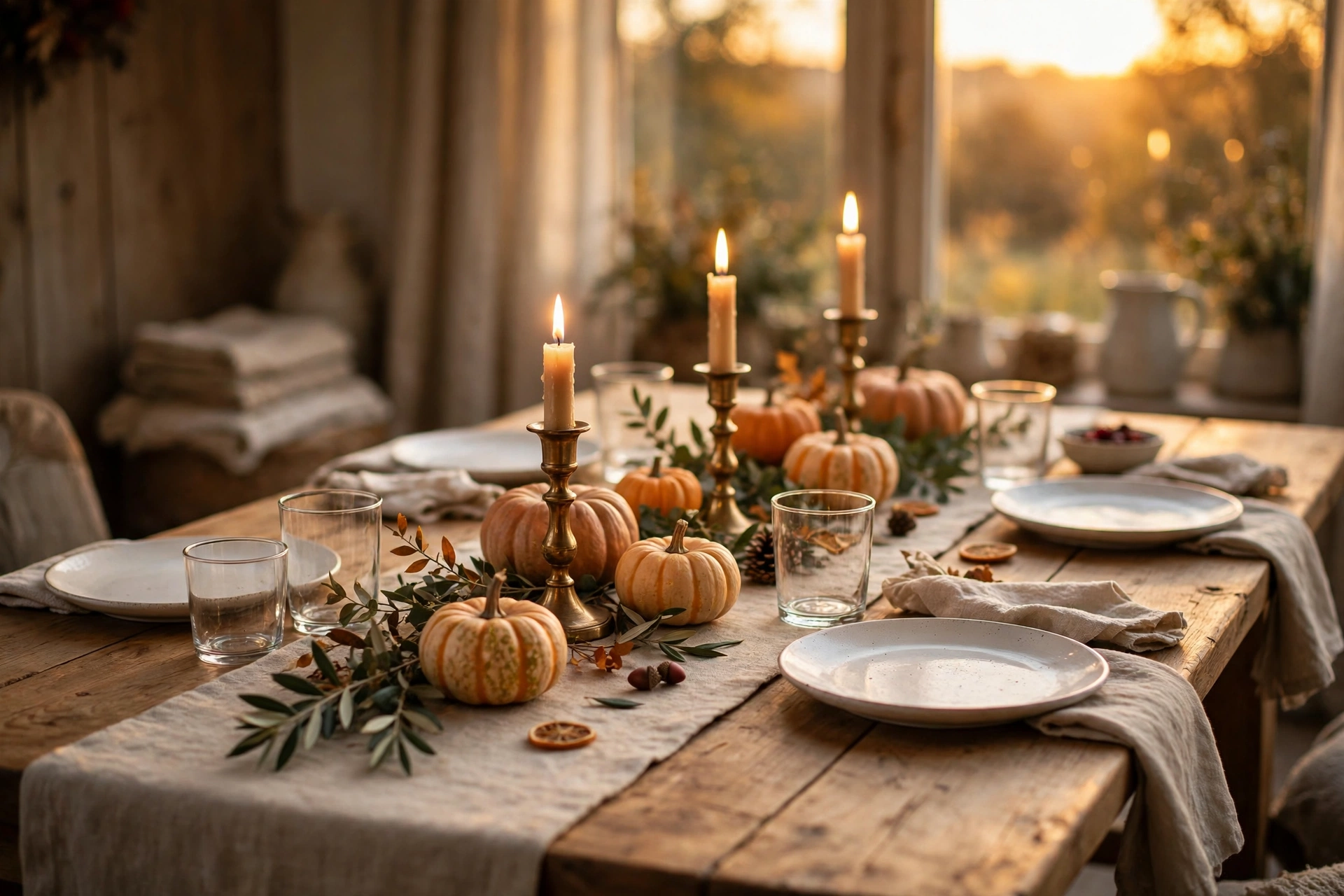
Linen is the safest runner fabric there is, and safe is not boring here. A natural linen runner in oat or flax has a soft texture that photographs beautifully and feels expensive even when it is not. The slight wrinkles are part of the charm, because linen is supposed to look lived in, not ironed within an inch of its life. Lay it down the middle of a bare wood table and you are basically done, the wood and the linen do all the work. If your table is dark wood, pick the lightest oat you can find so the runner reads clearly against it. If your table is light wood, a natural flax with a little more color in it keeps the runner from disappearing. FYI, linen washes well and gets softer every year, so this is a buy-once runner you will use for a decade. Our Thanksgiving table decor guide has a whole section on linen layers, and the same logic applies here, natural fibers and warm light belong together.
2. A red and cream plaid runner for instant Thanksgiving
Nothing says Thanksgiving faster than plaid. A red and cream plaid runner is the one runner that needs almost nothing else on top of it, because the pattern does the decorating for you. It works with white plates, cream candles, gold chargers, and just about any centerpiece you already own. The trick is the scale of the plaid. Big bold checks read modern and cheerful, small tight checks read traditional and cozy. Either way, keep the rest of the table simple, because a loud runner plus loud plates plus a loud centerpiece is a lot of noise at one table. Let the plaid be the star and let everything else support it. If you have kids at the table, plaid is also the most forgiving pattern there is, because a gravy drip on plaid is a lot less noticeable than a gravy drip on white linen.
3. A burlap runner with a lace edge for farmhouse warmth
Burlap gets a bad reputation as the scratchy brown fabric from the garden store, but a burlap runner with a soft lace edge is one of the warmest looks you can put on a Thanksgiving table. The rough texture of the burlap against the soft lace is exactly the contrast that makes a table feel handmade without feeling homemade. It pairs beautifully with wood chargers, cream candles, and a centerpiece of mini pumpkins and greenery. One warning, and I learned this the hard way: real burlap sheds. Give it a good shake outside before dinner, and put a thin cotton liner underneath if your table is finished wood, because burlap fibers and a sticky table are a bad combination. Our Thanksgiving dining room decor guide has a farmhouse section with the same advice, and it holds up, burlap is a look, not a chore, as long as you prep it.
4. A velvet runner in burgundy or forest green
If you want your table to feel rich, velvet is the fastest way there. A velvet runner in burgundy or forest green catches the light in a way no other fabric does, and it makes even plain white plates look like they belong at a special dinner. Velvet is the runner for the evening meal, when the candles are lit and the room is warm, because it glows in low light. Keep the topper simple with velvet, a few brass candlesticks and a low line of greenery, because velvet is already doing a lot of visual work and it does not need competition. IMO, burgundy velvet is the single most dramatic runner you can buy for under $25, and it works just as well at Christmas, so you get two holidays out of one purchase. Just keep it away from the gravy boat, because velvet and gravy are not friends.
5. A narrow runner on a bare wood table
Sometimes the best runner is the one that shows off the table underneath it. If you have a beautiful wood table, a narrow runner, about twelve inches wide, down the center lets the wood do most of the talking while the runner adds just enough color to frame the meal. This is my favorite look for a long farmhouse table, because the wood grain is the decoration and the runner is the punctuation. Pick a runner in a solid color, linen or cotton, with no pattern at all, so nothing fights the wood. Put your centerpiece directly on the runner and your plates directly on the wood, and the table will look like it was styled by someone who knows what they are doing. The narrow runner also saves money, because you need less fabric, and it saves laundry, because less fabric touches the food.

Layer It Like a Pro: Runners Plus Everything Else
A runner on its own is good. A runner layered with the right companions is great. These four ideas are about what goes under, over, and around the runner, the layering that turns a strip of fabric into a finished table. Our Thanksgiving place setting ideas guide has a whole section on layering place settings, and the same idea works for the table itself, layers make it look considered.
6. A tablecloth plus a runner, the base layer done right
The most common runner mistake is putting a runner on a tablecloth that is the same color as the runner. Cream on cream disappears. The fix is contrast. A white or cream tablecloth with a burgundy, forest green, or mustard runner reads clearly from across the room, and it protects your table from the inevitable spills at the same time. If your tablecloth is patterned, pick a solid runner in one of the tablecloth colors, so the runner pulls one color out of the pattern and makes the whole table feel coordinated. If your tablecloth is solid, the runner can carry the pattern, plaid or stripes or a simple border print. The tablecloth also solves the problem of a table that is not pretty, because a good cloth hides scratches, stains, and that one leaf that never matched.
7. A runner plus woven placemats for texture
Placemats and runners are friends, not rivals. A woven placemat in rattan, seagrass, or jute under each plate adds a second texture to the table, and it frames each place setting so the table looks organized instead of crowded. The rule is simple, the placemats should be a different texture than the runner, not a different color war. A linen runner with woven placemats is perfect. A burlap runner with woven placemats is too much of the same rough texture. Put the placemats so they overlap the runner slightly, about an inch, and the table will look like one continuous design instead of separate pieces. Round placemats soften a long rectangular table, and they are easier to fit when the table is crowded, because they take up less space than square ones.
8. Two runners crossed, one lengthwise and one across
This is the trick that makes guests ask who styled your table. Lay one runner down the length of the table, then lay a second, shorter runner across the width at the center, right where the main centerpiece sits. The cross creates a focal point in the middle of the table, and it gives you two colors or two textures to play with. A solid burgundy runner lengthwise with a plaid runner across, or a linen runner lengthwise with a velvet runner across, both work beautifully. The crossed runner should be about the width of the table, hanging a few inches over each side, and the centerpiece should sit right on top of the cross. It is a small move that looks like a big one, and it costs exactly one extra runner, which you probably already own.
9. A runner that matches your chargers, not your plates
Here is a layering secret most people miss. Your runner should talk to your chargers, the big decorative plates under your dinner plates, not to your dinner plates themselves. If your chargers are gold, a warm runner in burgundy, mustard, or cream makes the gold glow. If your chargers are wood, a natural linen or burlap runner keeps the whole table in the same warm family. If your chargers are dark green or navy, a cream runner gives them room to breathe. When the runner and the chargers agree, the dinner plates can be plain white and the table still looks finished, because the color lives in the layers around the plates instead of on them. This is also the cheapest way to change your table next year, because a new runner costs a lot less than new dishes.
Let Nature Run Down the Middle
The best Thanksgiving runner decorations are the ones that come from outside, not from a store. Dried wheat, eucalyptus, mini pumpkins, and orange slices cost almost nothing, they smell wonderful, and they look like they belong at a harvest dinner, because they do. These four ideas put nature right on the runner, in a line down the center of the table.
10. Dried wheat bundles tied along the runner
A few small bundles of dried wheat, tied with twine and laid in a row down the runner, are the simplest centerpiece there is. Wheat is tall, golden, and cheap, and it gives the table a vertical line that flat decorations cannot. Tie each bundle with a piece of twine or a thin ribbon, lay them head to tail so they overlap slightly, and let them run the whole length of the runner. The wheat should sit low, almost flat, so guests can see each other across the table. If you want a little more, tuck a few dried orange slices or cinnamon sticks between the bundles. The whole thing takes ten minutes and costs less than a bouquet, and it looks like you spent a fortune. Just keep the wheat away from open flames, because dried wheat and candles are a combination that needs distance.
11. A eucalyptus garland over the runner
Eucalyptus is the greenery that makes a Thanksgiving table smell like a holiday. A simple garland of fresh eucalyptus, laid right on top of the runner down the center of the table, gives you color, texture, and scent in one move. The silvery green leaves look beautiful against a burgundy or cream runner, and they stay fresh for days, so you can buy them early in the week and they will still look good on Thursday. Lay the garland in a loose S-curve instead of a straight line, because a curve looks natural and a straight line looks like a ruler. Tuck a few mini pumpkins or pinecones into the garland where it dips, and the runner becomes the whole centerpiece. Our Thanksgiving centerpiece ideas guide has a eucalyptus section too, and the same garland works there, which means one purchase covers two jobs.
12. Dried orange slices and cinnamon sticks on the runner
This is the runner decoration that guests notice with their noses before they notice it with their eyes. Dried orange slices, laid in a scattered line down the runner with a few cinnamon sticks between them, smell like Thanksgiving and look like a still life. The orange slices are easy to make yourself, slice oranges thin, bake them low and slow until they are dry, and they keep for weeks. Scatter them loosely, not in a perfect row, because a little messiness looks natural and a perfect row looks like a craft store display. Add a few star anise pods if you want a deeper scent, and keep the whole line low and flat so it does not block anyone’s view. This is also the cheapest idea in this guide, because a bag of oranges and a jar of cinnamon sticks costs less than a single bouquet.

13. Mini pumpkins marching down the runner
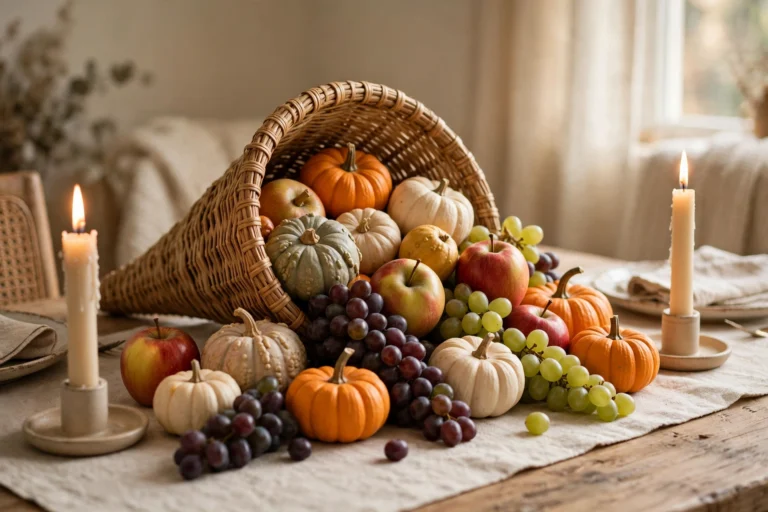
A row of mini pumpkins, in a mix of white, orange, and green, spaced evenly down the runner, is the most Thanksgiving thing you can put on a table. The trick is the spacing and the size. Use pumpkins that are all about the same size, about the size of a tennis ball, and space them about eight inches apart, so they read as a rhythm instead of a pile. Alternate the colors, white, orange, green, white, orange, green, and the line will look intentional instead of random. If you have a long table, use more pumpkins, not bigger ones, because big pumpkins block the view across the table and small ones do not. A few sprigs of greenery tucked between the pumpkins ties the whole line together, and the pumpkins double as place card holders if you write a name on each one with a gold marker.
Color and Pattern: Pick Your Palette
The runner is where your table gets its color, so picking the right color matters more than picking the right anything else. These four ideas are the palettes that work best at Thanksgiving, each with its own mood, each easy to build a whole table around.
14. A burgundy runner with brass
Burgundy and brass is the palette of a grown-up Thanksgiving, rich, warm, and a little bit dramatic. A burgundy runner, brass candlesticks, and gold chargers make a table that looks expensive even when it is not, because the deep red and the warm metal do all the work. Keep the rest of the table quiet, cream plates, white candles, a low centerpiece of greenery, so the burgundy and brass have room to shine. This palette works best in the evening, when the candles are lit and the burgundy goes deep and warm in the low light. If your dining room has dark wood furniture, burgundy and brass is the palette that was made for it, because the wood, the red, and the metal all sit in the same warm family.
15. A mustard and honey runner for a golden table
Mustard is the happiest Thanksgiving color, warm, golden, and full of light. A mustard runner on a cream tablecloth makes the whole table glow, and it pairs with almost everything, wood chargers, white plates, green eucalyptus, orange pumpkins. The trick with mustard is to keep it as the only strong color on the table, because mustard plus burgundy plus forest green is a lot of strong colors fighting for attention. Let the mustard be the star, let the pumpkins and the greenery be the supporting cast, and the table will feel sunny even on a grey November day. This is also the best palette for a room with little natural light, because mustard reflects warmth back into the room instead of absorbing it.
16. A forest green runner with cream candles
Forest green is the calm palette, the one that makes a Thanksgiving table feel like a quiet evening in the woods. A forest green runner with cream taper candles and a low centerpiece of pine and eucalyptus is elegant without trying too hard, and it works beautifully with wood chargers and cream plates. Green is also the most forgiving palette for a mixed table, because it goes with the orange of the pumpkins, the gold of the brass, and the cream of the candles all at once. If you want a table that feels peaceful instead of loud, forest green is your color. It also carries straight into Christmas with a few red accents swapped in, so the runner earns its keep twice.
17. A gingham or buffalo check runner for a casual table
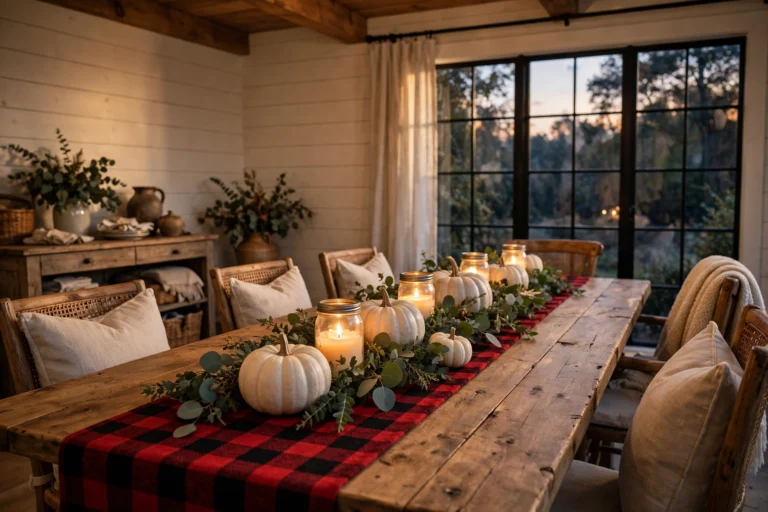
Not every Thanksgiving table needs to be formal, and a gingham or buffalo check runner is the answer for a casual, family-style dinner. A red and white buffalo check runner says cozy cabin, a black and white gingham runner says modern farmhouse, and both of them forgive a multitude of sins, because a check pattern hides stains, hides wrinkles, and hides the fact that your plates do not match. Checks pair best with simple white plates and mason jar candles, because the pattern is already doing a lot and the rest of the table should stay quiet. This is the runner for the table where kids eat, where the food is served family style, and where nobody is worried about being formal. It is also the cheapest runner to find, because every home store carries checks in November.
DIY Runners You Can Make This Weekend
You do not need to buy a runner to have a beautiful one. Some of the best Thanksgiving runners I have seen were made in an afternoon from things people already had at home. These four ideas cost almost nothing, they take less than two hours each, and they look like you planned them for weeks.
18. A drop cloth runner, hemmed and washed
A painter’s drop cloth from the hardware store is the best-kept secret in table runners. It is cheap, it is cotton canvas, and it comes in a warm natural color that looks like expensive linen once you wash it. Buy a drop cloth, cut it to the length of your table plus twelve inches on each end for the overhang, fold the edges under twice, and sew a simple hem, or use iron-on hem tape if you do not sew. Wash it once with a little fabric softener, and it will come out soft and slightly wrinkled in exactly the right way. The whole project costs under $10 and takes an hour, and the runner will last for years. If you want a little more, stencil a simple leaf or stripe pattern down the center with fabric paint, and you have a custom runner for the price of a coffee.
19. A kraft paper runner guests can write on
This is the runner that turns dinner into a memory. Roll out a strip of kraft paper down the center of the table, tape it at the ends, and put a cup of colored pencils or crayons at each place. Guests write what they are thankful for right on the runner, draw pictures, leave notes for each other, and by dessert the table is covered in handwriting and drawings. It is especially wonderful with kids, who will spend the whole meal drawing instead of asking when dessert is ready. The kraft paper also protects the table from spills, so it is doing a practical job while it does an emotional one. At the end of the night, roll it up and keep it, because a kraft paper runner covered in your family’s handwriting is a keepsake worth saving. Our Thanksgiving kids table decor guide has the same idea for the kids table, and it works just as well at the grown-up table.

20. A no-sew runner from a thrifted curtain panel
Curtain panels are runners in disguise. A thrifted curtain panel in a warm color, linen, velvet, or even a heavy cotton, is already the right width and already hemmed on the sides, so all you have to do is cut it to length and hem the two cut ends. Check the thrift store for panels in burgundy, forest green, mustard, or plaid, and you will find one for a few dollars that would cost $40 new. Iron it, lay it down the table, and nobody will ever know it used to hang in someone else’s window. This is also the fastest DIY runner in this guide, because the sides are already finished and you only have to hem two short ends. If you find two matching panels, you have a runner for the dining table and a runner for the sideboard, and the whole room will look coordinated for the price of lunch.
21. A hand-painted runner with leaf stamps
If you like a craft project, a hand-painted runner is the most personal one you can make. Buy a plain cotton runner, or make one from a drop cloth, and stamp a leaf pattern down the center using a real leaf and fabric paint. Paint the back of a maple or oak leaf, press it onto the fabric, lift it carefully, and you have a perfect leaf print. Repeat it down the runner, alternating leaf sizes and paint colors, burgundy, mustard, forest green, and the runner will look like it came from an artisan shop. The trick is to practice on scrap fabric first, because the first stamp is always a little messy and the tenth one is perfect. Let the paint dry overnight, iron it to set the paint, and wash it gently by hand. This runner takes an afternoon and costs almost nothing, and it is the one guests will ask about most.
Small Tables, Kids Tables, and Tight Budgets
A runner is not just for a big formal dining table. Small tables, kids tables, and tight budgets all get better with a runner, because a runner makes any table look like someone cared about it. These four ideas cover the tables that most guides forget.
22. A short runner for a small table
Small tables have a runner problem, because a standard runner is too long and hangs past the ends like a tablecloth that gave up. The fix is simple, buy a short runner, or fold a long one in half and use it doubled, or use a tablecloth folded into a runner. A runner on a small table should hang about six inches over each end, no more, because a long overhang on a small table looks like the runner is swallowing it. A narrow runner also helps, about ten inches wide instead of fourteen, so the plates have room and the runner does not crowd them. The best small-table runner is a solid color with no pattern, because a pattern on a short runner looks busy and a solid color looks calm. This is also the runner for an apartment Thanksgiving, where the table seats four and the room is small, because a short runner makes the table feel complete without making the room feel crowded.
23. A kraft paper runner for the kids table
The kids table deserves its own runner, and kraft paper is the answer again, this time as the whole table covering. Cover the kids table with kraft paper, tape it down, and give every child a cup of crayons and a few stickers. The paper protects the table from juice spills and marker accidents, and it gives the kids something to do while the adults talk. Write each child’s name at their place in big letters, draw a turkey or a pumpkin at the center, and the kids table will feel like the best seat in the house instead of the exile it usually is. When dinner is over, roll the paper up and throw it away, and the table underneath is clean. No laundry, no stains, no stress, and the kids will ask for the paper table again next year.
24. A runner for under $15
You do not need a big budget for a beautiful runner. A fabric remnant from the craft store, a thrifted scarf, a long piece of ribbon-trimmed burlap, or a runner from the dollar store can all look wonderful with the right topper. The secret is to spend the $15 on the runner and spend your effort on the topper, because a cheap runner with a good topper looks expensive and an expensive runner with no topper looks unfinished. A $10 linen-look runner from a discount store, plus a eucalyptus garland and three candles, looks like a $100 table. Check the clearance aisle in early November, because last year’s runners go on sale right when you need this year’s, and the colors are almost always the same. FYI, the cheapest runner I ever bought cost $4 at a thrift store, a burgundy velvet panel that someone had cut in half, and it is still the runner I reach for most.
25. The runner as the whole centerpiece
Some years you have no time, no budget, and no energy, and the runner has to do everything. That is fine, because a good runner can be the whole centerpiece. Pick a runner with a strong pattern, plaid, a bold stripe, or a rich velvet, lay it down the table, put one candle at each end, and you are done. The pattern is the decoration, the candles are the glow, and the table looks finished. This is the idea for the year you are hosting for the first time, the year the baby is six weeks old, the year you moved house in October. A strong runner plus two candles is a complete table, and nobody at that table will think you cut corners. They will think you have taste, and they will be right.
The Gravy Test: Will Your Runner Survive Dinner?
A beautiful runner that cannot survive dinner is not a good runner, it is a decoration for a table nobody eats at. Before you commit to a runner, run it through the Gravy Test, my three-question durability check. First, can it be washed? Linen, cotton, and polyester can all go in the washing machine, and that matters, because gravy will find your runner no matter where you put the gravy boat. Velvet and silk cannot be washed easily, so keep them away from the food end of the table or use them only for the evening meal when the serving dishes stay on the sideboard. Second, does it stain or hide stains? White runners stain, dark runners hide stains, patterned runners hide stains best of all. If you have kids or a wobbly gravy boat, pick a pattern. Third, does it stay put? A runner that slides around when someone pulls a plate is a runner that ends up in the mashed potatoes. Use a thin non-slip shelf liner under the runner, cut to size, and it will stay exactly where you put it all evening.
Buy Once vs Every Year: Runner Budget
Runners are one of the cheapest Thanksgiving decorations you can buy, but the money still adds up if you buy a new one every year. Here is how I think about it. Buy once: a natural linen runner, a burgundy velvet runner, and a solid forest green runner. Those three cover almost every Thanksgiving palette, they last for years, and they cost about $60 total if you shop carefully. Buy every year, or rather, make every year: the kraft paper runner, the wheat bundle topper, the dried orange slices. Those cost almost nothing, they are different every year, and they are the parts of the table that make it feel fresh instead of repeated. The runner itself should be an investment. The things on top of the runner should be the fun, cheap, seasonal part. That way your table looks new every year without buying a new table every year.
Small Table? The Runner Still Works
A small table is not a reason to skip the runner, it is a reason to choose the runner carefully. On a small table, use a short runner, a narrow runner, and a low topper. The runner should hang six inches over each end, the topper should be one low line of greenery or three small pumpkins, and the candles should be short, because a tall candle on a small table blocks the view across it. If your table seats four, the runner can be the whole decoration, because four place settings plus a runner plus a low topper is a complete table. If your table is round, a runner still works, just lay it across the center so it hangs over two opposite edges, and put the centerpiece where the runner crosses the middle. A round table with a runner looks intentional in a way a round table without one rarely does.
Runner Troubleshooting: 6 Quick Fixes
The runner is too short. Fold a tablecloth into a runner, or layer two short runners end to end with a small overlap in the middle, hidden under the centerpiece. Nobody will see the seam.
The runner keeps sliding. Put a strip of non-slip shelf liner underneath, or use a few small dots of museum putty at the corners. Both come off cleanly and neither damages the table.
The runner wrinkles. Linen wrinkles are fine, they are part of the look. If the wrinkles bother you, hang the runner in a steamy bathroom for ten minutes before dinner, or iron it on low with a press cloth.
The runner clashes with the plates. If the plates are patterned, use a solid runner in one of the plate colors. If the plates are plain, the runner can carry the pattern. One pattern per table is the rule.
The runner is too wide. Fold it in half lengthwise and press it flat. A folded runner looks like a narrow runner, and it works perfectly on a crowded table.
Gravy on the runner. Blot it immediately, do not rub it. Rinse with cold water as soon as dinner is over, then wash it normally. Hot water sets a gravy stain, cold water lifts it. This is the one stain rule worth remembering.
Frequently Asked Questions
How long should a Thanksgiving table runner be?
A table runner should hang six to twelve inches over each end of the table. Measure your table, add twelve to twenty-four inches total, and that is your runner length. A runner that stops exactly at the edge looks too short, and a runner that hangs past twelve inches gets in the way of chairs and laps.
Can I use a table runner on a round table?
Yes, lay the runner across the center of the round table so it hangs over two opposite edges, and put your centerpiece where the runner crosses the middle. A runner on a round table looks intentional and gives the centerpiece a clear home.
What color runner is best for Thanksgiving?
Burgundy, mustard, forest green, and warm plaid are the classic Thanksgiving runner colors. Burgundy is the most dramatic, mustard is the warmest, forest green is the calmest, and plaid is the most forgiving. Pick the color that matches your chargers and your dining room, not the color that is trending.
How do I keep a table runner from sliding?
Put a thin strip of non-slip shelf liner under the runner, cut to the same size, or use a few small dots of museum putty at the corners. Both keep the runner in place all evening and come off cleanly without damaging the table.
Can I wash a Thanksgiving table runner?
Most linen, cotton, and polyester runners can be washed in the machine on a gentle cycle with cold water. Velvet and silk runners should be spot cleaned or dry cleaned. Always check the care label, and always treat a gravy stain with cold water first, because hot water sets it.


2 Comments