
27 Cozy Reading Nook Decor Ideas That Make Every Corner Feel Like a Getaway
Intro: The Chair Nobody Sat In
For two years I had a beautiful armchair in our living room that nobody ever sat in. It looked perfect in photos. Cream linen, wooden legs, a little side table beside it with a candle I never lit. But every evening, we all ended up on the sofa, phones in hand, TV on, books untouched on the shelf. The chair was pretty, and it was lonely, and I finally asked myself why. It had no light worth reading by. It had no blanket within reach. It had no place for a mug, except a table so small my tea went cold before I found a coaster. It was a chair for looking at, not a chair for living in.
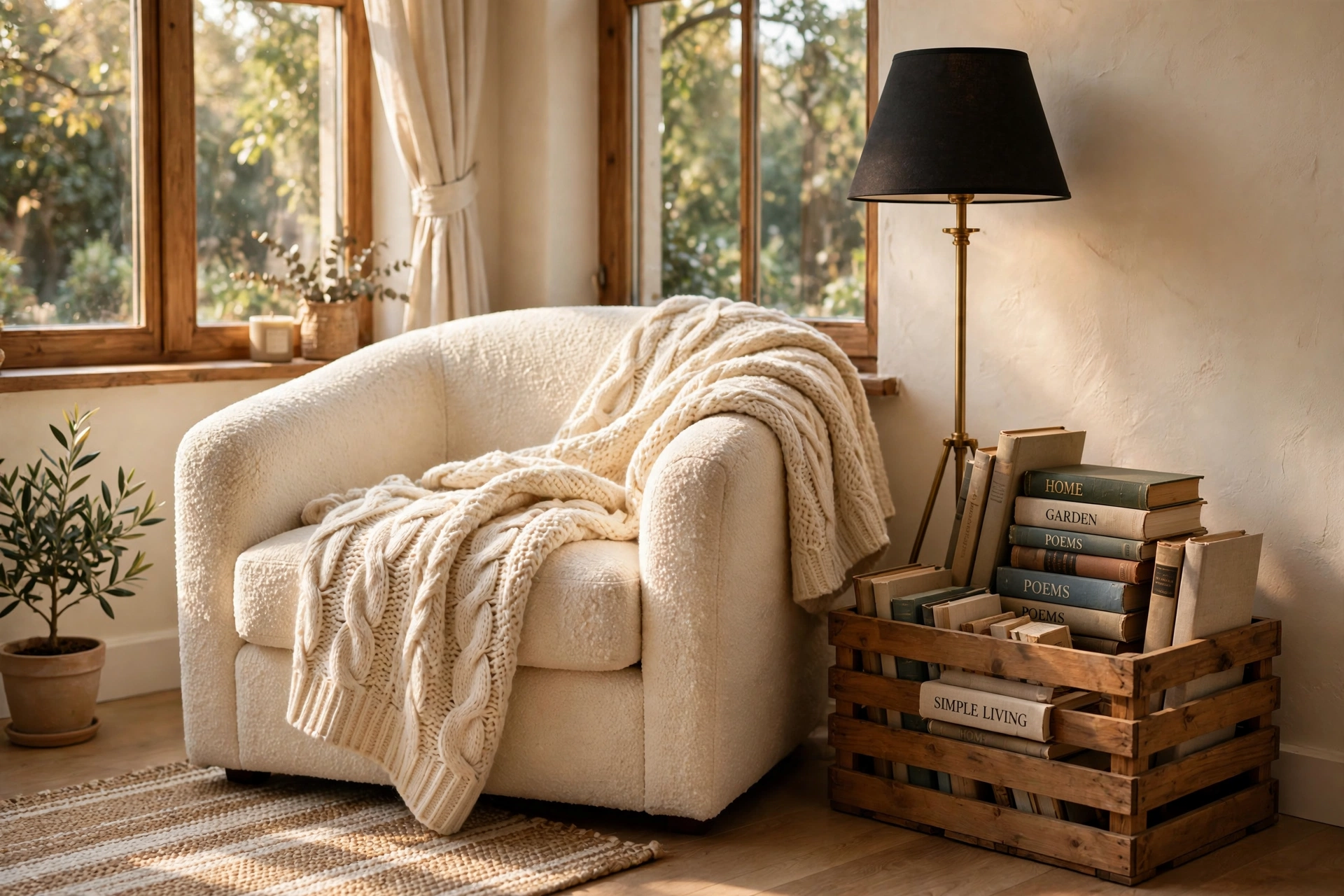
One rainy Saturday, I moved that chair six feet to the left, into the window corner. I dragged a floor lamp behind it, threw my softest blanket over one arm, and put a small wooden crate beside it for books. That night, I sat down with a book I had been meaning to read for months, and I did not get up for an hour. My daughter came and sat on the floor beside me with her own book. Nobody planned it. The corner just finally worked, and we kept going back to it, night after night, like it had always been waiting for us.
That is what these cozy reading nook decor ideas are about. Not a whole new room. One corner that works. Every idea below follows the rule I use for every nook in the house, which I call Chair, Light, Layer. Chair means a seat you sink into and do not want to leave, not a seat that only looks good. Light means one warm light you can actually read by, placed so it falls over your shoulder, not in your eyes. Layer means one soft thing you can pull up when you get cold, a blanket, a cushion, a rug under your feet, so your body stays warm while your mind wanders. If a nook breaks that rule, IMO it stays empty, no matter how pretty it is in a photo. Every idea below keeps the rule, and keeps the nook feeling like a small getaway.
Before you buy anything, do what I call The 20 Minute Test. Sit in the spot for twenty minutes with a real book and a real mug of tea. Do you shift around? Do you squint? Do your feet get cold? Does your arm ache from holding the book? The test tells you the truth in twenty minutes, and it is free. Fix the thing that bothers you first, and only then add the pretty things. Now, let us find the corner.
Zone 1: Find the Corner First (Ideas 1 to 5)
1. Claim the Window Corner and Let Daylight Do the Work
A window corner is the easiest reading nook there is, because daylight does half the work for free. Put your chair at a slight angle to the glass, not flat against it, so light falls over one shoulder and you can look up and watch the street or the rain. Add a sheer curtain if the afternoon sun is too bright, and keep the sill clear for a mug and a small plant. FYI, I read best in a window corner in the morning, when the light is soft and the house is still quiet. By evening, the same corner needs a lamp, so plan for both, and the corner will work all day.
2. Turn an Awkward Alcove Into the Best Seat in the House
Every house has an awkward alcove, a shallow recess beside a fireplace, a nook beside a built in shelf, a corner that is too small for a sofa and too big to leave empty. That is your reading nook, waiting. Measure the alcove, then choose a chair that fits with two inches to spare on each side, so you can get in and out without scraping the walls. A chair that is too big will make the alcove feel cramped. A chair that fits, with a small lamp and a wall shelf above it, makes the alcove feel intentional, like it was built for reading all along.
3. Use the Space Behind the Sofa, Not in Front of the TV
If your living room is one open room, the space behind the sofa is often wasted, a walkway, a pile of cushions, a spot where nothing quite fits. Put a low bookshelf behind the sofa as a divider, then tuck a chair and a lamp in the corner behind it, facing away from the TV. You get a quiet pocket inside a busy room, and the sofa blocks the sound and the glare. It works best in a family home, where one person wants to read and everyone else wants to watch something loud. A nook behind the sofa is a peace treaty, in furniture form.
4. Make a Landing Nook on the Stairs
A wide landing, the top of the stairs, or a hallway that is wider than it needs to be can hold a small reading nook, and it will get used more than you expect. Put a narrow bench or a small chair on the landing, a wall sconce or a clip light above it, and a basket of books beside it. People stop there on the way to bed, on the way down in the morning, and on rainy afternoons when the rest of the house is busy. Keep the walkway clear, at least two feet, so nobody trips in the dark. A landing nook is small, but it turns dead space into a daily habit. For the same quiet corner feeling in a bedroom, my cozy fall bedroom decor ideas use the same warm layers, just in a room built for sleep.
5. Steal a Corner of the Bedroom, Even If It Is Tiny
A bedroom reading nook does not need a whole corner. It needs one chair, one light, and one surface, in the corner farthest from the door, so you feel tucked away. If the corner is truly tiny, use a small accent chair or a large floor cushion, a wall mounted lamp that folds away, and a floating shelf instead of a side table. Read there before bed, with warm light only, and no phone, and your brain will start to link that corner with winding down. IMO, a bedroom nook that is used for ten minutes a night beats a living room nook that is used never, because the habit is what makes it cozy, not the size.
Zone 2: The Chair Is the Whole Nook (Ideas 6 to 10)
6. Choose a Chair You Sink Into, Not a Chair You Pose In
Sit in a chair before you buy it, if you possibly can, and sit for longer than thirty seconds. A good reading chair supports your lower back, lets your feet rest flat or on a footstool, and has arms low enough to rest a book on. If you already own a chair that looks good but feels stiff, add a lumbar cushion and a seat cushion, and test it again with The 20 Minute Test. A chair that passes the test will get used every day. A chair that fails it will hold a pile of clean laundry, no matter how expensive it was. Comfort first, always, and let the pretty follow.
7. Try a Papasan or a Big Floor Cushion for a Low, Lazy Nook
Not every reading nook needs a traditional armchair. A papasan chair, a big floor cushion, or a bean bag with a back, on a thick rug, makes a low, lazy nook that kids and teenagers actually love. It works in a bedroom corner, a playroom, or a living room where a big chair would block the view. Add a bolster cushion behind your back, a small tray for a mug, and a basket for books, so you are not reaching across the floor. Low nooks feel relaxed and a little bit playful, and they are easy to move when the room needs to change. Just keep the rug thick, because a thin rug on a hard floor will end the reading session early.
8. Build a Window Seat, Even a Fake One
A real built in window seat is lovely, but a fake one works just as well. Put a low bench, a storage ottoman, or two sturdy crates with a cushion on top, under a window, add a thick seat pad, a row of cushions along the wall, and a blanket folded at one end. You get a window seat for reading, storage for books underneath, and a sunny spot that doubles as extra seating when guests come. Keep the seat pad at least three inches thick, or it will feel hard after twenty minutes. A window seat nook is the one guests will steal first, so build it like you mean it, and keep a second blanket nearby. Pair it with the same warm window styling in my fall living room decor ideas, so the seat and the room feel like one calm space.
9. Add a Footstool, and Watch Your Reading Time Double
A footstool is the cheapest upgrade a reading nook can get. Feet up, back supported, book at a comfortable angle, and suddenly an hour passes without you noticing. Choose a footstool that is about the same height as your chair seat, or a little lower, and wide enough for both feet. A storage ottoman works double duty, books inside, feet on top, and a tray on top turns it into a table when you need one. If space is tight, use a small pouf that tucks under the chair when it is not in use. FYI, I did not believe a footstool mattered until I tried one. Now I will not read without it.
10. Rock, Swivel, or Swing, If That Is How You Read
Some people read best when they move a little. A rocking chair, a swivel chair, or a hanging egg chair gives you that gentle motion, and it makes a nook feel like a retreat, not a workstation. A rocker suits a bedroom or a nursery corner, where the motion is soothing. A hanging chair suits a living room corner with a strong ceiling anchor and room to swing, and it needs a cushion and a blanket to feel warm, not bare. Whatever you choose, test it with a book in your hands, not empty. A chair that swings too much will make the words swim. A chair that moves just a little will make an hour feel like ten minutes.
Zone 3: Light and Layers That Keep You There (Ideas 11 to 14)
11. Put the Lamp Behind Your Shoulder, Not in Your Face
Reading light should fall over your shoulder and onto the page, not into your eyes and not from the front, where it glares. Place a floor lamp just behind and to the side of your reading shoulder, with the shade at about head height when you are seated, and angle it down a little. A lamp with a warm bulb, around 2700K, and a dimmer, so you can turn it down in the evening, will beat a bright overhead light every time. Test it at night, with the room lights off, before you call the nook done. If you squint, move the lamp. If you see a shadow of your hand on the page, move the lamp to the other side. Light is a placement problem, not a shopping problem.
12. Add a Wall Sconce When Floor Space Is Precious
When a nook is squeezed into a corner with no room for a floor lamp, a wall sconce is the answer. A plug in sconce, a battery sconce, or a hardwired sconce with a swing arm, mounted just above shoulder height, gives you reading light without taking up a single inch of floor. A swing arm is best, because you can pull the light closer for a paperback and push it back for a tablet. Keep the shade small and the light warm, and put the switch within reach from the chair, so you do not have to stand up to turn it off. A sconce makes a tiny nook feel finished, like a hotel reading corner, in the best way.
13. Layer a Blanket, a Cushion, and a Rug, in That Order
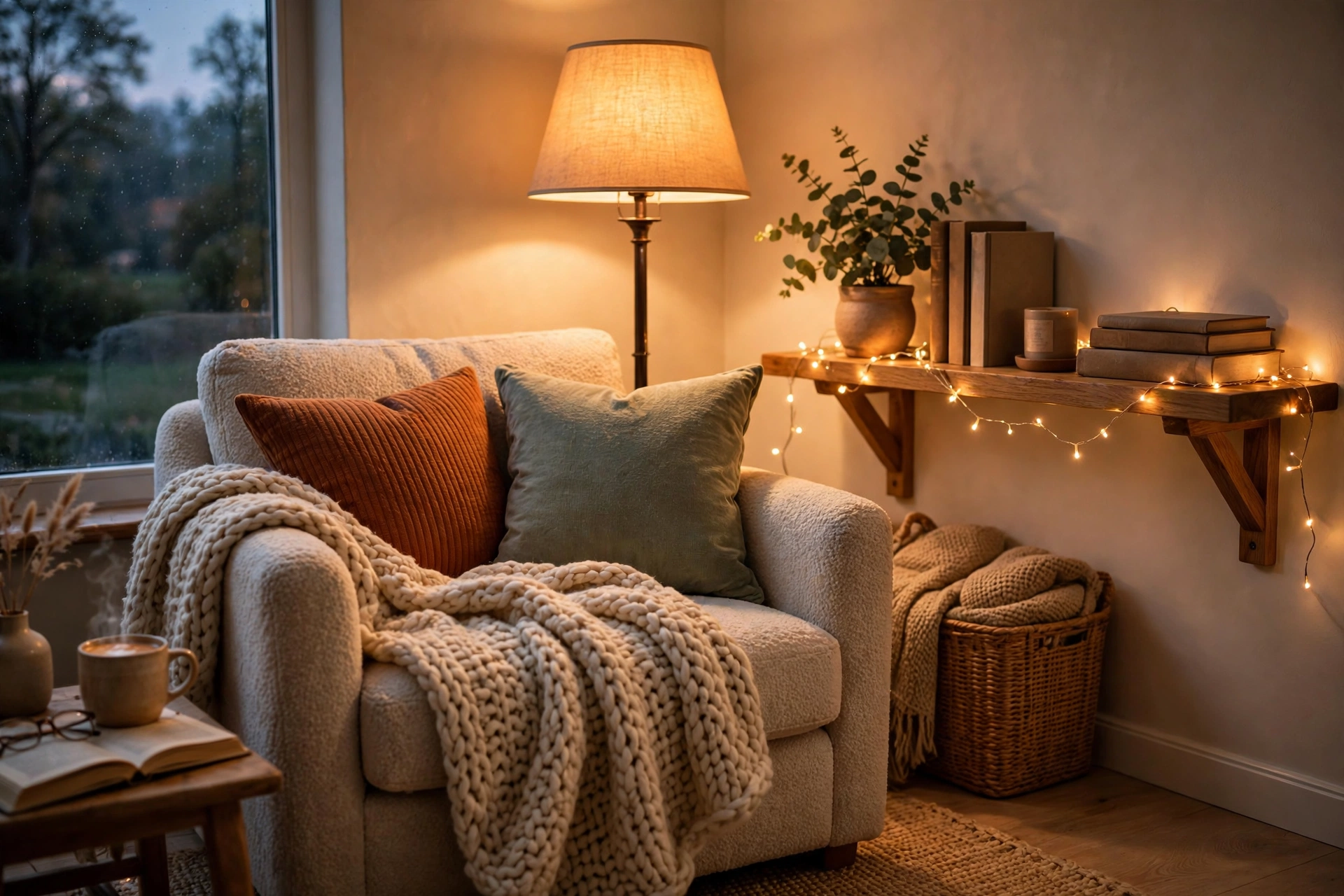
Layers are what make a nook feel cozy, and the order matters. Start with a rug under the chair, thick enough that your feet stay warm, and big enough that the chair and the footstool both sit on it. Add a cushion behind your back, one that supports you, not just decorates the chair. Then drape a blanket over one arm of the chair, folded, so you can pull it up without standing. That is Chair, Light, Layer, in physical form. Use textures that feel good to touch, chunky knit, soft fleece, woven cotton, because your hands will find them while you read. A nook that feels good to touch will get used. A nook that only looks good will not.
14. String One Soft Strand of Lights, and Stop There
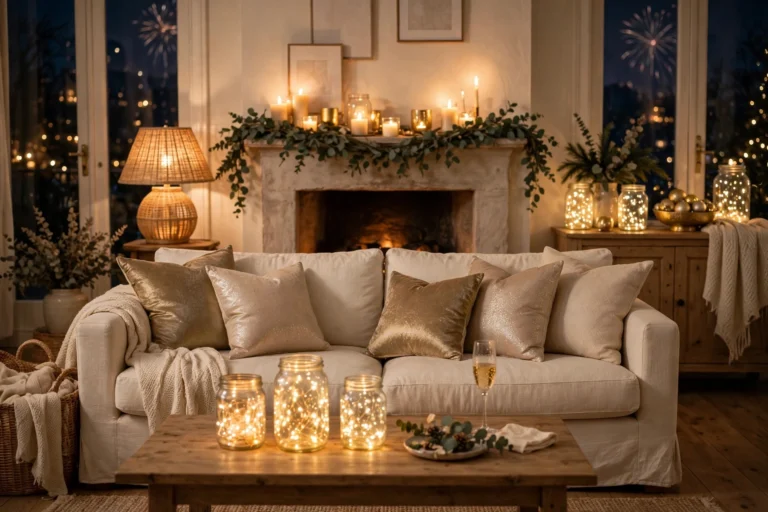
One soft strand of warm fairy lights, draped along a shelf, around a window frame, or in a glass jar on the floor, makes a reading nook glow in the evening without competing with your reading lamp. Keep it to one strand, warm white, on a timer, so it comes on at dusk and goes off while you sleep. More than one strand, or lights in three colors, will make the nook feel like a party, not a retreat. The fairy lights are background, the lamp is for reading, and the two should never fight. I keep mine on a small shelf above the chair, where they glow softly in the corner of my eye while I read, and the whole corner feels warm, even on a cold night.
Zone 4: Books and Storage Within Arm’s Reach (Ideas 15 to 19)
15. Put Floating Shelves at Arm’s Reach, Not Up High
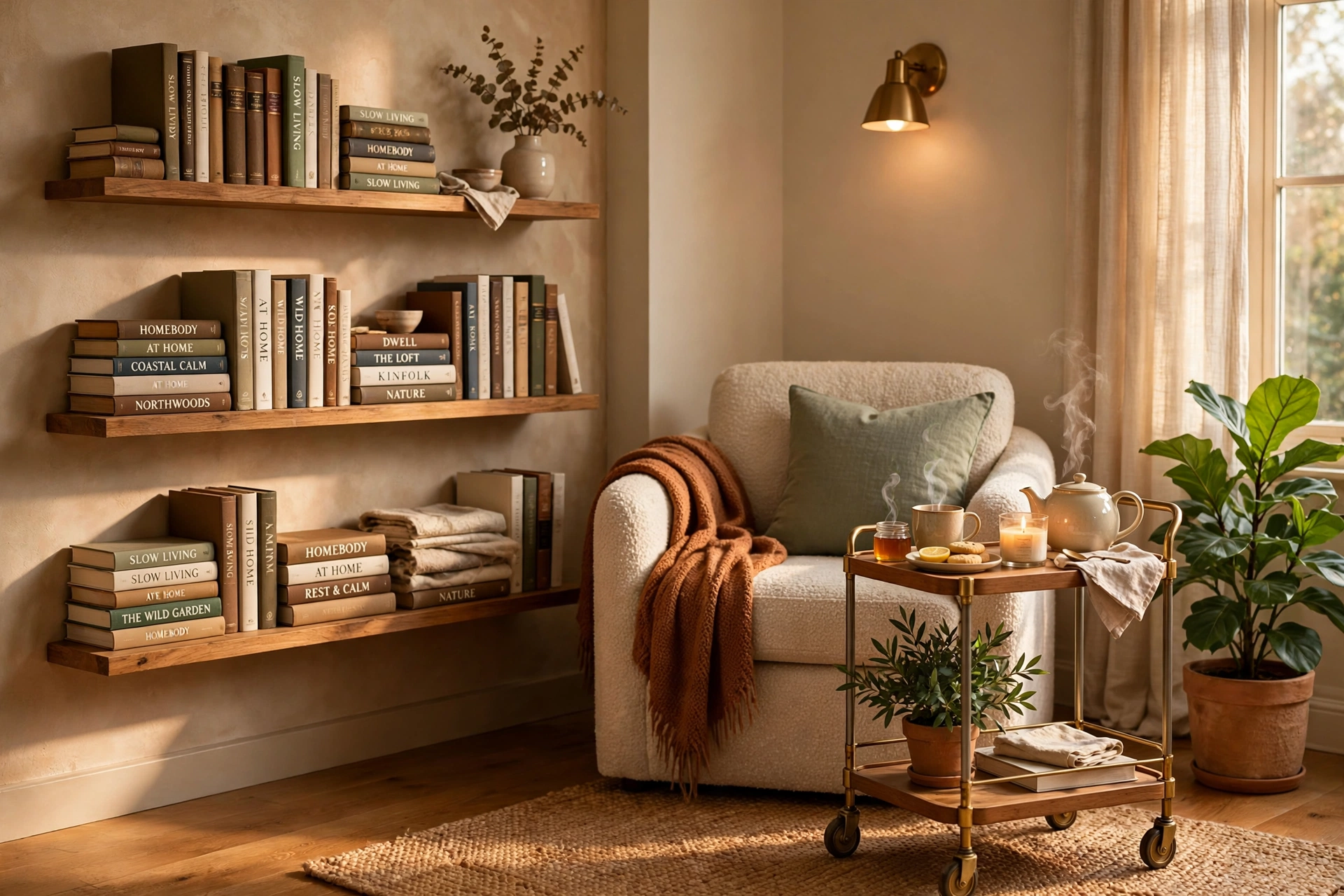
Bookshelves in a reading nook should be at arm’s reach from the chair, not up high where you need a ladder. Put one or two floating shelves beside the chair, at shoulder height when seated, with your current book, your next book, and a small plant or candle on them. Keep the shelves shallow, so books sit in one row and you can see the spines. A shelf that is too deep will hide books behind books, and you will forget what you own. A shelf at arm’s reach, with ten books you actually want to read, beats a wall of books you never touch. Edit often, and keep the shelf feeling like a shortlist, not a storage unit.
16. Use a Crate, a Basket, and a Tote for Three Kinds of Books
Three containers, three kinds of books, and no clutter. A wooden crate beside the chair holds the books you are reading now. A woven basket under the side table holds the books you want to read next. A canvas tote, hung on a hook, holds library books, so they never get mixed up with your own. That system keeps a nook tidy without making it feel like a library. Label nothing, and let the containers do the sorting. When the crate is full, it is time to finish a book or return one, not time to buy a bigger crate. A nook with a limit stays cozy. A nook without one becomes a pile.
17. Turn a Rolling Cart Into a Book and Tea Cart
A small rolling cart, the kind sold for kitchens, makes a perfect reading nook cart, because it moves. Top shelf: a mug, a small teapot or a water carafe, and a candle. Middle shelf: your current books and a notebook. Bottom shelf: extra blankets, a charging cable, and a pair of reading glasses. Roll it beside the chair when you sit down, roll it away when the room needs to be tidy. It works in a living room, a bedroom, and a small apartment, where a fixed side table would block the walkway. Keep the cart light, so it actually rolls, and keep the top clear, so a mug has a safe home. A cart that moves is a nook that adapts.
18. Give Every Nook a Side Table Big Enough for a Mug
A side table in a reading nook has one job, and it is not to look pretty. It must hold a mug, a book, and a pair of glasses, at the same time, without wobbling. Test it with a full mug before you commit. If the table is too small, use a C shaped side table that slides under the chair arm, so the surface sits right beside you. If the table is too tall, your arm will ache reaching for tea. If it is too low, you will knock the mug over. The right height is about the same as the chair arm, or an inch lower. A table that passes the mug test will get used every day. A table that fails it will hold a candle you never light, and your tea will end up on the floor.
19. Stack Books as Decor, But Stack Them Like You Mean It
Stacks of books can be decor, if they are stacked with intent. Stack three to five books, largest at the bottom, smallest at the top, spines facing out, with a small object on top, a candle, a tiny plant, a pair of glasses. Keep stacks to one or two spots in the nook, on the side table and on the floor beside the chair, not on every surface. A stack should look like a pause, not a pile. Rotate the top book often, so the stack feels alive, and keep a bookmark in the book you are reading, so the stack invites you back. IMO, a stack of books you love, in a nook you use, is better decor than any object you bought just to fill a shelf.
Zone 5: Scent, Sound, and the Seasons (Ideas 20 to 23)
20. Keep One Candle, One Plant, and One Mug in the Nook
A reading nook needs three small rituals, and they are all sensory. One candle, in a scent you love, lit only when you read, so the smell becomes linked with reading time. One plant, low maintenance, a pothos or a snake plant, that makes the corner feel alive and cleans the air a little. One mug, your reading mug, kept in the nook or on the cart, so tea time and reading time become one habit. Keep it to one of each. Two candles, three plants, and four mugs will make the nook feel cluttered, and the ritual will disappear. One candle, one plant, one mug, used every day, is a nook with a soul. For the same seasonal ritual feeling across the house, my winter living room decor ideas use one warm scent and one soft light per room, so the whole house winds down together.
21. Add Soft Sound, Not Silence, If Silence Feels Loud
Some people read best in silence. Some people read best with soft sound, rain, a fireplace video, low instrumental music, or the hum of the house. If silence feels loud in your nook, add a small speaker, a white noise machine, or a phone on a shelf, set to one soft sound, at a volume you can barely hear. Keep the device out of sight, behind a book or under the side table, so the nook still looks calm. Do not use a TV in a reading nook, because a screen will win the fight for your attention every time. Soft sound is background. A screen is a rival. Choose background, and the book will win.
22. Swap the Layers for Fall, Then Again for Winter
A reading nook should change with the seasons, in small ways, so it never feels stale. In fall, swap in a plaid blanket, a rust colored cushion, and a candle that smells like cinnamon or apple. In winter, swap in a chunky knit blanket, a cream cushion, and a candle that smells like pine or vanilla. Keep the chair, the lamp, and the shelves the same, and change only the layers and the scent. That is a fifteen minute swap, twice a year, and it makes the nook feel new without spending much. Store the off season layers in a basket under the side table, so the swap is easy, and the nook always feels like the season you are in.
23. Make a Holiday Nook Without Making It a Theme Park
At Christmas, a reading nook can be the coziest spot in the house, if you keep it simple. Add a small string of lights, a tiny tree or a pine sprig in a jar on the shelf, and a red or green cushion, and stop. Do not fill every shelf with ornaments, or the nook will feel like a display, not a retreat. Keep the book, the mug, and the blanket as the stars, and let the holiday be a quiet background. A holiday nook that is still a reading nook will get used on Christmas Eve, with a book and a cup of cocoa, while the rest of the house is loud. That is the whole point. The same quiet holiday rule works across the living room, and it is the spirit behind my new year living room decor ideas, where fresh and calm beat loud and new.
Zone 6: Small Spaces, Rentals, and Real Life (Ideas 24 to 27)
24. Build a Nook in 2 Feet of Space, and Prove It Works
Two feet of space is enough for a reading nook, if you choose the right pieces. A narrow chair or a floor cushion, a wall mounted lamp, a floating shelf, and a small basket, all in a strip of wall beside a door or a window. Sit sideways, with your back to the wall, and your feet stretched out, and you have a nook. The key is to keep the floor clear, so the space feels bigger than it is, and to keep the light warm and close. Measure twice, buy once, and test it with The 20 Minute Test before you add anything else. A two foot nook that works will be used more than a six foot nook that does not, because it fits your real life, not your fantasy house.
25. Use No Hole Tricks for Rentals and Fresh Paint
Rentals and fresh paint mean no holes, and that is fine, because the best reading nook tricks are removable by design. Use a floor lamp instead of a sconce, a leaning bookshelf instead of floating shelves, removable hooks for a light strand or a hanging plant, and a rug to define the corner without paint or nails. A tension rod in a window corner can hold a curtain or a light strand, with no damage at all. Everything in this guide can be done with no holes, and everything can come down or move when you move house. A rental nook should feel like yours, not like a compromise, and removable pieces, chosen well, do exactly that.
26. Make a Kid Friendly Nook That Grows With Them
A kid friendly reading nook needs low shelves, soft seating, and books they can reach without asking. Put a low basket of picture books beside a floor cushion, a small lamp they can turn on themselves, and a rug they can sprawl on. Keep breakables high, keep the candle out of reach or use a battery candle, and let them choose the cushion and the blanket. A nook a child chooses will be a nook a child uses. Read together there at first, then let them claim it. IMO, the best reading nook in a family home is the one the kids fight over, not the one that stays perfect for photos.
27. Do the 20 Minute Test One Last Time, and Call It Done
When the nook is built, do The 20 Minute Test one last time, with a real book, a real mug, and the light on. Sit for twenty minutes. Do you shift? Do you squint? Do your feet get cold? Does your arm ache? Fix the one thing that bothers you most, and leave the rest alone. A nook is done when you forget you are sitting in it, and you only notice the book. That is the test, and it is the only test that matters. Do not keep adding things until the nook looks perfect in a photo. Keep it until it feels perfect in real life, and then go and read in it, today, not someday.
The Light and Eye Strain Check: Warm, Close, and Dimmer Ready
Reading light should be warm, close, and adjustable, or your eyes will tire fast. Warm means around 2700K, the color of a candle or an old lamp, not the blue white of a kitchen light. Close means the lamp is within two feet of the chair, so the light falls on the page without lighting the whole room. Adjustable means a dimmer, or a lamp with two brightness levels, so you can turn it down in the evening and up on a gray afternoon. Check for glare on a tablet or an e-reader, because a light that is perfect for paper can glare on a screen. Move the lamp a few inches, tilt the shade, and test again. If your eyes feel tired after twenty minutes, it is usually the light, not the book. Fix the light first, and the book will feel easier.
Keep the nook away from a bright window at midday, or use a sheer curtain to soften the sun, because direct sun on a page will make you squint and squinting will end the session. Keep the lamp shade clean, because dust dims light more than you think. Keep a spare bulb in the basket beside the chair, so a blown bulb does not end a reading streak. Light is the one part of a nook that is worth spending a little more on, because it is the part your eyes will thank you for, every single day.
Buy Once vs Refresh Each Season: A Reading Nook Budget That Works
Buy once, and buy well: a comfortable chair, a good reading lamp with a dimmer, a thick rug, and a sturdy side table or cart. These are the bones of every nook in this guide, and they are worth spending a little more on, because you will use them every day for years. Refresh each season, and keep it cheap: a new blanket, a new cushion cover, a new candle scent, a small plant, and one new book. That split keeps the budget honest. The bones stay the same, the soft bits change, and the nook never feels stale, even though most of it is the same.
As a guide, a whole nook, chair and lamp and rug and table, should cost under 200 dollars if you already own a chair, and under 400 dollars if you are starting from scratch with a good chair and lamp. Start with the chair and the lamp, where The 20 Minute Test matters most. Add the rug and the shelves next. Leave the decor for last, or buy it slowly, one piece at a time, as you learn how you actually use the nook. A nook built slowly, around a real habit, looks better than a nook bought all at once, because it fits the reader, not just the room.
Small Spaces, Rentals, and Second Nooks
Small spaces want less, not more. One chair, one light, one shelf, one basket, and stop. If the space is narrow, use a floor cushion and a wall lamp, so the floor stays clear. Rentals want removable everything, and that is fine, because the best nook pieces are removable by design. A second nook, in a bedroom or a hallway, should be simpler than the first, not a copy of it. A chair, a lamp, and a basket is enough for a second nook, because it is a backup, not a showpiece. From the doorway, a simple nook looks inviting. A crowded nook looks like storage. Simple and warm wins, every time, in every room, at every size.
Troubleshooting: 6 Cozy Reading Nook Fixes That Actually Work
1. The chair looks great but nobody sits in it
Move it to a window corner, add a lamp behind your shoulder, and put a blanket and a mug within reach. A chair that is lit, layered, and near tea will get used. A chair that is only pretty will stay empty. Do The 20 Minute Test, and fix the first thing that bothers you.
2. The light glares or leaves shadows on the page
Move the lamp behind your reading shoulder, tilt the shade down, and switch to a warm bulb around 2700K. If the shadow is from your hand, move the lamp to the other side. Light is placement, not brightness, and a small move fixes most glare.
3. The nook feels cold, even with a blanket
Add a rug under the chair and the footstool, close a drafty window or add a sheer curtain, and keep a second blanket in the basket. Cold feet end reading sessions fast. Warm feet, warm rug, warm blanket, and the nook will hold you for an hour.
4. Books pile up and the nook looks messy
Use the crate, basket, and tote system, one for now, one for next, one for library books. When the crate is full, finish a book or return one. A limit keeps the nook cozy. A pile without a limit becomes clutter.
5. The nook is too dark in the evening
Add a second soft light, a fairy strand or a small table lamp, on a timer, so the corner glows without competing with your reading lamp. Keep the reading lamp warm and close, and the background light soft and low. Two lights, two jobs, and the nook will glow, not glare.
6. Kids or pets claim the nook before you do
Give them their own low cushion and basket beside yours, and keep your chair for you. A shared nook with a kid corner beside it will get used by everyone, and your chair will stay yours. A nook that is only for adults, in a family home, will be claimed anyway, so plan for it.
FAQs About Cozy Reading Nook Decor Ideas
What is the smallest space that works for a reading nook?
Two feet of wall space can work, with a narrow chair or a floor cushion, a wall lamp, a floating shelf, and a small basket. Keep the floor clear, keep the light warm and close, and test it with The 20 Minute Test before you add anything else.
How much light does a reading nook really need?
One warm reading lamp, around 2700K, placed behind your shoulder and within two feet of the chair, plus one soft background light, is enough. Add a dimmer if you can, so you can turn the light down in the evening and up on a gray day.
What is the best chair for a reading nook?
The best chair is the one you sink into and do not want to leave, with good lower back support, arms low enough to rest a book on, and room for your feet on a footstool. Sit in it for twenty minutes with a book before you buy it, if you can.
Can I build a reading nook in a rental without drilling?
Yes. Use a floor lamp, a leaning shelf, removable hooks, a tension rod, and a rug to define the corner. Every idea in this guide can be done with no holes, and everything can move with you when you move house.
How do I keep a reading nook from becoming a clutter pile?
Use three containers, a crate for now, a basket for next, and a tote for library books, and keep a limit on each one. When a container is full, finish or return a book. Edit the shelves often, and keep the nook feeling like a shortlist, not storage.



One Comment