
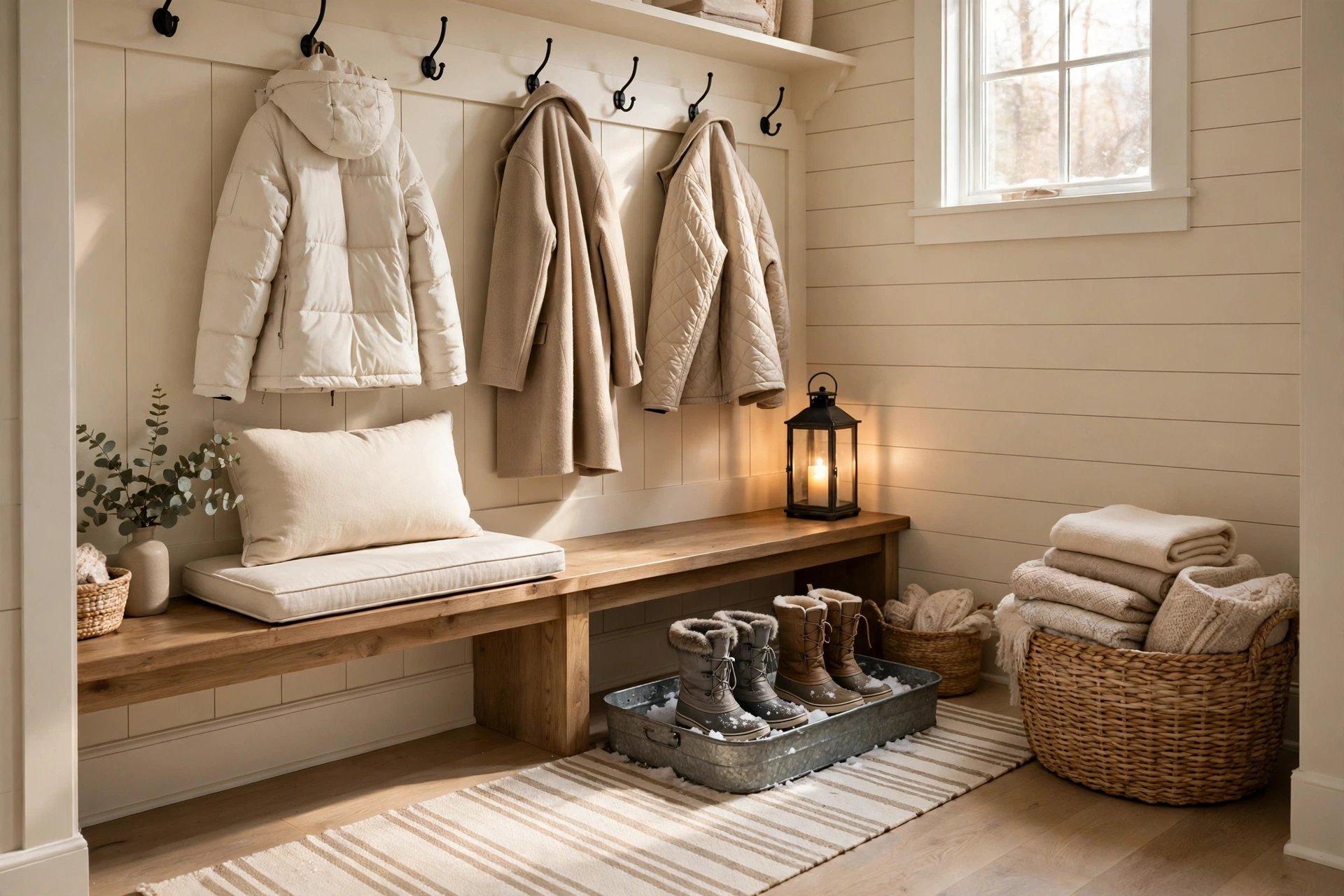
15 Winter Mudroom Decor Ideas for a Cozy Entry
Our first winter in this house, I came home one January evening in the middle of a snowstorm and opened the back door onto a scene I still remember too clearly. Four pairs of boots in a wet heap, two coats sliding off a single hook, a scarf frozen stiff on the floor, and a trail of salt and slush leading straight across the wood floor into the kitchen. My daughter had kicked her snow boots off by the door and they had tipped over, spilling meltwater into a puddle that reached the rug. I stood there with grocery bags in both hands and thought, this little room is the first thing we see when we come home, and it looks like a lost and found bin.
That night I stopped treating the mudroom like a closet and started treating it like a landing strip. A landing strip has a job: everything that arrives gets sorted, dried, and put in its place, fast. Winter mudroom decor is not really about making a small room pretty, though it does that too. It is about building a system so simple that a tired person in a wet coat can follow it without thinking. These 15 winter mudroom decor ideas are the ones that finally worked for us, through three winters of snow, salt, school mornings, and wet mittens.
Before the ideas, here is the rule that holds them all together. I call it Hook, Tray, Basket. Every person in the house gets one hook, one spot on the boot tray, and one basket. That is it. A coat lives on the hook. Boots live on the tray. Hats, gloves, and scarves live in the basket. When something does not have one of those three homes, it ends up on the floor, and the floor is how a mudroom turns into a mess. IMO, most mudroom clutter is not a storage problem, it is a decision problem, and this rule makes the decision for you.
Winter Mudroom Decor for the Landing Zone
The landing zone is the two or three feet just inside the door. This is where winter actually enters your house, snow on boots, salt on shoes, cold air on everything. If you get this strip right, the rest of the room almost takes care of itself. If you get it wrong, no amount of pretty baskets will save you.
1. A boot tray with a real lip, not a flat mat
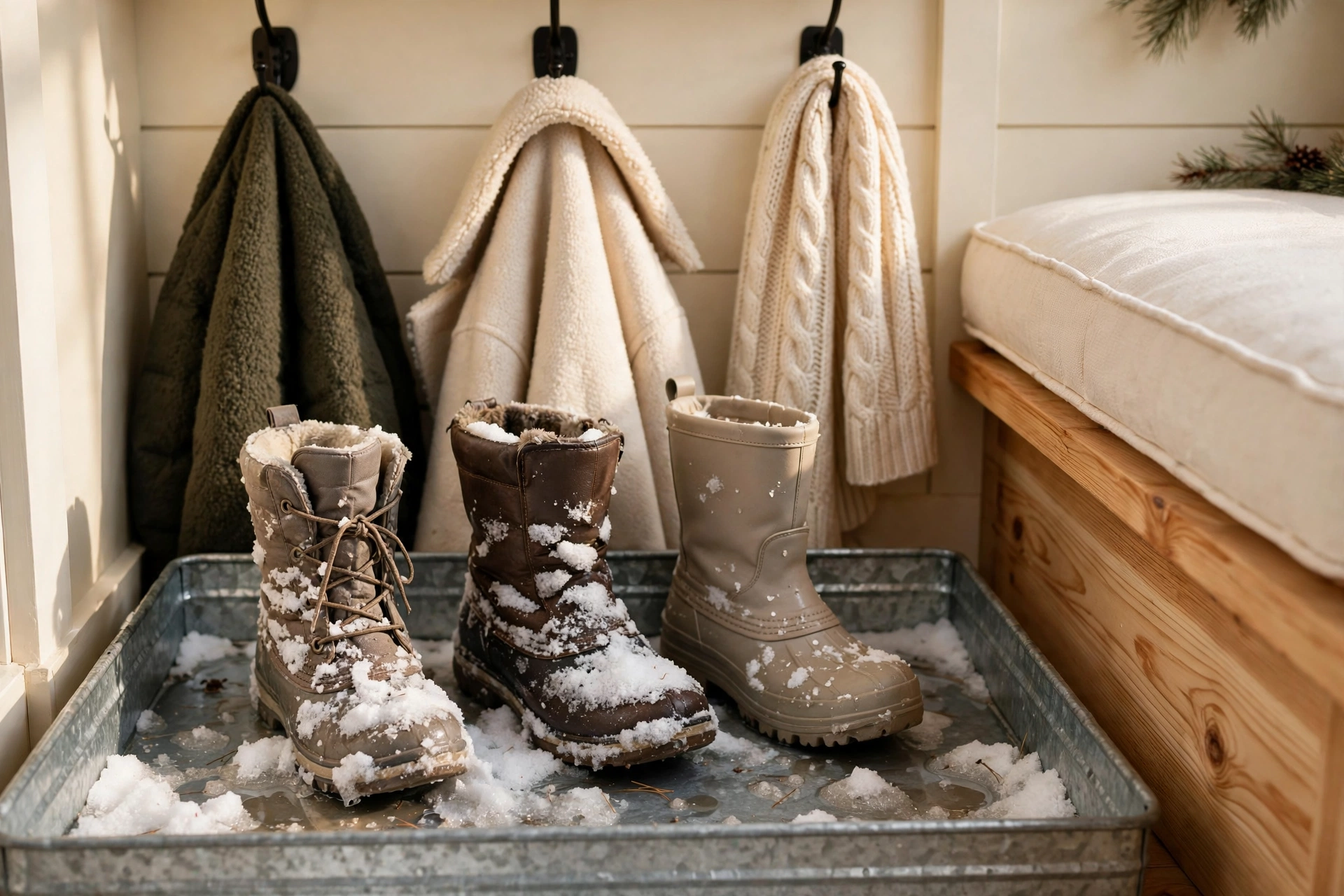
A flat doormat soaks up a little water and then gives up. A boot tray with a raised edge, at least an inch high, holds the meltwater until you can empty it. I learned this the expensive way after salt water crept under a flat mat and left a white stain on the floor that took a whole afternoon to scrub out. Look for a tray in galvanized metal, heavy rubber, or stone. Metal looks best in a farmhouse style mudroom, rubber is the most forgiving if you have kids who drop things, and a stone tray with pebbles drains beautifully and hides dirt. Size it for your household, not your door: two people need about 24 inches, a family of four needs 36 or more. One tray per two people works better than one giant tray, FYI, because you can pull one out and rinse it in the sink without moving the whole row of boots.
2. Hooks at two heights, one per person
One row of hooks at adult height means kids throw their coats on the bench or the floor, because they literally cannot reach. Put a second row at about 48 inches for kids, and give every person their own hook. We used simple black metal hooks on a pine board, five dollars each, and labeled them with small wooden tags. The labels sound fussy until you watch a seven year old hang her coat on her own hook because it has her name on it. Leave one spare hook for guests, and hang it a little apart from the family row so a visitor does not have to squeeze between two wet parkas. If your wall is short, stagger the hooks in two rows, high and low, so coats do not bunch up and block each other.
3. A bench you can actually sit on
A mudroom bench is not decoration, it is where you sit to pull boots off without hopping around on one foot. Ours is a simple pine bench, 16 inches deep and 18 inches high, with a cushion in a washable outdoor fabric. The cushion matters more than the bench: a bare wood bench in January is cold, and nobody sits on a cold bench, so the boots come off standing up and the mess starts again. Under the bench, leave the space open for the boot tray, or add two low baskets for shoes that are not in season. If you are short on space, a wall mounted folding bench works, it flips up when you need the floor for sleds and snow shovels. We keep a folded wool throw on one end of ours, which brings me to the warmth section later, and it doubles as the thing you grab when you are waiting for the car to warm up.
Winter Mudroom Storage That Earns Its Floor Space
A mudroom is usually the smallest room in the house, so every inch of storage has to earn its keep. The test I use is simple: if you cannot reach it with wet gloves on, it is in the wrong place. Open storage beats closed storage here, because nobody opens a cabinet door with an armful of winter gear.
4. Labeled baskets, one per person
This is the basket half of Hook, Tray, Basket, and it is the one that saves the most time on school mornings. Each person gets a basket, about the size of a shoebox and a half, for hats, gloves, scarves, and the random things that live in coat pockets. Ours are seagrass, because they look warm and they hide a lot, but any sturdy basket works. Label them. A chalkboard tag, a wooden tag, or a simple paper label inside a clip frame all work, and the label is what stops the baskets from becoming a shared junk drawer. Keep the baskets at waist height or on a shelf above the bench, never on the floor, because a floor basket becomes a laundry basket within a week.
5. Cubbies that hold the whole winter kit
If you have the wall space, a row of open cubbies is the single best upgrade in winter mudroom decor. Each cubby holds one person’s complete winter kit: boots below, coat on the hook inside, basket above. The open front means you can see at a glance what is missing, which is how you catch the missing glove before you are already in the car. We built ours from three simple box shelves stacked in a row, painted the same cream as the walls, and they cost less than one store bought mudroom unit. If building is not your thing, a bookshelf turned on its side works the same way. Leave the top cubby shelf for out of season things, like the sun hats and the sandals, so winter gear never has to fight for space.
6. A boot rack that lets wet boots drip dry
Boots that sit flat on a tray dry slowly and smell like it. A slatted boot rack, or a simple two tier rack with gaps between the bars, lets air move around each boot and lets water drip down into the tray below. Ours is a plain metal rack, two tiers, and the kids boots go on the bottom where they can reach them. Stuff each boot with a rolled up towel or a pair of old socks overnight if they are soaked through, it pulls the moisture out faster than air alone. FYI, never put wet leather boots right next to a radiator or a heat vent. The heat dries the outside fast and cracks the leather, while the inside stays damp. Room temperature air and time is the kinder way, and the rack gives both.
Warm Winter Mudroom Decor for the Coldest Corner
Mudrooms are cold. They sit by an outside door, they have hard floors, and they get opened to the weather a dozen times a day. The styling trick is to add warmth in ways that can also take a beating. Everything in this section is washable, replaceable, or both, because a mudroom is no place for anything precious. For more cold weather warmth through the whole house, our winter home decor ideas use the same layered approach room by room, and the hygge winter decor guide is the best place to steal the candlelight and texture ideas for a small space like this.
7. A washable runner that can take the salt
A runner does three jobs in a mudroom: it warms the floor under bare feet, it catches the salt and grit that escapes the tray, and it makes the room look finished instead of like a garage. The key word is washable. A wool runner is beautiful and will hold salt stains forever, so save the wool for the living room. We use a low pile indoor outdoor runner in a warm stripe, and it goes in the washing machine once a month, more often in February when the salt is at its worst. Dark patterns hide stains better than light ones, but avoid anything too dark, because then you cannot see the grit you are supposed to sweep up. Leave six inches of floor showing on each side of the runner so the room still looks bigger than it is.
8. A basket of throw blankets by the door
This one sounds decorative, and it is, but it earns its place. A basket of folded throws by the mudroom bench means there is always a warm layer within reach when someone is waiting for a ride, or when you come in from the cold and need five minutes to warm up before you take your coat off. We use chunky knit and fleece throws in cream and oatmeal, rolled rather than folded so you can see all of them at a glance. The basket itself is a big seagrass one on the floor beside the bench, and it doubles as the place where the dog’s blanket lives in our house. Keep it to three or four throws, any more and the basket overflows and the throws end up on the bench.

9. Warm light from a lantern or a sconce
Most mudrooms get one harsh ceiling light, and it makes the room feel like a hallway in an office building. A battery lantern on the bench or a small sconce by the mirror changes the whole feeling for about twenty dollars. We keep a lantern with a warm LED candle on the windowsill, and it goes on the moment the sun goes down, which in January is about four in the afternoon. If you have an outlet, a plug in wall sconce with a warm bulb does the same job and frees up the bench. Skip the cool white bulbs here. Warm light, around 2700 Kelvin, is what makes cream walls and wood tones look cozy instead of washed out, and it is the single cheapest upgrade in this whole list.
The Small Touches That Make a Winter Mudroom Feel Finished
Once the system works, the room still needs the small things that make it feel like part of your home instead of a service entrance. These three cost almost nothing, and they are the ones guests actually notice.
10. A winter wreath on the mudroom door
A wreath on the inside of the mudroom door, or on the wall above the bench, is the first pretty thing you see when you come home. Skip the red berries and the Christmas ornaments in January and go plain winter: eucalyptus, pinecones, dried oranges, and magnolia leaves stay up from New Year through March without looking like a leftover holiday. Our winter wreath ideas have a whole list of these post Christmas combinations, and the eucalyptus and pinecone one is the one hanging in our mudroom right now. Hang it on a simple hook or a suction cup if you do not want to put a nail in the door, and keep it light so the door still closes properly.
11. A scent station with cedar, cinnamon, and a simmer pot jar
A mudroom in winter smells like wet wool and road salt unless you give it something better to smell like. A small wooden tray on the bench holds our scent station: a bundle of cedar, a jar of cinnamon sticks and dried orange slices, and a little bowl of the simmer pot mix we use on the stove. The tray keeps everything contained, and the cedar is the workhorse, it smells like a forest and it absorbs moisture at the same time. Refresh the cinnamon and orange once a month. Skip the plug in air freshener here, the warm air from the vent just pushes the scent out the door every time it opens, and a natural bundle lasts longer anyway.
12. A message board the whole family actually uses
A small chalkboard or a cork board above the bench is where the mudroom earns its keep as the family command center. Ours holds three things only: the week’s schedule, a note about whose turn it is to take the trash out, and the reminder to charge the snow blower battery. Three things is the limit, because a board with twelve notes is a board nobody reads. A framed chalkboard looks better than a bare cork board, and chalk markers write cleaner than real chalk and do not leave dust on the bench. If you have kids, give them the bottom corner of the board for their own drawings and reminders. It is their room too, and a kid who helped decorate the board is a kid who hangs up their coat.
Keeping a Winter Mudroom Tidy All Season Long
A mudroom is not a set it and forget it room. It needs two tiny habits to stay working all winter, and both take less time than finding a lost glove.
13. The nightly two minute reset basket
Every evening, before bed, someone does the two minute reset. It is a basket, kept on the bench, and the job is simple: walk through the mudroom, pick up anything that is not in its hook, tray, or basket home, and put it in the reset basket. In the morning, the basket gets emptied back to the right homes, and anything left in it after two days gets moved to its real home somewhere else in the house. The basket is the secret weapon because it gives clutter a temporary home instead of a permanent one. We started this the winter my daughter was seven, and it is still the rule, because two minutes at night beats twenty minutes of searching in the morning.

14. A salt and snow gear station by the door
Winter gear multiplies: ice melt, a snow brush, a small shovel, the dog’s paw towel, the extra pair of gloves you keep forgetting. Give all of it one station, a tall narrow basket or a galvanized bucket right beside the door, and it stops spreading across the room. Ours holds the ice melt in a lidded jar, the snow brush, and a stack of old towels for wiping paws and boots. The rule is that anything used outside the door lives in this station, and anything used inside the house lives in the baskets. When the station is full, something has to leave. That one rule has kept our mudroom from slowly turning into a garden shed three winters running.
15. The seasonal swap: Christmas out, plain winter in
The last idea is about timing. The week after Christmas, take the red and gold out of the mudroom and swap in plain winter: cream, oatmeal, pine green, and natural wood. The wreath loses its ornaments and keeps its pinecones. The red throw comes off the bench and the oatmeal one goes on. The scent station swaps cinnamon for cedar. It takes twenty minutes, and it is the difference between a mudroom that feels tired in January and one that feels fresh until March. Our winter table decor follows the same swap, and the Christmas entryway decor post is the one to revisit if you want to see what the holiday version looked like before the swap.
The Wet Boot Test
Here is the second framework, and it is the test for the whole system. I call it the Wet Boot Test. After the first real snow of the season, come home, take your boots off the way you normally would, and look at the floor. If all the meltwater is inside the tray, the system works. If water has reached the floor, something is wrong, and it is almost always one of three things: the tray is too small, the tray is too flat, or the boots are not actually landing on the tray. Fix the one that is true and test again after the next snow. A mudroom that passes the Wet Boot Test in January will still be working in March, and that is the whole point.
The Moisture and Durability Check
Before you buy anything for a winter mudroom, run this check. Everything in the room will get wet, salty, and cold, and then warm and dry, over and over, all season. That cycle is what kills cheap materials. Wood needs a sealant, at least two coats of polyurethane on any surface that touches the floor. Fabric needs to be washable, so check the label before you fall in love with a cushion. Metal needs to be powder coated or galvanized, because bare steel rusts the first time a salty boot drips on it. And the floor itself needs a rug pad that does not trap water underneath, a rubber backed pad beats a felt one here. If a product description says spot clean only, it does not belong in a mudroom. If it says machine washable, outdoor rated, or sealed, it does.
Budget: Buy Once vs Buy Each Winter
Buy once: the bench, the hooks, the boot tray, and the boot rack. These are the bones of the system, and cheap versions wobble, rust, or crack by February. Spend the real money here, and buy them in a finish you will still like in three years. Buy each winter, or even just once and refresh: the runner, the baskets, the throw blankets, the scent bundles, and the wreath. These are the soft layers, and they are where you get to change the look without spending much. A new runner and a new throw each year costs less than one dinner out, and it is what makes the room feel new in January instead of tired. Thrift stores are great for the baskets and the lantern, by the way, because both look better with a little wear. The one thing I would never buy used is a boot tray, because a warped tray does not hold water, and that is its whole job.
No Mudroom? Steal These Ideas for a Hallway Corner
Most houses do not have a real mudroom, and that is fine. Everything in this list works in a hallway corner, it just gets smaller. A boot tray by the front door, three hooks on the wall, one basket on a shelf above, and a runner to mark the zone. The runner matters most in a hallway, because it draws the line between the landing strip and the living room, and guests understand the line without being told. A narrow console table with a basket underneath can stand in for the bench, and a wall mounted folding bench takes up zero floor when it is not in use. The rule is the same, Hook, Tray, Basket, just scaled down. If the hallway is really tight, skip the bench entirely and put a small stool by the door instead. The point is a place to sit and a place for the boots, not a separate room.
Troubleshooting: 5 Quick Fixes When the Mudroom Still Feels Like Chaos
1. Coats keep falling off the hooks. The hooks are too close together or too shallow. Space them at least six inches apart and use hooks with a deep curve, not a peg. Heavy winter coats need a hook they can actually hang on.
2. The room smells like wet boots. Stuff boots with newspaper or old towels overnight, and put a small open bowl of baking soda on the shelf. The baking soda absorbs the smell, and the stuffing pulls the moisture out. Replace the baking soda once a month.
3. Salt stains on the floor. Mix equal parts white vinegar and warm water, wipe, then rinse with plain water. Do it the same day if you can, because salt that sits eats into the finish. A quick wipe takes two minutes and saves a refinish.
4. One person never uses the system. Give that person the easiest version of it. One hook at their height, one basket with their name on it, and the tray right where their boots land when they kick them off. Systems fail when they ask for effort, so move the system to where the person already is.
5. The room fills up with out of season stuff. Do a ten minute swap on the first of every month. November: sandals out, boots in. April: boots out, sandals in. Anything that has not been used in a month goes to its real home somewhere else in the house.
Frequently Asked Questions
How do I keep a mudroom from smelling like wet boots in winter?
Airflow and drying are the fix, not air freshener. Use a slatted boot rack so air moves around each boot, stuff soaked boots with newspaper or old towels overnight, and keep a small open bowl of baking soda on a shelf to absorb odors. A cedar bundle helps too, and it smells better than any spray.
What is the best flooring for a winter mudroom?
Tile, sealed concrete, or luxury vinyl plank are the best choices, because all three handle water, salt, and grit without damage. Wood can work if it is sealed well and you keep a boot tray between the boots and the floor, but it needs more care. Avoid carpet in a mudroom, it holds moisture and salt and is very hard to clean properly.
How do I decorate a mudroom with no natural light?
Warm light and light colors do the heavy lifting. Paint the walls cream or warm white, add a lantern or a sconce with a warm bulb, and use a mirror to bounce the light around. Light colored baskets and a pale runner keep the room from feeling like a cave, and a small plant that tolerates low light, like a pothos, adds life without needing a window.
Can I make a mudroom in a small hallway?
Yes, and it takes less space than you think. A boot tray, three hooks, one basket on a shelf, and a runner to mark the zone is a complete mudroom in about four square feet. Use a wall mounted folding bench if you want a seat without losing floor space, and keep the palette light so the hallway still feels open.
When should I swap Christmas decor out of the mudroom for plain winter decor?
The week after Christmas is the right time. Take out the red and gold, keep the pinecones, eucalyptus, and natural wood, and swap in cream and oatmeal textiles. The whole swap takes about twenty minutes, and the plain winter look stays fresh from January through March.





One Comment