
25 Patterned Tile Bathroom Ideas for a Bold Look
My bathroom used to be the most boring room in the house. Plain white square tiles, white grout, a white vanity, and a mirror I had never once looked at twice. It worked, in the way a waiting room works. Then I visited a friend who had just redone her tiny bathroom with a black and white checkerboard floor, and I stood in her doorway for a full minute just looking at the floor. Nothing else in the room was fancy. Same white walls, same plain mirror, same ordinary faucet. But that floor changed everything, and I walked home thinking about tile for the first time in my life. That is the whole secret of patterned tile bathroom decor: one confident pattern does the work of an entire renovation, and most of the ideas below cost less than a new faucet.
So this guide is built around twenty-five patterned tile bathroom decor ideas that bring that same wow into your bathroom without ripping anything out. Some of them are real tile jobs, and some of them are peel-and-stick, paint, or a single box of tile on one small wall. Patterned tile is back in a big way in 2026, encaustic stars, hexagons, checkerboard, and stripes are everywhere in the bathroom roundups, and the reason is simple: a bathroom is small, you see it every day, and a pattern you love makes the whole room feel designed instead of assembled. IMO, the bathroom is the bravest room in the house for pattern, because it is the one room where a bold choice never has to compete with a sofa or a rug. If you love the warm side of bathroom style too, our terracotta bathroom decor guide is the cozy cousin of this one, and the two styles share the same warm wood and brass.
Two ideas run through everything below. The first is the Floor, the Wall, the Accent rule: pattern should live in exactly one of those three places, never all three at once. Pick the floor, or pick the wall, or pick one small accent, and let everything else stay quiet. The second is the Wet Test: before you commit to any tile, splash water on a sample and watch what happens. If the water beads up, the tile is sealed and safe. If it soaks in dark, it needs sealing. And if your foot slips on the wet sample, that tile belongs on a wall, not a floor. FYI, the Wet Test takes thirty seconds and has saved me from more bad tile choices than any showroom visit ever did.
Floors That Do the Talking
1. A black and white checkerboard floor
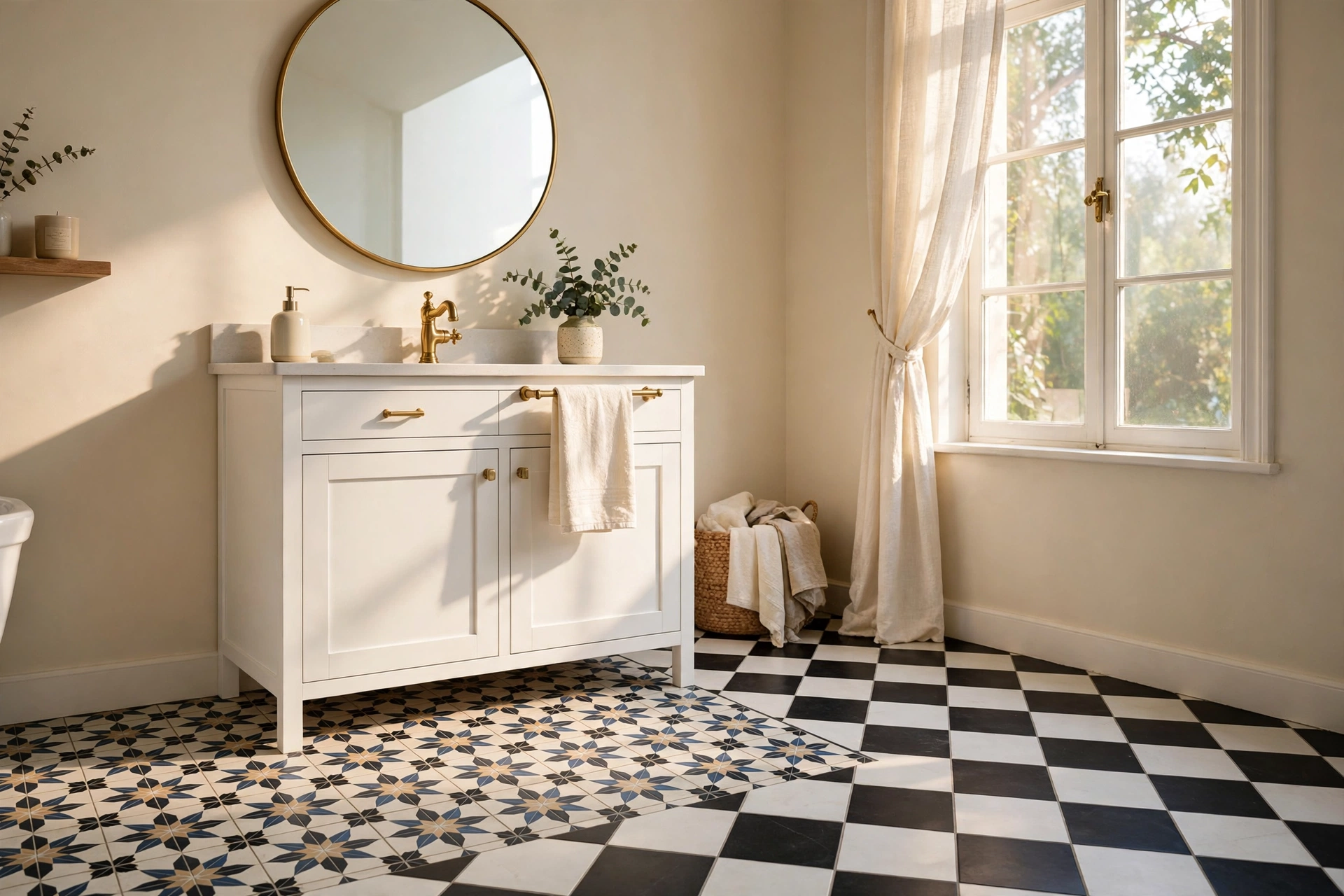
Nothing says patterned tile faster than a black and white checkerboard floor, and nothing changes a bathroom more for the money. If your floor is already white tile, you can fake the look with peel-and-stick black squares on every other tile, and the result reads as intentional from the doorway. If you are replacing the floor, large checkerboard squares, twelve inches or bigger, look more expensive than small ones, because fewer grout lines make the pattern feel calmer. Keep the rest of the room simple, because a checkerboard floor is the loudest voice in the room and it does not need competition. Our black and white bathroom decor guide uses the same contrast trick with a simpler palette.
2. Encaustic-look tiles with a star pattern
Encaustic tiles, the cement-look tiles with bold star and flower patterns, are the most pinned bathroom floor of 2026, and for good reason. One patterned tile repeated across the floor makes a rug you never have to wash, and the pattern hides dust and water spots better than any plain tile. Real cement encaustic needs sealing and care, but porcelain lookalikes give you the same pattern with none of the maintenance, and they cost about the same as ordinary floor tile. Lay them in a straight grid, never diagonally, because the pattern is busy enough already and a diagonal layout fights it.
3. Hexagon tiles in two tones
Hexagon tiles are the friendly face of patterned tile, because the shape is soft and the pattern feels playful instead of formal. Use two tones, white and sage, or cream and dusty blue, and let the hexagons drift from one color to the other across the floor like a wave. The trick is to keep the color change gradual, a band of mixed hexagons in the middle, rather than a hard line, because the blend is what makes it look designed. Small hexagons, about two inches, give you the most pattern for the money, and they grip bare feet better than big smooth tiles, which is a quiet bonus on a wet floor.
4. Striped floor tiles that stretch the room
Stripes are the oldest trick for making a small room feel bigger, and they work on a bathroom floor better than anywhere else. Run striped tiles lengthwise down a narrow bathroom and the room reads longer, because your eye follows the lines. Choose two tones close together, cream and soft gray, rather than a high contrast pair, because a bathroom floor should stretch the room, not shout at it. If real striped tile is hard to find, lay plain rectangular tiles in alternating tones, and the stripe appears on its own for the price of ordinary tile.
5. Terrazzo-look tiles for soft pattern
If bold pattern scares you, terrazzo-look tile is the gentle way in, because the pattern is just speckles and chips scattered across a calm background. It reads as plain tile from the doorway and reveals its confetti pattern up close, which is exactly the right amount of interest for a bathroom you use half asleep. Terrazzo-look porcelain is tough, it hides hair and dust, and it pairs with everything, wood, brass, black, white. Use it on the floor and keep the walls plain white, and the bathroom feels like a boutique hotel without a single bold decision.
Walls With Personality
6. One feature wall in the shower
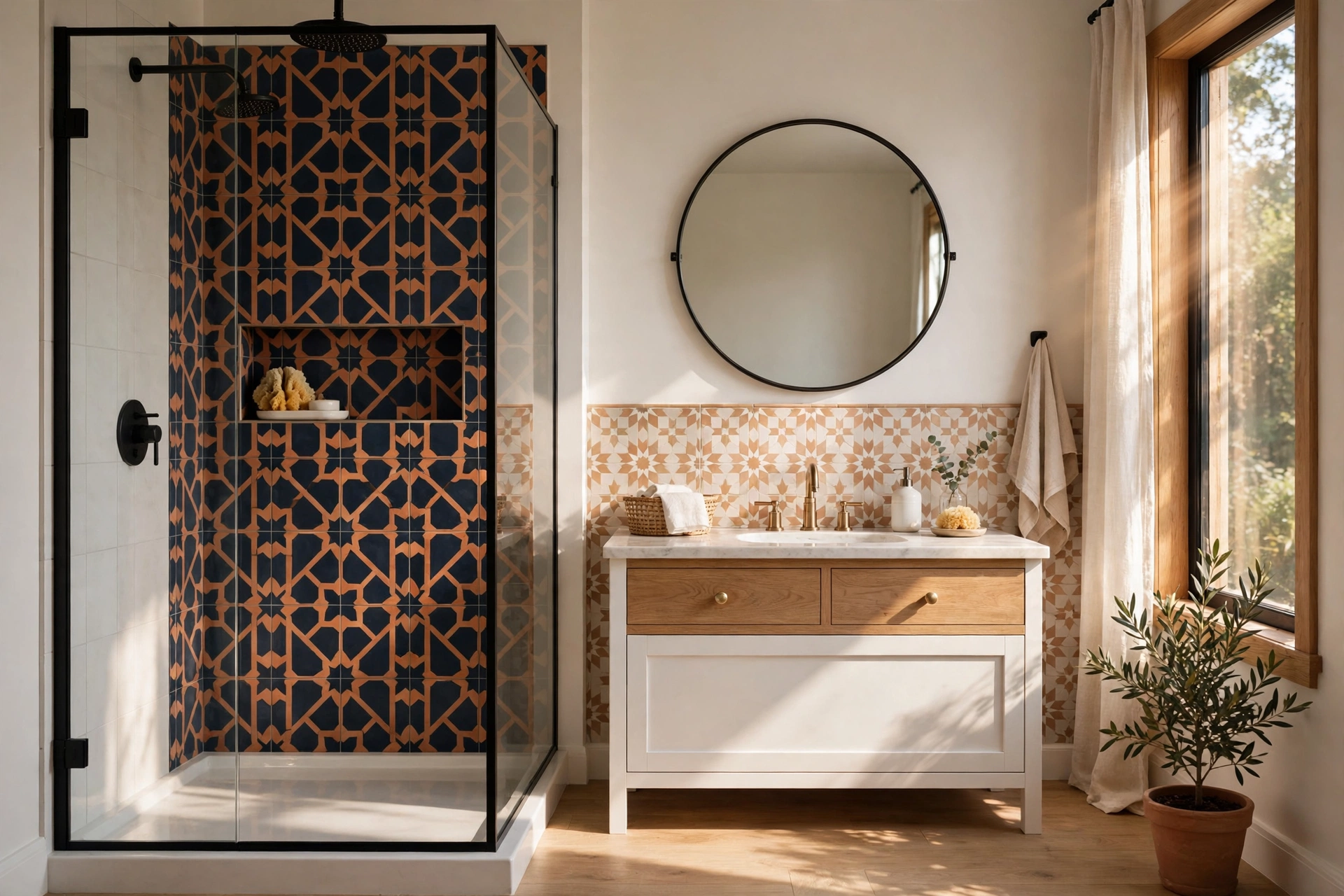
A shower feature wall is the single best place for a bold patterned tile, because it is the wall you look at every single morning and it is framed by the shower glass like a picture. Pick one pattern, a fish scale, a fan, or a bold geometric, and run it floor to ceiling on the back shower wall only. The other shower walls stay plain white, which makes the pattern pop and keeps the shower from feeling closed in. This is the idea I would do first if I could only do one thing in the whole guide, because you see it every day and it costs one box of tile.
7. A patterned backsplash behind the vanity
The vanity backsplash is the smallest canvas in the bathroom, and that is exactly why it is perfect for pattern. You only need about two feet of tile, so a single box covers it, and the pattern sits right behind the faucet where your eye lands every morning. Choose a handmade-look tile, zellige or encaustic, in a color pulled from your towels, and keep the grout a soft sandy tone so the pattern stays warm. If real tile feels like too much, peel-and-stick patterned tiles hold up fine behind a vanity as long as they stay out of direct shower spray.
8. Patterned wainscot on the lower half of the wall
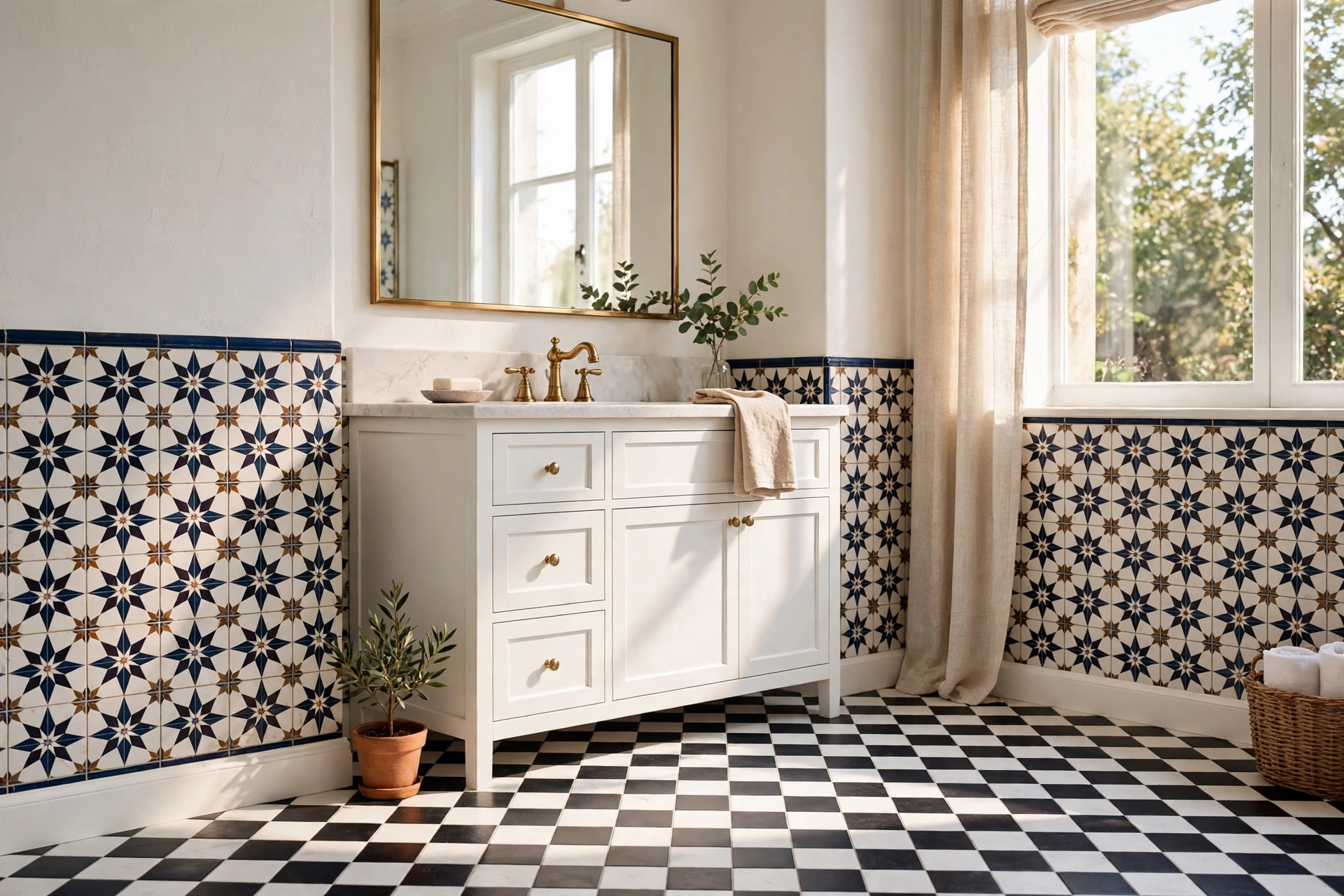
Pattern on the lower half of the wall and plain paint above is the classic bathroom proportion, and it works because the pattern stays at the level where the splashes happen. Run patterned tile up to about waist height around the room, then paint the upper wall a soft cream or sage, and the bathroom feels taller and calmer than a fully tiled room. This is also the budget move, because you tile half the wall and paint the rest, and the paint color can change with the seasons for the price of a sample pot.
9. A patterned niche inside the shower
A shower niche lined with patterned tile turns a shampoo shelf into a piece of jewelry. The niche is tiny, so you can use the most expensive tile you love, a hand-painted star or a deep green fish scale, and one box covers it with plenty left over. Keep the bottles to three so the pattern stays visible, and choose a pattern that echoes the floor or the backsplash so the room feels connected. Even a rented bathroom can fake this with a small patterned tile tray hung in the shower, as long as it drains and dries between uses.
10. A half-wall of pattern behind the tub
The wall behind a freestanding tub is the backdrop for the whole bathroom, so give it the pattern. A half-wall of bold tile behind the tub, with plain paint above, frames the tub like a stage and makes the whole room feel intentional. Choose a pattern with one strong color, deep green or dusty blue, and keep the tub itself white so the tile does the talking. If your tub sits against a plain wall today, a single row of patterned tile as a border at the top of the half-wall gives you the same framed look for a fraction of the tile.
Small Bathrooms, Big Pattern
11. One bold floor in a powder room
A powder room is the bravest room in the house for pattern, because it is tiny, nobody showers in it, and guests see it more than any other bathroom. Give it the boldest floor you love, a checkerboard, a star encaustic, a wild geometric, and keep the walls plain. The pattern becomes the whole personality of the room, and because the room is small, one box of tile covers the floor. This is the room where I always say go bigger than you think, because a timid pattern in a powder room just looks like a mistake.
12. A single border strip of pattern
If a whole patterned wall feels like too much, a single border strip of patterned tile is the quiet way in. Run one row of patterned tile around the room at waist height, or along the top of the wainscot, and the room gets a line of personality without any commitment. The strip works as a bridge between the floor and the wall, so choose a pattern that shares one color with each. This is also the cheapest entry point in the whole guide, because one row of tile costs less than a dinner out and changes the room tomorrow.
13. Vertical stacked tiles that lift a low ceiling
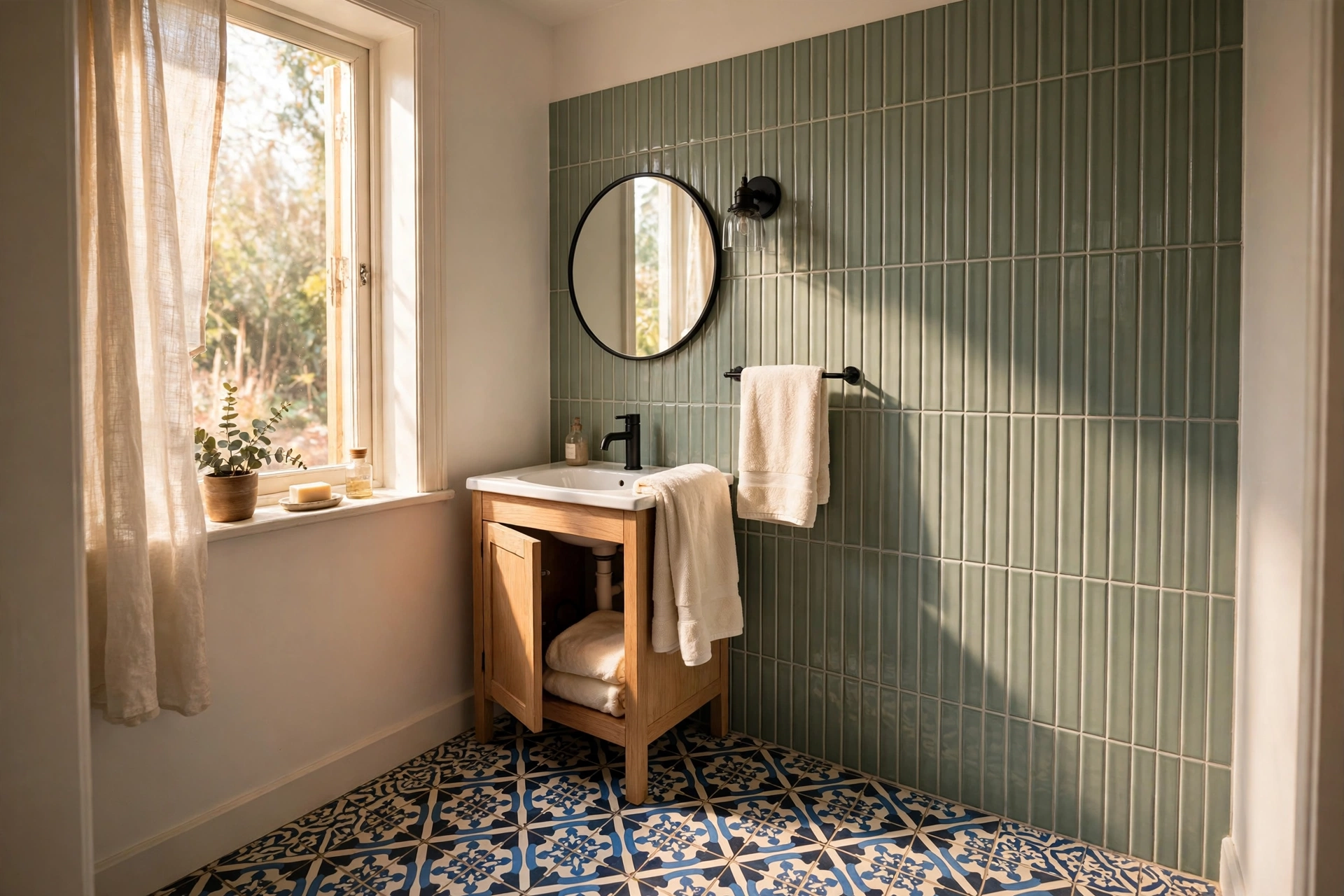
Vertical stacked tiles, plain rectangles laid straight up in columns, make a low bathroom ceiling feel taller, because your eye follows the lines upward. Add a pattern by alternating two tones in the columns, cream and sage, or white and soft blue, and the wall gets a gentle stripe that never overwhelms the room. This is the pattern for people who want interest without busyness, and it works beautifully in a small bathroom where a bold floor would fight the mirror. Our modern bathroom decor guide uses the same vertical trick in a plainer room.
14. Pattern only where the mirror reflects it
Here is a trick I wish someone had told me sooner: put the pattern on the wall opposite the mirror, not behind it. The mirror doubles the pattern, so one patterned wall reads as two, and the bathroom feels twice as decorated for the same tile. Stand in the doorway, look in the mirror, and whatever the mirror shows is the wall that deserves the pattern. This works in the smallest bathroom, because the reflection does half the work, and it is the reason a single patterned wall can carry a whole room.
Color Stories in Patterned Tile
15. Black and white, the classic that never dates
Black and white is the patterned tile palette that never goes out of style, because the contrast does the work and the colors match everything you already own. A black and white checkerboard, a black and white star, a black and white stripe, all of them read as confident rather than trendy, and they look just as good in ten years as they do today. Keep the rest of the room warm, a wood tray, a cream towel, a brass faucet, because black and white alone can feel cold, and one warm thing is all it takes to fix it.
16. Blue patterns for a calm, coastal feel
Blue patterned tile is the calmest pattern you can put in a bathroom, because blue is the color of water and the room already feels like water. A dusty blue and white geometric on the shower wall, or a soft blue hexagon on the floor, makes the bathroom feel like a quiet morning by the sea. Keep the blue muted, dusty or slate rather than bright, because a bathroom is a room for waking up slowly, and a loud blue fights that. Pair it with white towels and a wood stool, and the room feels like a spa without a single spa product.
17. Green and sage for a garden bathroom
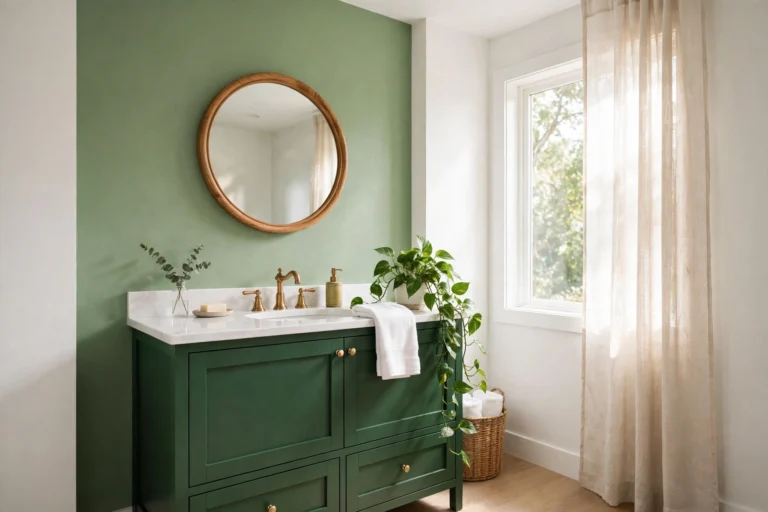
Sage green patterned tile is the 2026 favorite for a reason, because it brings the garden into the wettest room in the house without a single plant. A sage and cream encaustic on the floor, or a deep green fish scale in the shower, pairs with warm wood and brass better than any other color in this guide. Green also hides water spots and soap marks better than white, which is a small daily mercy. If your bathroom has no window, sage is the color that makes it feel like it does, because your eye reads green as daylight.
18. Warm terracotta and clay patterns
Warm terracotta patterned tile is the cozy end of this guide, and it is the pattern that makes a bathroom feel like a home rather than a hotel. A terracotta and cream star tile on the floor, or a clay-toned geometric on the backsplash, warms up cold mornings in a way no other color does. Pair it with cream towels, a wood vanity, and brass fixtures, and the whole room glows. Our art deco bathroom decor guide uses the same warm metal pairing, and the two styles sit beautifully side by side.
Mixing Patterns Without the Mess
19. The scale rule: one big, one small, one plain
The scale rule is the whole secret of mixing patterns: one big pattern, one small pattern, and one plain surface. A big checkerboard floor, a small hexagon backsplash, and plain white walls, and the room feels layered instead of loud. The mistake is two big patterns, which fight each other for attention, or three small patterns, which blur into noise. Write the three down before you buy anything, big, small, plain, and if you cannot name all three, you are buying too much pattern.
20. One color thread through every pattern
Every pattern in the room should share at least one color, because that shared color is the thread that ties them together. If the floor is black and white, the backsplash should have black or white in it, not a third color that appears nowhere else. Pull the thread color from the biggest pattern in the room, usually the floor, and check every other pattern against it before you buy. This is the rule that makes a checkerboard floor and a floral backsplash look intentional together, and breaking it is the reason most mixed-pattern bathrooms look like an accident.
21. Grout color is a design choice, not an afterthought
Grout color changes a patterned tile more than the tile itself, because the grout is the frame around every single piece. Dark grout makes a pattern bolder and more graphic, light grout makes it softer and quieter, and a grout that matches the tile makes the pattern almost disappear. Choose the grout after you choose the tile, and test it on three tiles before you commit to the whole room, because grout dries darker than it looks wet. Seal dark grout in a wet room, because it needs the same care as any grout, and wipe it once a week so soap never dulls the lines.
22. Wood calms every pattern down
Wood is the peacemaker of a patterned bathroom, because it is warm, plain, and natural, and it gives your eye somewhere to rest. A wood vanity, a wood stool, a wood-framed mirror, or even a wood tray on the counter, and the boldest tile suddenly feels like a home instead of a showroom. The wood does not have to match anything else in the room, because wood matches everything, and one wood piece is enough. If your bathroom feels too busy after the tile goes in, add wood before you rip anything out, because wood fixes busy faster than any other material.
Finishing Touches
23. A mirror that echoes the tile shape
A mirror that echoes the tile shape ties the whole room together without a single extra purchase. Hexagon floor, hexagon mirror. Arched tiles, arched mirror. Checkerboard floor, a square mirror with a black frame. The echo is subtle, most guests will never notice it, but the room feels designed in a way they cannot quite name. Choose the mirror after the tile, not before, and hold it up against the wall to check the echo before you hang it, because a mirror that fights the tile shape is worse than a plain one.
24. Towels and textiles that let the tile lead
Towels are the biggest soft surface in a bathroom, so they should let the tile lead. In a patterned tile bathroom, keep the towels plain, in one color pulled from the tile, and nothing else. No patterns on the towels, no bright colors, because every extra pattern dilutes the tile. Fold them in thirds and stack them with the fold facing out, and the towel stack becomes part of the design instead of a pile of laundry. Two bath towels and two hand towels in the tile’s quietest color are all you need to start, and they cost less than a box of tile.
25. Seal it, photograph it, and call it done
The last idea is not a decoration, it is a check. Seal the grout and any natural tile, then take a photo of the bathroom from the doorway and look at the photo instead of the room. A photo shows clutter your eyes forgive in person, a tile that is crooked, a corner that is too empty, a color that does not belong. Fix whatever the photo shows, take one more, and when the photo looks calm and balanced, you are done. I do this with every bathroom I style now, including the Christmas bathroom decor and the terracotta bathroom from our other guides, and it has never steered me wrong.
The Durability and Water Check: Steam, Splashes, and Grout
A bathroom is the wettest room in the house, so check three things before you style it. First, steam: patterned cement-look tiles can spot in steam if they are unsealed, so choose porcelain lookalikes or seal real encaustic twice before the first shower. Second, splashes: keep paper, fabric, and unsealed wood away from the sink edge, because one splash a day ruins them in a month. Third, grout: a patterned floor hides dirt beautifully, but the grout still needs sealing, so seal it after any tile job and re-seal once a year. This three-minute check saves the whole look, because a pattern that cannot survive a shower is not a pattern, it is a chore.
Buy Once vs Buy Every Year
Buy once, and buy well: the floor tile, the shower feature wall tile, a good mirror, and the faucet. These four pieces carry the look year after year, and spending a little more on them pays off every single morning. Buy every year, and buy cheap: the towels, the soap, the small plant on the vanity, and the bath mat you will wash a hundred times. The fresh pieces are what make the bathroom smell good and feel cared for, and they are also the pieces you will happily replace. My rule is simple: if it is glued down or screwed in, buy it once and buy it well; if it wilts, dries out, or gets used up, buy it fresh and cheap every year.
Small-Space Variations
A tiny bathroom can still do patterned tile, it just needs a smaller version of the formula. Use one bold floor or one patterned wall, never both, and keep the other surfaces plain white so the room still feels big. If your bathroom is a powder room with no shower, you have even more freedom, because nothing gets wet, so unsealed encaustic, a fabric shade, and a wood tray are all fair game. In a rental, lean on the peel-and-stick tiles, the border strip, and the towels, because those three change the room without touching a single wall. And if your bathroom has no window, lean harder on the mirror and the pattern opposite it, because the reflection is the only daylight a windowless bathroom gets.
Troubleshooting Fixes
If the room feels too busy, add one plain thing, a cream bath mat, a plain white towel, or a wood tray, because plain surfaces are the pause a patterned room needs. If the pattern feels too small and fussy, step back to the doorway, because a pattern that looks busy up close often reads perfectly from three feet away. If the grout lines look dirty against the pattern, seal them and wipe them once a week, because clean grout is what makes a pattern look expensive. If the floor pattern fights the wall pattern, remove the smaller one, because one pattern always wins and the other should go quietly. If the room still feels flat, add one curved thing, a round mirror or an arched tray, because pattern needs curves to soften all those straight lines.
Frequently Asked Questions
What is patterned tile bathroom decor?
Patterned tile bathroom decor uses tiles with a printed or shaped pattern, like checkerboard, encaustic stars, hexagons, or stripes, to make the bathroom floor or walls the main design feature. The pattern replaces the need for art or bold paint, and one confident pattern usually carries the whole room.
Does patterned tile make a small bathroom look smaller?
No, if you follow the one-pattern rule. One bold floor or one patterned wall in a small bathroom actually makes it feel designed and bigger, because your eye has one clear thing to follow. Two or three competing patterns are what make a small room feel cramped.
What patterned tile is best for a shower floor?
Small hexagon or penny tiles in porcelain are the safest shower floor, because the many grout lines grip bare feet and the porcelain never needs sealing. Keep the pattern small on a shower floor, because a big pattern underfoot can feel dizzying when it is wet.
How do I mix patterned tile with other patterns?
Use the scale rule: one big pattern, one small pattern, and one plain surface, and make sure every pattern shares at least one color. If the floor is black and white, the backsplash should carry black or white too, so the room feels tied together instead of random.
How do I clean and seal patterned tile?
Seal the grout and any cement-look tile before the first shower, then re-seal once a year. Clean with a gentle pH-neutral cleaner and a soft cloth, never bleach on colored grout, and wipe the floor once a week so soap never dulls the pattern.

One Comment