
15 Marble Bathroom Decor Ideas for a Timeless Look
The first time I walked into a marble bathroom, I was eleven years old and it was at a hotel my parents could barely afford for one night. I remember standing in the doorway in my socks, staring at the floor, because the floor looked like frozen clouds. White stone, grey veins running through it like rivers on a map, and my own reflection staring back at me from the polish. I was afraid to touch anything. Twenty-five years later I still think about that bathroom every time I plan one, because it taught me the whole secret of marble bathroom decor: marble does not need to shout. It just needs room to be itself.
That hotel bathroom also taught me the expensive lesson, which I learned the hard way in my own home years later. I put a beautiful Carrara marble top on my vanity, then set a bottle of lemon-scented cleaner on it, and by morning there was a dull ring where the bottle had sat. Marble is a natural stone, and natural stone has feelings. It stains, it etches, it chips if you drop a heavy bottle on the edge. None of that means you should avoid it. It means you should plan for it, the same way you plan for anything beautiful in a house that gets used every day.
This guide has 15 marble bathroom decor ideas that work in real bathrooms, from full marble walls to one small marble tray on the vanity. Most of them cost far less than a full remodel, and the budget section at the end shows you how to get the look without the stone-yard bill. Marble has been in style for two thousand years, and IMO, it is the safest bet in home decor. Trends come and go, but a white marble bathroom never looks dated.
If you want the whole bathroom to feel like a spa when you are done, my spa bathroom decor post covers the towels, the candles, and the calm routines that pair perfectly with marble.
The Marble Triangle: My Three-Surface Rule
Before we get to the 15 ideas, here is the rule that saves me every single time. I call it the Marble Triangle, and it has three points: walls, floor, and vanity.
Marble belongs on at most two of those three surfaces, never all three in the same stone. If your walls are marble, let the floor be something quieter, like a warm wood-look tile or a plain matte porcelain. If your floor is marble, keep the vanity top simple, a solid white quartz or a honed limestone that does not fight the floor. Two marble surfaces give you the luxury. The third surface in a different material gives your eyes a place to rest, and it is what keeps a marble bathroom from looking like a showroom.
The second part of the rule is about the veins. Pick one vein direction and let it lead. If your wall tile has strong diagonal veins, your vanity top should have soft veins running the same way, or almost no veins at all. When two marble pieces have loud veins going in different directions, the room starts to feel busy, even if you cannot say why.
Keep the Marble Triangle in mind as you read. Every idea below names which point of the triangle it sits on, and if you mix and match, check that you still have no more than two marble surfaces in the same stone.
Marble Walls That Set the Tone
Walls are where marble makes its biggest statement, because they are the first thing you see when you walk in. These three ideas start at the walls and work outward.
1. Large-Format Marble Tile on the Shower Walls
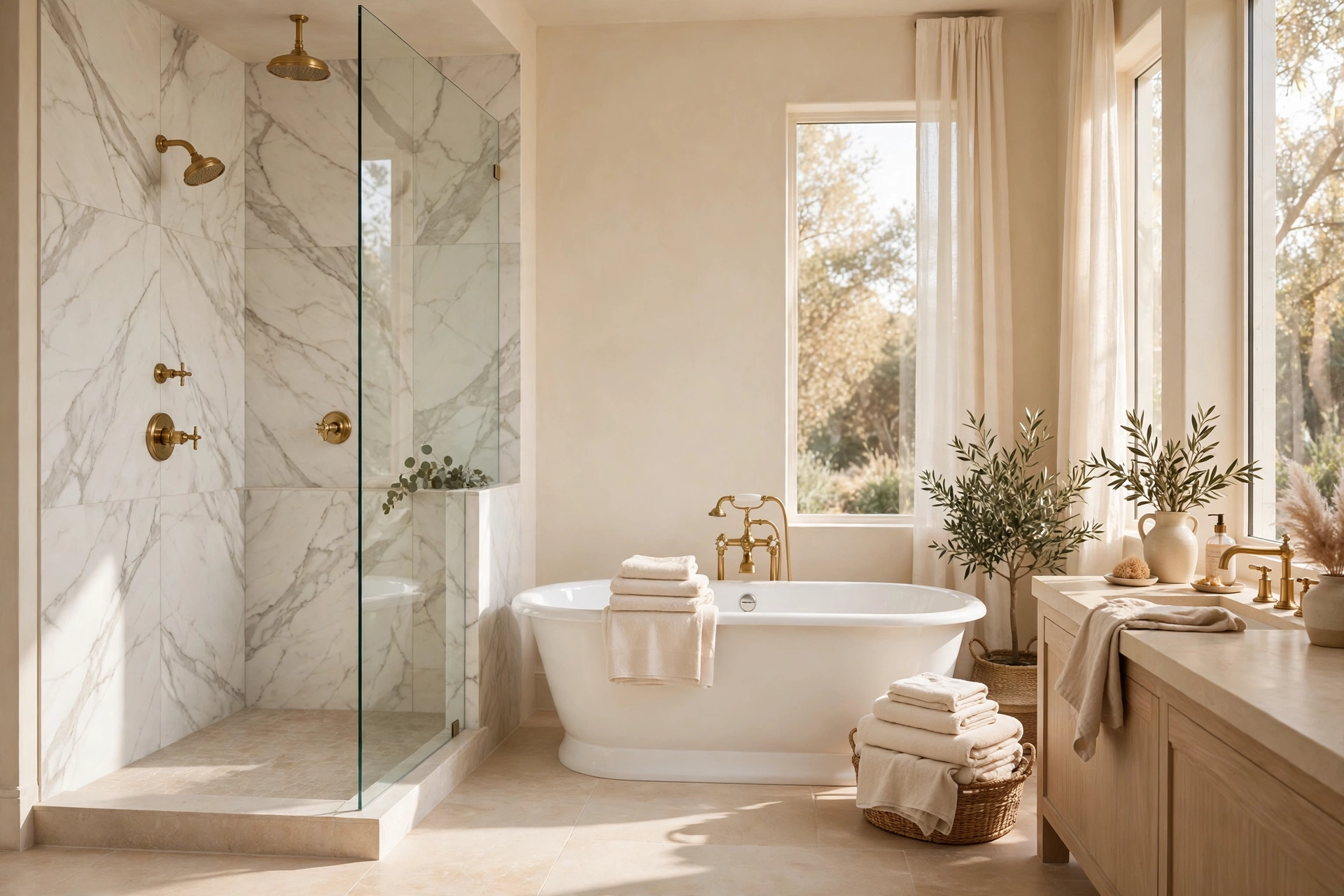
Use large-format marble tile, 24 by 48 inches if your shower can take it, on the shower walls, with the veins running vertically so the eye travels up. Fewer grout lines mean the stone reads as one big slab instead of a patchwork, and that is the whole trick. A niche in the same marble, cut from the same tile, holds the shampoo bottles without breaking the pattern. This is the walls point of the Marble Triangle, and once the shower is done, the rest of the room can stay simple. FYI, ask your tile setter to book-match the two main walls if the budget allows, so the veins mirror each other across the corner. It looks like a million dollars and costs nothing extra in material.
2. A Full Marble Slab Backsplash Behind the Vanity
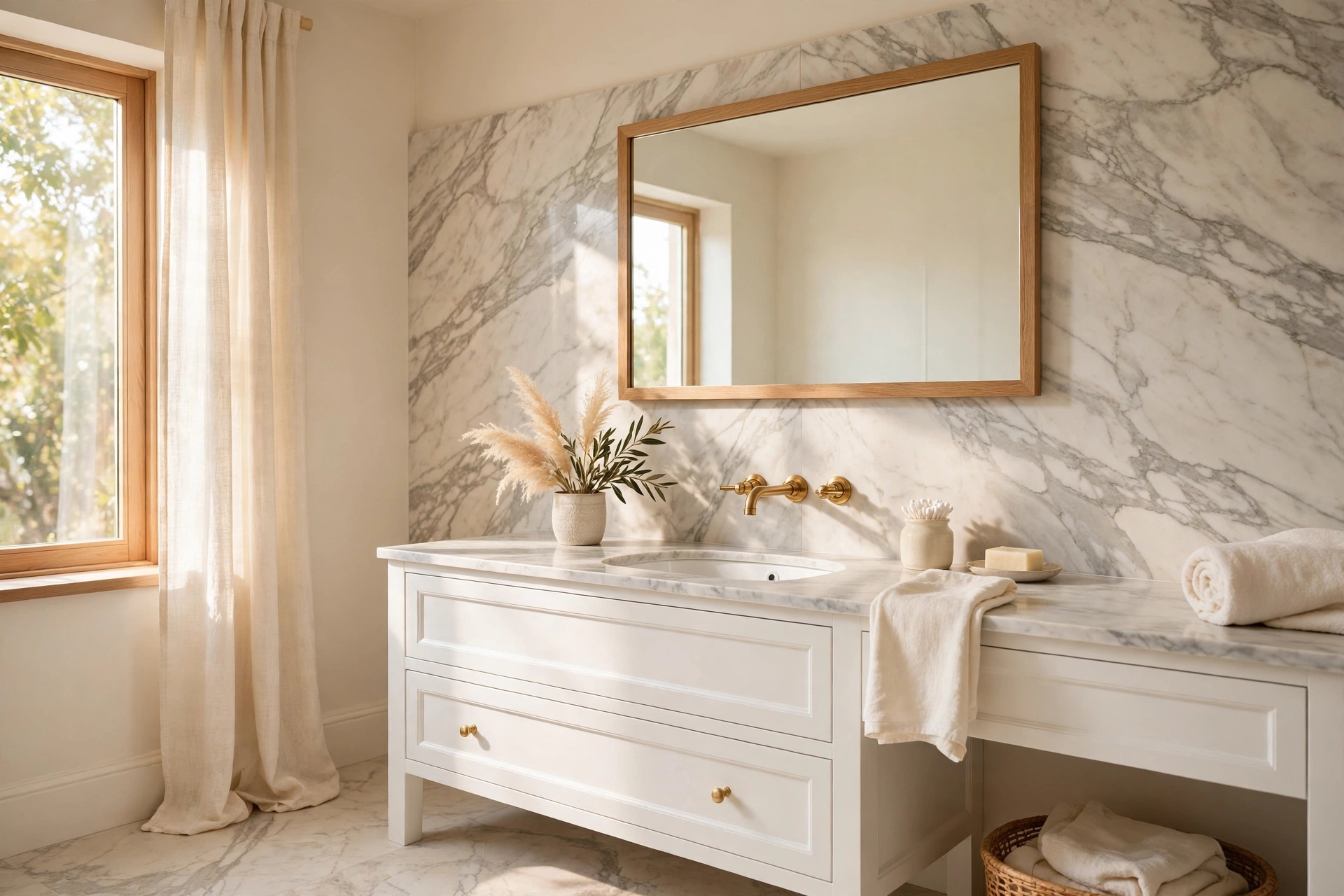
Run one full slab of marble behind the vanity, from the countertop all the way up to the mirror, with no seam in the middle. A single slab backsplash is the most luxurious move on this list, and it is also the most practical, because there is nowhere for water to hide. Choose a slab with soft grey veining if your vanity is white, or a dramatic dark-veined slab if the vanity is walnut, because the contrast is what makes the slab look intentional. This is the walls point of the triangle meeting the vanity point, so keep the floor quiet, a plain matte tile in a warm greige, and let the slab be the star.
3. Marble Wainscoting on the Lower Half of the Wall
Run marble tile as wainscoting on the lower half of the walls, up to about 42 inches, with a painted upper wall in a warm white or a soft sage. The marble chair rail, a thin pencil tile in the same stone, finishes the edge cleanly. This is the classic hotel look, and it is also the smartest way to use real marble in a bathroom that gets splashed, because the lower half is the part that takes the water. Paint above, marble below, and the room feels both grand and easy to live with. If you want the full wall-styling picture, my modern bathroom decor post shows how a painted upper wall and a stone lower wall work together in a modern scheme.
The Vanity: Where Marble Earns Its Keep
The vanity is where you touch marble every single day, so this is where the stone has to work hardest. These three ideas put marble where your hands already are.
4. A Marble Vanity Top With a Waterfall Edge
Choose a marble vanity top with a waterfall edge, where the stone runs down the side of the vanity to the floor in one continuous piece. The waterfall edge hides the cabinet underneath and turns a plain vanity into furniture, and it protects the side of the cabinet from every splash the sink sends its way. Keep the cabinet simple, flat-front doors in a warm wood or a soft greige, because the waterfall edge is doing all the talking. This is the vanity point of the Marble Triangle, so if your vanity top is marble, keep the walls painted or tiled in something calm.
5. A Vessel Sink Sitting on a Marble Slab
Set a white ceramic vessel sink on a thick marble slab, with the slab overhanging the vanity by an inch on each side. The vessel gives you height, the slab gives you a landing zone for soap and a toothbrush cup, and the overhang keeps water off the cabinet front. Pick a slab with quiet veins for this one, because a loud vein under a white vessel looks like a crack from across the room. Brass or matte black faucets both work against white marble, and IMO brass wins, because the warm metal picks up the warm grey in the stone.
6. A Marble Tray That Organizes the Whole Vanity
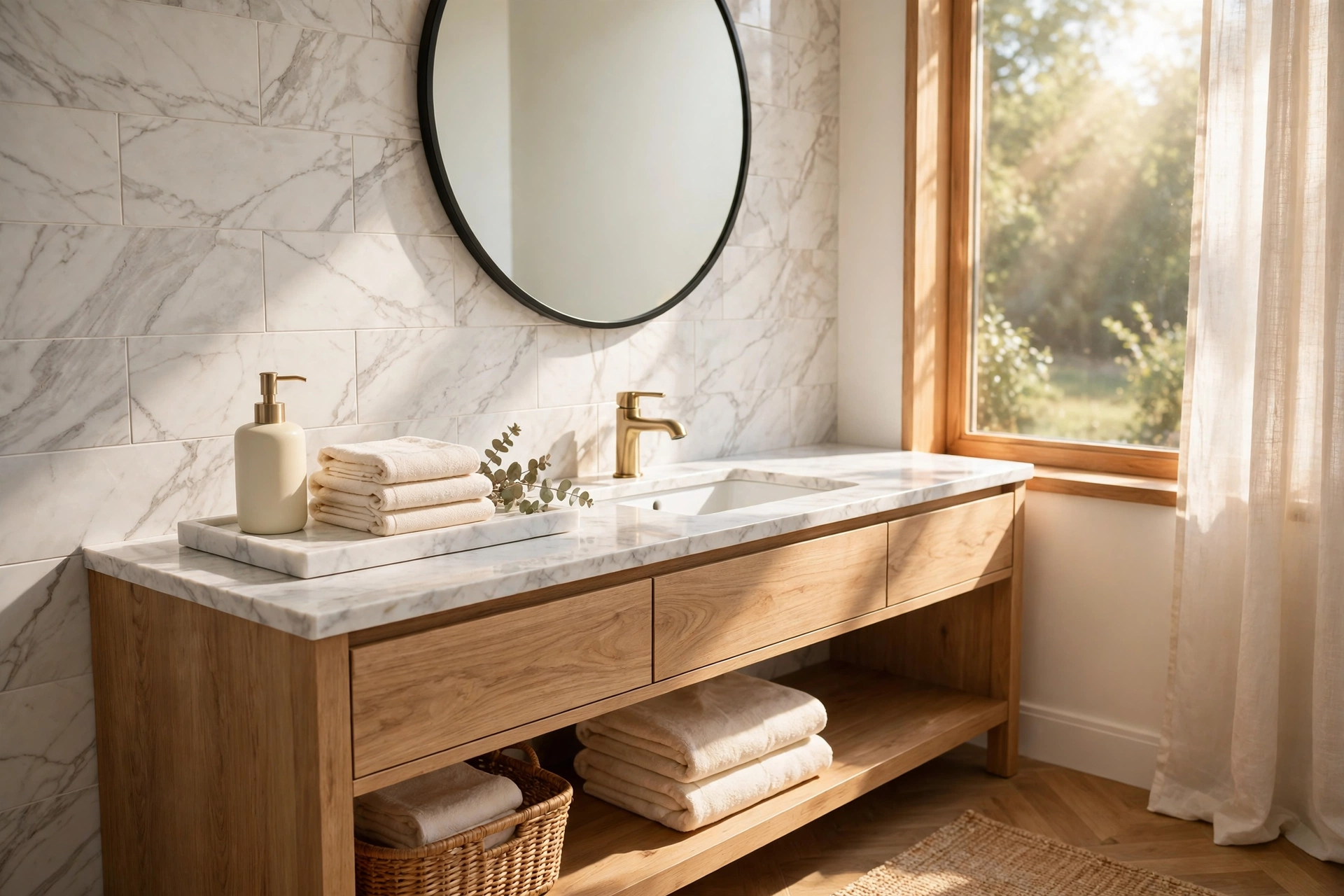
Take one rectangular marble tray, about 12 by 18 inches, and set it on the vanity as the home for everything small: the soap dispenser, the hand cream, a small vase with a eucalyptus sprig. The tray is the vanity point of the triangle in miniature, and it does two jobs at once. It keeps the bottles from sliding around, and it keeps drips and spills off the countertop, because you can lift the whole tray and wipe under it in ten seconds. A tray costs less than dinner out, and it is the fastest way to test whether you like living with marble before you commit to a whole countertop.
Floors, Tubs and the Details Underfoot
The floor is the surface you feel with bare feet every morning, so marble down there has to be chosen with your feet in mind, not just your eyes. These three ideas cover the floor and the tub surround.
7. A Checkerboard Marble Floor in Black and White
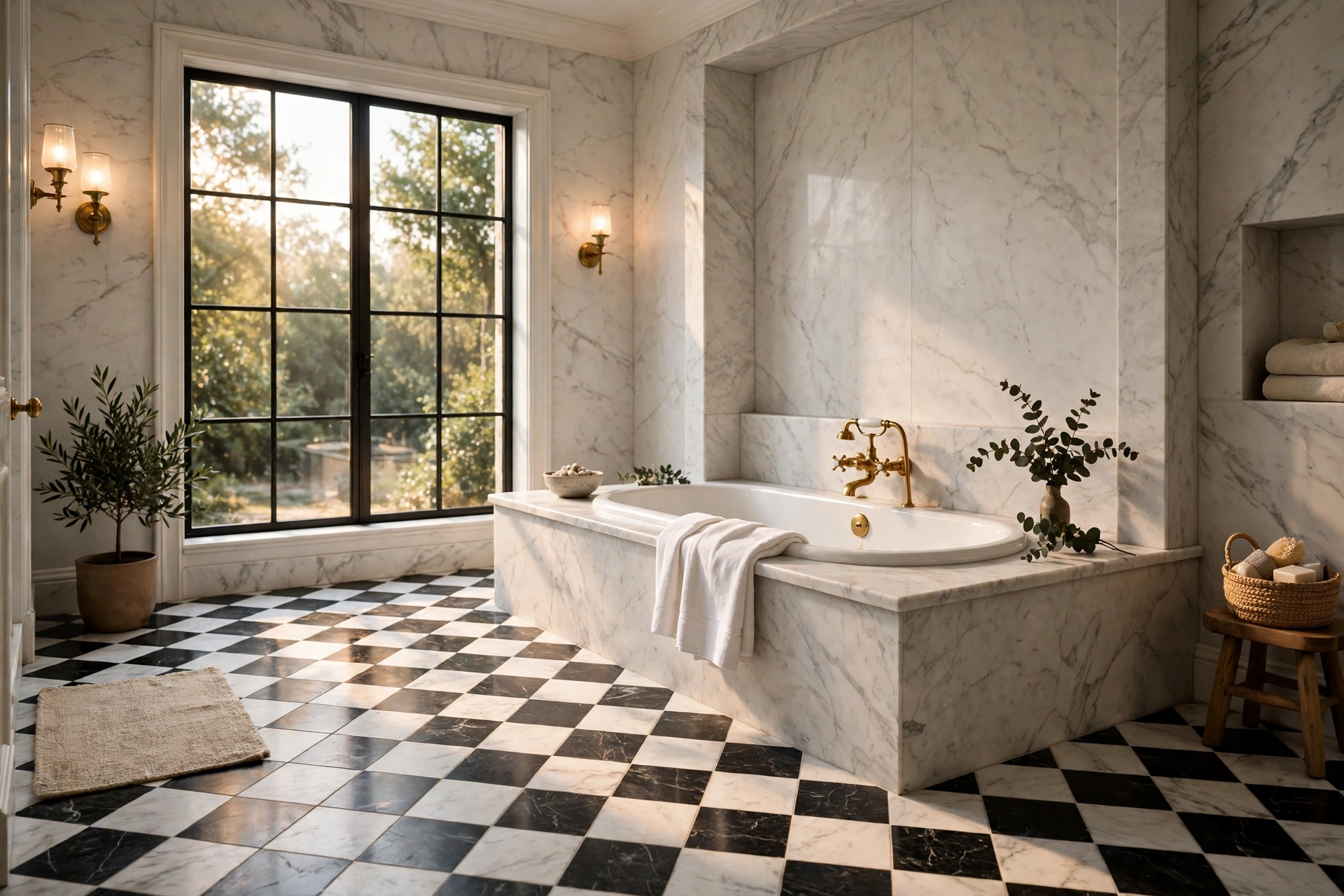
Lay a checkerboard marble floor in black and white, 12-inch squares, with the pattern running on the diagonal so the room feels wider than it is. A checkerboard floor is the most forgiving marble floor there is, because the pattern hides water spots and footprints that a plain white marble floor would show within an hour. This is the floor point of the Marble Triangle, so keep the walls painted and the vanity top a solid surface, and let the floor carry the pattern for the whole room. If you love patterned tile but want more options, my patterned tile bathroom decor post has encaustic, hexagon, and striped layouts that pair well with a marble floor.
8. A Marble Tub Surround With a Built-In Ledge
Wrap the bathtub in marble tile and build a wide ledge along the back edge, deep enough for a book, a candle, and a cup of tea. The ledge is the difference between a tub you look at and a tub you actually use, because it gives you somewhere to put things without balancing them on the rim. Use a honed finish on the surround, not polished, because honed marble is less slippery when wet and it hides water marks better. This is the floor point of the triangle meeting the walls, so keep the vanity top simple and let the tub be the moment in the room.
9. Brass Fixtures That Warm Up White Marble
Swap the faucets, the shower head, and the towel bars for unlacquered brass, and watch white marble wake up. Marble on its own can read cold, especially in a north-facing bathroom, and brass is the warm metal that fixes it. The warm gold picks up the warm grey in Carrara veining and makes the whole room glow at dusk. Unlacquered brass will patina over time, and that is a feature, not a flaw, because the soft darkening looks lived-in next to stone. If brass feels too bold for you, brushed nickel does the same job more quietly, but IMO, brass is the pairing marble was made for.
Small Marble Touches With Big Impact
You do not need a remodel to live with marble. These three ideas bring the stone in at the scale of a shopping bag, and they are the ones I recommend first to anyone who is marble-curious.
10. A Marble Soap Dish, Tumbler and Tray Set
Buy a matching set: a marble soap dish, a marble tumbler for toothbrushes, and a small marble tray, all in the same stone. Three small pieces in the same marble read as one deliberate choice, while three random marble pieces read as a gift shop. Set them on the vanity in a row, and the vanity instantly looks styled, even if the rest of the bathroom is plain builder white. This is the cheapest real marble on this list, and it is the best test of whether you enjoy the stone, because you will see it every morning and you will learn its habits fast.
11. A Marble-Framed Mirror That Doubles the Stone
Hang a mirror with a thick marble frame, or have a frameless mirror cut with a marble border tile around it, so the stone frames your reflection. A marble-framed mirror doubles the marble in the room without adding a second surface, because the mirror reflects the opposite wall and the frame adds the stone. Keep the frame slim, about two inches, so it reads as a detail and not as a second countertop on the wall. This is my favorite small-bathroom move on the list, because the mirror makes the room feel bigger and the marble makes it feel expensive, both at once.
12. A Marble Stool and a Folded Stack of Towels
Set a small marble stool beside the tub or the vanity, and stack three folded white towels on it with a sprig of eucalyptus on top. The stool is a seat, a side table, and a piece of sculpture all at once, and the towel stack is the softest thing in a room full of hard stone. This is also the easiest seasonal swap on the list: change the towels with the seasons, and the whole bathroom changes with them. My christmas bathroom decor post shows how the same marble stool and towel stack carry a whole Christmas look with just a red towel and a pine sprig, and my winter bathroom decor post does the same trick for January with cream and evergreen.
Marble on a Budget: The Look Without the Price
Real marble is expensive, and there is no point pretending otherwise. These three ideas get you the look for a fraction of the stone-yard price, and two of them fool even designers.
13. Marble-Look Porcelain Tile That Fools Everyone
Use large-format porcelain tile printed with a marble pattern on the shower walls or the floor. Modern printing is so good that even I have to touch the tile to tell it apart from real stone, and porcelain has two advantages real marble never will: it does not etch, and it does not need sealing. Pick a pattern with soft, sparse veins, because the busiest prints are the ones that give the game away. This is the budget move that lets you put marble on the walls and the floor at the same time without breaking the Marble Triangle, because visually the room still reads as one calm stone.
14. Peel-and-Stick Marble Contact Paper for Renters
Cover one vanity backsplash, or the front of a plain cabinet, with peel-and-stick marble contact paper. It costs about fifteen dollars, it goes on in an afternoon, and it peels off clean when you move out. The trick is to use it on one small surface only, a backsplash or a shelf front, because a whole room of contact paper looks like contact paper, but one surface looks like a decision. Smooth it on with a credit card to push out the bubbles, and trim the edges with a sharp blade so the seams disappear.
15. One Real Marble Slab, Everything Else Quiet
If you can afford exactly one piece of real marble, make it the vanity top, and keep everything else in the room quiet: painted walls, a plain floor, simple fixtures. One real slab in a calm room reads as luxury, because the eye has nothing else to compete with. I have seen bathrooms with marble everywhere that look like a tile warehouse, and bathrooms with one marble vanity top that look like a boutique hotel. The single slab is the whole Marble Triangle in one move: walls, floor, and vanity, and only one of them is stone.
The Vein Test: My Final Check Before You Commit
Before you order a single slab, run the Vein Test, because it takes five minutes and it has saved me from two expensive mistakes. Stand ten feet back from the marble sample, or from the installed tile if it is already up, and squint until the veins blur. If the veins read as soft movement, like clouds or water, you have a winner. If one loud vein jumps out and grabs your eye, that vein will grab your eye every morning for the next ten years, so soften it: rotate the tile, flip the slab, or pick a quieter piece from the same batch.
The second part of the test is the light test. Look at the marble in the morning light and again at dusk, because marble changes color as the light changes, and a slab that looks crisp white at noon can look grey-blue at 7 p.m. If you love it in both lights, buy it. If you only love it in one, keep looking. Marble is a ten-year decision, and ten minutes of squinting is cheap insurance.
The Marble Reality Check: Sealing, Etching and Water
Let me be honest with you: marble is the most high-maintenance stone you can put in a bathroom, and anyone who tells you otherwise is selling you something. Here is what actually matters.
First, seal it. A penetrating sealer, applied when the stone is installed and again every six to twelve months, is the only thing standing between your marble and every splash of toothpaste, shampoo, and bath oil. Sealing takes twenty minutes with a cloth and a bottle, and it is the single most important maintenance job in this whole guide. Unsealed marble stains, and sealed marble mostly does not.
Second, acids etch marble. Lemon juice, vinegar, and most bathroom cleaners with a low pH will leave a dull mark where they sit, and no amount of scrubbing removes an etch, because the acid has dissolved a thin layer of the stone itself. Keep a pH-neutral stone cleaner under the sink, and wipe up spills right away. I learned this one with the lemon cleaner ring on my own vanity, and I still see that ring every morning.
Third, water is fine, standing water is not. Marble in a shower is perfectly happy as long as the water drains and the stone dries between uses. A shower with poor drainage, or a soap dish that sits in a puddle, will darken over time. Squeegee the shower walls after the last shower of the day if you want the marble to stay bright, and use a soap dish with feet so air moves underneath.
Fourth, honed beats polished in wet areas. A honed finish, which is matte and soft to the touch, hides water marks and is less slippery under bare feet. Polished marble belongs on the vanity top and the walls, where you look at it, not on the shower floor, where you stand on it.
Buy Once vs Refresh: A Marble Budget That Makes Sense
Marble has a clear buy-once list and a clear refresh list, and knowing which is which keeps the budget sane.
Buy once: the vanity top, the shower walls, and the floor. These are the surfaces that are expensive to change later, so spend the money here on the stone you actually love, even if it means waiting a month to afford it. A cheap marble you do not love is the most expensive purchase in the house, because you will pay to replace it.
Refresh each year: the accessories. Soap dishes, trays, towels, the eucalyptus sprig, the stool cushion. These are the pieces that wear out, go out of style, or get knocked off the vanity by a busy morning, and replacing them once a year keeps the bathroom feeling new without touching the stone.
The middle ground is the tile. Marble-look porcelain is the buy-once budget choice, because it lasts as long as real stone and costs a third as much, and nobody standing in your bathroom will know the difference unless you tell them.
Marble in a Small Bathroom
Small bathrooms are where marble shines brightest, because the stone makes a small room feel like a jewel box instead of a closet. Three rules make it work.
First, one stone, one direction. In a small bathroom, use one marble and let the veins run the same way on every surface, because two different marbles in a small room look like a mistake, not a choice.
Second, go big on tile size. Large-format tile with fewer grout lines makes a small bathroom feel bigger, because the eye travels across the stone instead of stopping at every grout line. Small mosaic marble in a small bathroom does the opposite, it chops the room into pieces.
Third, let the mirror do the work. A big mirror over the vanity reflects the marble on the opposite wall, so the room reads as twice as much stone as it actually has. This is the cheapest square footage in the whole guide.
Troubleshooting: 5 Marble Fixes
Marble problems are almost always fixable, and these are the five I reach for most.
Water rings on the vanity top: wipe the ring with a damp cloth and a drop of pH-neutral stone cleaner, then dry it immediately. If the ring is an etch, not a stain, a marble polishing powder and a soft cloth will usually bring the shine back, but test it in a corner first.
A stained grout line next to the marble: clean the grout with a baking soda paste and an old toothbrush, then seal the grout once it is dry. Grout stains faster than marble, and sealed grout is the difference between a bathroom that looks a year old and one that looks ten.
A chipped edge on the vanity top: a clear epoxy made for stone, applied with a toothpick and wiped smooth before it sets, fills a small chip invisibly. For a big chip, call a stone fabricator, because a bad DIY repair is worse than the chip.
Veins that look too busy: soften them with accessories. A stack of white towels, a wooden tray, a green plant, all of these break up the pattern and give the eye somewhere calm to land. You do not need to replace the tile, you need to interrupt it.
A bathroom that feels cold: add warmth, not more marble. A wooden stool, brass fixtures, a woven basket, warm light bulbs at 2700K. Marble is a cool stone, and warm materials are what make it feel like a home instead of a museum.
Frequently Asked Questions
Is marble good for bathrooms?
Yes, marble is a classic bathroom stone, and it has been used in bathrooms for centuries, but it needs sealing and gentle cleaning. Seal it when it is installed and every six to twelve months after, use a pH-neutral cleaner, and wipe up acids like lemon juice and vinegar right away. If you want the look with less maintenance, marble-look porcelain tile gives you the same pattern with no sealing at all.
How do you seal marble in a bathroom?
Clean the stone and let it dry completely, then wipe on a penetrating sealer with a soft cloth, wait ten minutes, and wipe off the excess. Let it cure for 24 hours before the shower gets wet. Test it by dripping water on the surface: if the water beads up, the seal is working, and if it soaks in dark, it is time to seal again. Most bathrooms need a fresh coat every six to twelve months.
Can you use marble in a small bathroom?
Yes, marble is one of the best choices for a small bathroom, because the stone makes the room feel like a jewel box. Use one marble with the veins running the same way, choose large-format tile with fewer grout lines, and hang a big mirror so the stone reflects and the room feels twice as big. A marble tray and a marble soap dish give you the look even if a full remodel is not in the budget.
What goes well with white marble in a bathroom?
Warm wood, unlacquered brass, and soft textiles are the three pairings that work every time. Walnut or white oak warms the stone, brass fixtures pick up the warm grey in the veins, and white or cream towels soften all the hard surfaces. Plants help too, because a green eucalyptus sprig is the one color that looks good against every marble.
How do you clean marble without damaging it?
Use warm water and a pH-neutral stone cleaner, wipe with a soft cloth, and dry the surface so water does not sit on it. Never use vinegar, lemon juice, bleach, or abrasive scrub pads, because acids etch marble and abrasives scratch the polish. For daily cleaning, a damp microfiber cloth is enough, and a weekly wipe with stone cleaner keeps the seal working.

One Comment